Common Sense
Paine wrote the pamphlet that talked ordinary Americans into backing independence from Britain.
Read this if you…
- want the pamphlet that started the American Revolution
- love the founding fathers and america
- want context for the Declaration of Independence (Paine set the table)
Skip this if you…
- hate freedom
- hate america
Why It Matters
Paine wrote the pamphlet that talked ordinary Americans into backing independence from Britain. In three months it sold more copies per head than any American book before or since. It showed that a political argument written in plain language for regular people could change history, and it did exactly that.
Where to go next
- Samuel by Samuel. Common Sense built on it. - Paine's case against kings rests on 1 Samuel 8 — he quotes the chapter directly, naming Samuel and Gideon - Israel's demand for a king, and God's warning against it, becomes Paine's scriptural proof that monarchy is a sin, not a right - Read *Samuel* first and you'll see Paine isn't improvising — he's handing his Protestant readers their own Bible as the anti-monarchy brief
- Judges by Samuel. Common Sense built on it. - Paine doesn't argue against monarchy from reason alone — he opens the Bible and quotes *Judges* directly - Gideon's refusal of the crown is his scriptural trump card: kingship, he insists, is contrary to God's will, and here is the chapter that proves it - Read the original passage and you'll see exactly what Paine was reaching for — the oldest argument against kings, conscripted for 1776
- The Gospels by Matthew. Common Sense built on it. - Paine builds part of his case by wresting *The Gospels* away from the monarchists, quoting Matthew's "render unto Caesar" and arguing it gives kings no sanction - The verse had long been a prop for royal authority — knowing that history shows you exactly what Paine is overturning - A pamphlet for independence, leaning on a Gospel verse to deny the divine right of kings
- Paradise Lost by John Milton. Common Sense built on it. - Paine's case against reconciliation with Britain leans on Milton, quoted by name - He lifts Satan's "never can true reconcilement grow where wounds of deadly hate have pierced so deep" (*Paradise Lost* IV.98–99) and turns it on the crown - Knowing whose mouth that line is in — the unrepentant rebel angel's — gives Paine's borrowing its full charge
Depicted in Art
Three-quarter oil portrait of the aged Paine in dark coat with white stock, facing the viewer with weathered features against a neutral ground.
John Wesley Jarvis, 1807
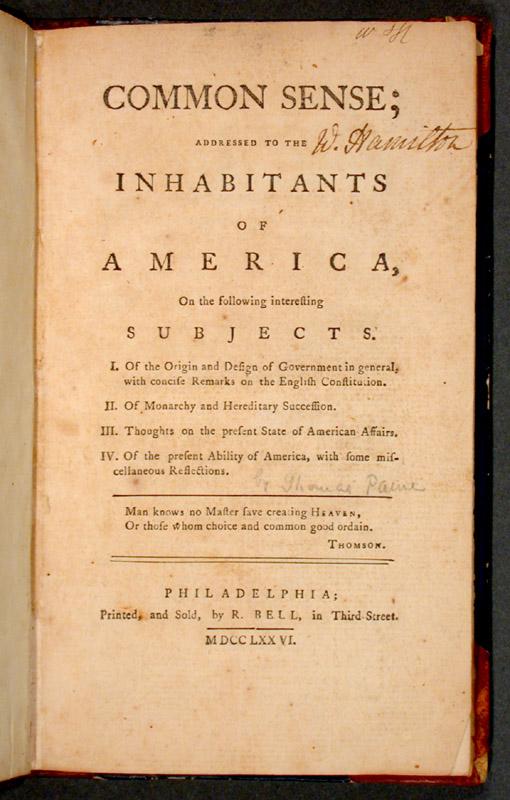
Typographic title page of the original Philadelphia pamphlet, listing the four sections and Paine's anonymous attribution to 'an Englishman,' with the price 'Two Shillings' at the foot.
1776
Half-length oil portrait of Paine in a black tailcoat and white necktie, presented in an oval composition, facing slightly left.
Laurent Dabos, 1792
Recommended Editions

Penguin Classics
2005
The Penguin pairs Common Sense with The Crisis, Rights of Man, and The Age of Reason in one volume. Edward Larkin's introduction sets Paine inside the radical Enlightenment rather than the founding-fathers diorama.

Please support us by purchasing through these links, at no extra cost to you!
Deep Dive
What It's About
This summary gives away plot details.
Notable Quotes
“These are the times that try men's souls.”
“Government, even in its best state, is but a necessary evil.”