
Read this if you…
- want where "I think, therefore I am" comes from - first famous modern discussion of consciousness
- want the book modern philosophy starts with
Skip this if you…
- don't like rigorous philosophical argumentation (it can be a bit dry)
- would rather just google "i think therefore i am" and related concepts
Why It Matters
Descartes threw out every belief that could possibly be doubted and found one thing standing: "I think, therefore I am." That single move launched modern philosophy by making the individual mind, not God or tradition, the starting point for knowledge. Every philosopher since has had to build on this book or argue with it.
The  Take
Take
One of the philosophical ideas at the forefront of my own beliefs is cogito ergo sum, and he articulated it well
The lineage through Meditations on First Philosophy
- The Complete Essays by Michel de Montaigne. Meditations on First Philosophy built on it. - The doubt Descartes weaponizes was already in the air — much of it Montaigne's - Scholars trace the *Meditations*' hyperbolic doubt back to the Pyrrhonian skepticism of Montaigne's *Essays* (especially the *Apology for Raymond Sebond*) and Charron - Reading Montaigne first shows you doubt used as a way of living; Descartes takes the same tool and tries to end it once and for all in the *cogito*
- Confessions by Augustine of Hippo. Meditations on First Philosophy built on it. - "I am thinking, therefore I exist" has a forebear in Augustine — Descartes himself went to the library to check, and confirmed Augustine used the same move to ground the certainty of existence - The *Meditations*' inward retreat from the senses toward a self-certain mind reworks the introspective ascent Augustine performs in the *Confessions* - Read Augustine first and Descartes's radical-seeming method reveals its lineage: the soul turning on itself to find the one thing it can't doubt
- An Enquiry Concerning Human Understanding by David Hume. Meditations on First Philosophy shaped it. - The doubt Hume sets out to dismantle has a name here: Cartesian doubt - Descartes' method of suspending everything to find one certainty becomes Hume's chief target in Section XII of the *Enquiry* - Hume's charge: this universal skepticism is self-undermining, since it has to lean on the very faculties it claims to suspect
- Ethics by Baruch Spinoza. Meditations on First Philosophy shaped it. - Spinoza cut his teeth on Descartes — his first published book laid out *Principles of Cartesian Philosophy* in geometric form - He kept Descartes' machinery, the more-geometrico method of definitions, axioms, and proofs, and turned it on Descartes himself - The *Ethics* is built to demolish the one thing Descartes was surest of: the split between mind and body, two substances where Spinoza will allow only one
- Pensées by Blaise Pascal. Meditations on First Philosophy shaped it. - Descartes built a God reason could prove — and Pascal could not forgive him for it: "he has no further need of God" - The *Pensées* keep the thinking self and the mind-body split, then turn on the rest as "useless and uncertain" - This is the work Pascal is answering when he insists the heart, not the intellect, is the only road to faith
Depicted in Art
Half-length portrait of Descartes in a dark cloak and wide white collar, head turned slightly, eyes calm and watchful against a plain dark ground.
Frans Hals, 1649
Engraved bust portrait of Descartes in oval frame with Latin inscription, hair to shoulders, plain dark dress.
Balthasar Moncornet
Latin letterpress title page: 'MEDITATIONES De Prima PHILOSOPHIA, In qua Dei existentia et animae immortalitas demonstrantur,' with Michel Soly's Paris imprint and a small printer's device.
Anonymous, 1641
Queen Christina at a long table surrounded by her court watches as Descartes demonstrates a geometric figure on paper; Father Mersenne and courtiers look on.
Pierre-Louis Dumesnil the Younger
Descartes stands gesturing at Queen Christina's writing desk in a cold Stockholm chamber, the queen seated and attentive, ministers in the background.
Nils Forsberg (or after)
Recommended Editions
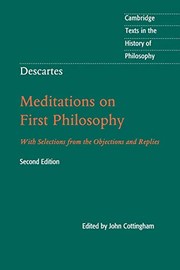
John Cottingham
Cambridge University Press · 2017
John Cottingham's Cambridge is the philosophy-department version, and it ships with the Objections and Replies from Hobbes, Arnauld, and Gassendi. Reading Descartes without those is half the conversation.
Donald A. Cress
Hackett Publishing · 1993

Please support us by purchasing through these links, at no extra cost to you!
Deep Dive
What It's About
This summary gives away plot details.
Notable Quotes
“I think, therefore I am.”
“this proposition (pronunciatum) I am, I exist, is necessarily true each time it is expressed by me, or conceived in my mind.”