Self-Reliance and Nature
Read this if you…
- want the founding document of American individualism
- want the American answer to Romanticism
- love looking at nature spiritually
- want something short
Skip this if you…
- hate american individualism
- are allergic to new age mysticism (this is like americanism, protestantism, and eastern religious themes mixed)
- don't like essays
The  Take
Take
Powerful, invigorating, philosophical, short
The lineage through Self-Reliance and Nature
- The Complete Essays by Michel de Montaigne. Self-Reliance and Nature built on it. - The book the young Emerson read and felt "as if he had himself written" — the kinship that shaped his voice - Montaigne's habit of trusting his own mind over inherited authority is the skepticism *Self-Reliance* turns into a creed - Emerson named Montaigne directly in his "Montaigne; or, the Skeptic" — read the *Essays* first to see where Emerson's confidence in the self was born
- Paradise Lost by John Milton. Self-Reliance and Nature built on it. - Emerson names Milton outright in *Self-Reliance* — one of the trio (with Moses and Plato) he holds up as a man who set books and traditions at naught and trusted his own thought - *Paradise Lost* is the work that earned Milton that place: the great act of one mind composing its own cosmos - Read it first and you see what Emerson is pointing at — self-reliance isn't a slogan here, it's Milton's whole posture
- The Republic by Plato. Self-Reliance and Nature built on it. - Emerson's idealism — the world as a veil over eternal forms — is Plato refitted for nineteenth-century America - *Self-Reliance* names him outright, and Emerson read *The Republic* as one of the few books worth setting all other books aside for - Read Plato first and *Nature*'s shimmering metaphysics stops feeling like mysticism — it's the cave allegory, transplanted
- Plutarch's Lives by Plutarch. Self-Reliance and Nature built on it. - When Emerson reaches for a measure of the self-reliant great man, he reaches for "Plutarch's heroes" — the *Lives* were his lifelong bible for heroes - *Self-Reliance* invokes "Plutarch's age" as its benchmark for greatness; the ancient biographies are the standard Emerson is holding the modern individual against - Read Plutarch first and you hear exactly what Emerson means by a life worth admiring
- Exodus by Moses. Self-Reliance and Nature built on it. - Emerson's most provocative lines are Exodus inverted — "write on the lintels of the door-post, Whim" is a deliberate, irreverent flip of the blood-on-the-doorpost command from Exodus 12 - He twists the holy-ground moment too, turning "take the shoes from off their feet" into proof that the divine is within, not above - *Self-Reliance* needs the scripture standing behind it: the shock lands only once you hear the sacred original he's overwriting
- Walden or, Life in the Woods by Henry David Thoreau. Self-Reliance and Nature shaped it. - This is the program; *Walden* is the experiment that runs it - Emerson laid out the doctrine — trust yourself, find the divine in nature — and his protégé Thoreau went to the woods to live it out - Thoreau built his cabin on land Emerson owned; the philosophy and the man were that close
Depicted in Art
Thomas Cole and William Cullen Bryant stand together on a rocky ledge in the Catskills, overlooking a wooded gorge with a waterfall below.
Asher Brown Durand, 1849
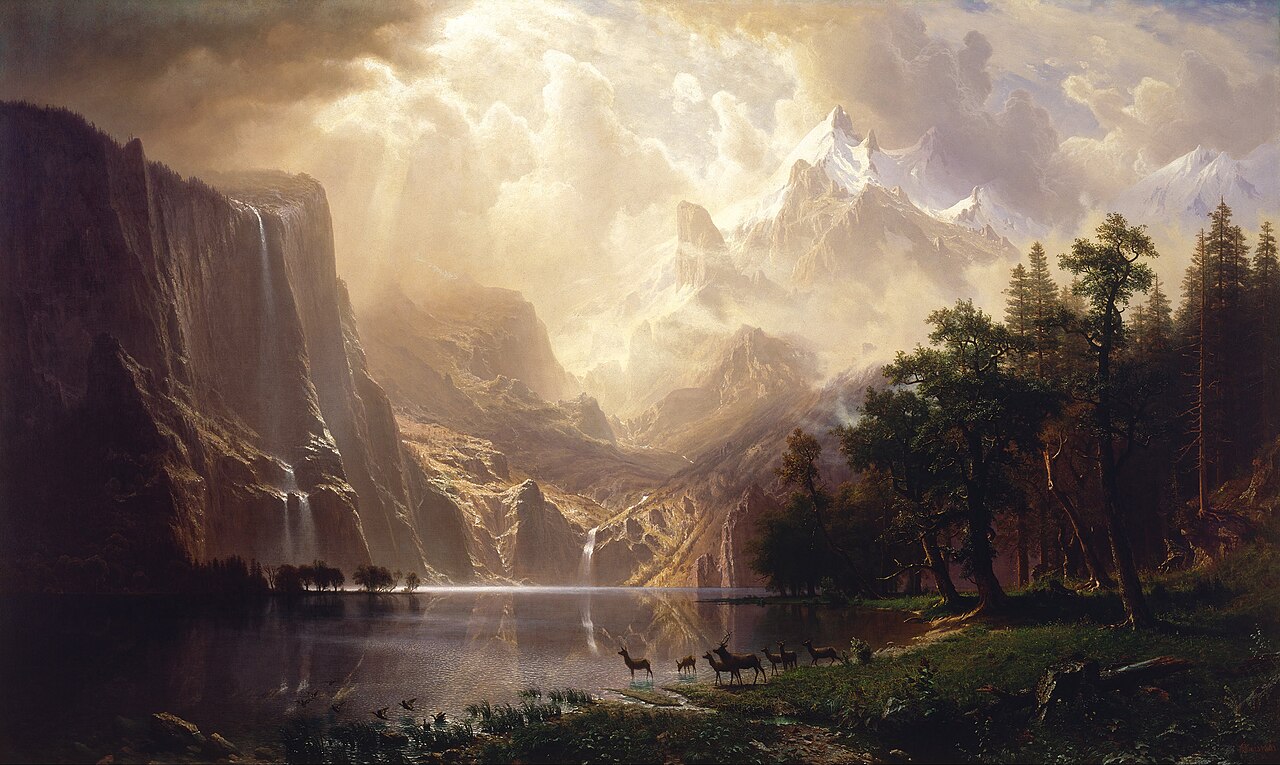
A luminous alpine valley with a mirror lake, deer at the water's edge, and the Sierra peaks rising into shafts of golden cloud-broken light.
Albert Bierstadt, 1868
A blazing red-orange sunset ignites altocumulus clouds above untouched Maine forest near Mount Katahdin; no human presence, only a small bird at left.
Frederic Edwin Church, 1860
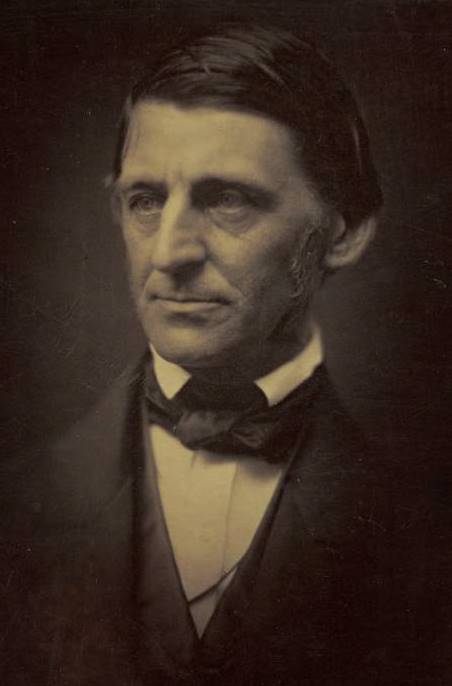
Three-quarter charcoal portrait of Emerson at 43, hair already thinning, gaze set above the viewer.
Eastman Johnson, 1846
A young man reclines on a hillside watching a steam train curve across a stump-strewn Pennsylvania valley, church spire and roundhouse in the middle distance.
George Inness, 1855
A clear-cut Catskill foreground of stumps and a lone cabin gives onto a glowing pink-and-gold valley with Hunter Mountain dark beyond.
Sanford Robinson Gifford, 1866
Vast South American panorama with a Andean snow peak in the distance, layered jungle, waterfall, and a tiny shrine in the foreground.
Frederic Edwin Church, 1859
Churchgoers walk a country path through dappled New England woods toward a distant white-spired meetinghouse.
Asher Brown Durand, 1860
Sweeping panorama of the Connecticut River's oxbow bend; storm clouds retreating left over wild forest, sunlit cultivated fields right, the painter at his easel below.
Thomas Cole, 1836
Recommended Editions

Dover Publications
1993
The Dover Thrift is a few dollars and includes Self-Reliance, Compensation, The Over-Soul, and Circles. No apparatus, but at this price it's the impulse-buy edition that has changed a lot of lives.
Please support us by purchasing through these links, at no extra cost to you!
Notable Quotes
A foolish consistency is the hobgoblin of little minds.
- Matthew McConaughey, actor, 1969–: Read Emerson's Self-Reliance two sentences at a time for months, and credits the essays with shaping his confidence and the voice of Greenlights.
- Friedrich Nietzsche, German philosopher, 1844–1900: "More enlightened, adventurous, multifarious, refined than Carlyle; above all, happier."
- Walt Whitman, American poet, author of ‘Leaves of Grass’, 1819–1892: "I was simmering, simmering, simmering; Emerson brought me to a boil."
- Robert Frost, American poet, four-time Pulitzer Prize winner, 1874–1963: "My four greatest Americans: George Washington… Thomas Jefferson… Abraham Lincoln… and fourth, Ralph Waldo Emerson, the poet."
- Matthew Arnold, English Victorian poet and critic, 1822–1888: "This is tonic indeed!"
- Oliver Wendell Holmes Sr., American physician, poet, and essayist, 1809–1894: "Our intellectual Declaration of Independence."
- Barack Obama, 44th U.S. President, 1961–: Named Emerson's Self-Reliance among the books that most influenced him in a 2008 New York Times interview.