
Read this if you…
- want the central Hindu scripture
- want a foundational religious text you can read in one sitting
- are interested in Hindus view of duty, and the soul
Skip this if you…
- don't want explicitly religious/Hindu writing
- want a narrative (this is a small chapter of a large narrative, and is mostly philosophical/religious dicussion)
The lineage through The Bhagavad Gita
- Walden or, Life in the Woods by Henry David Thoreau. The Bhagavad Gita shaped it. - Thoreau carried the *Gita* to Walden Pond as a constant companion — and named it inside the book it helped produce - In *Walden* he writes of bathing his intellect each morning in "the stupendous and cosmogonal philosophy of the Bhagvat Geeta" - The detachment and inward discipline the *Gita* preaches became Thoreau's own model for a deliberate life
Depicted in Art
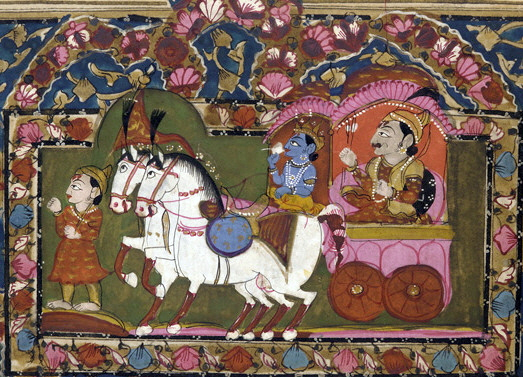
Krishna and Arjuna ride together in a horse-drawn chariot before the battle of Kurukshetra; Krishna holds the reins as Arjuna sits beside him with bow in hand.
Krishna gestures in instruction toward a kneeling Arjuna beside the chariot at Kurukshetra; the two armies stand drawn up in the background.
1805
Arjuna draws his bow on the chariot while blue-skinned Krishna handles the reins; Karna's chariot bears down from the opposite side of the battlefield.
1820
Krishna's universal body fills the frame as a many-headed, many-armed colossus containing gods, beings, suns and worlds; tiny Arjuna kneels in awe at his feet.
1820
Arjuna takes up his bow at the front of the chariot, then turns and addresses Krishna with grief on his face as the two armies face off behind them.
1824
Krishna's universal form towers as a colossus of dozens of stacked multicolored heads and scores of pinwheeling, weapon-bearing arms, filling the page from edge to edge.
1740
Krishna stands in his cosmic form, multiple heads and arms wreathed in suns and gods; Arjuna kneels with folded hands at the lower edge.
Anant Shivaji Desai (Ravi Varma Press), 1910
A decorated North Indian manuscript page combines geometric rosettes with floral borders around the Sanskrit verse text of the Gita.
1850
A many-headed, many-armed Krishna fills the sheet in his universal form, ringed by gods and emanations in the bright palette of an early Bombay chromolithograph.
1900
Krishna stands revealed in his cosmic form, tiers of heads and a wheel of weapon-bearing arms radiating outward while a small Arjuna kneels below with folded hands.
M.A. Joshi & Co., 1910
Recommended Editions

Eknath Easwaran
Nilgiri Press · 2007
Easwaran's prose Gita is calm and unfussy, and the chapter intros explain dharma, karma, and the gunas without forcing English equivalents that don't exist. The most-assigned U.S. classroom edition for forty years.
Please support us by purchasing through these links, at no extra cost to you!
Notable Quotes
Now I am become Death, the destroyer of worlds.
Screen & Stage
.jpg) loose
looseSatyagraha
Opera · 1980
Philip Glass

Bhagavad Gita
Film · 1993
G. V. Iyer
Posters via The Movie Database (TMDB)
- J. Robert Oppenheimer, American physicist, Manhattan Project director, 1904–1967: "The most beautiful philosophical song existing in any known tongue."
- Henry David Thoreau, American transcendentalist, 1817–1862: "In the morning I bathe my intellect in the stupendous and cosmogonal philosophy of the Bhagvat Geeta."
- Hermann Hesse, German-Swiss novelist, Nobel laureate, 1877–1962: "The marvel of the Bhagavad-Gita is its truly beautiful revelation of life's wisdom which enables philosophy to blossom into religion."
- Ralph Waldo Emerson, American transcendentalist essayist, 1803–1882: "It was the first of books; it was as if an empire spoke to us."
- T. S. Eliot, Anglo-American poet, Nobel laureate, 1888–1965: "The next greatest philosophical poem to the Divine Comedy within my experience."
- George Harrison, musician, 1943–2001: Built his post-Beatles life on the Gita's call to act without attachment to the fruits of action — funding the first English Hare Krishna temple and giving away copies.
- Nelson Mandela, statesman, activist, 1918–2013: Knew the Gita intimately from his Robben Island years and drew on its teaching of duty performed without attachment to the outcome.
- Mahatma Gandhi, Indian independence leader, 1869–1948: "When doubts haunt me … I turn to the Bhagavad Gita and find a verse to comfort me."
- Aldous Huxley, British novelist and essayist, 1894–1963: "The Bhagavad-Gita is perhaps the most systematic scriptural statement of the Perennial Philosophy."