
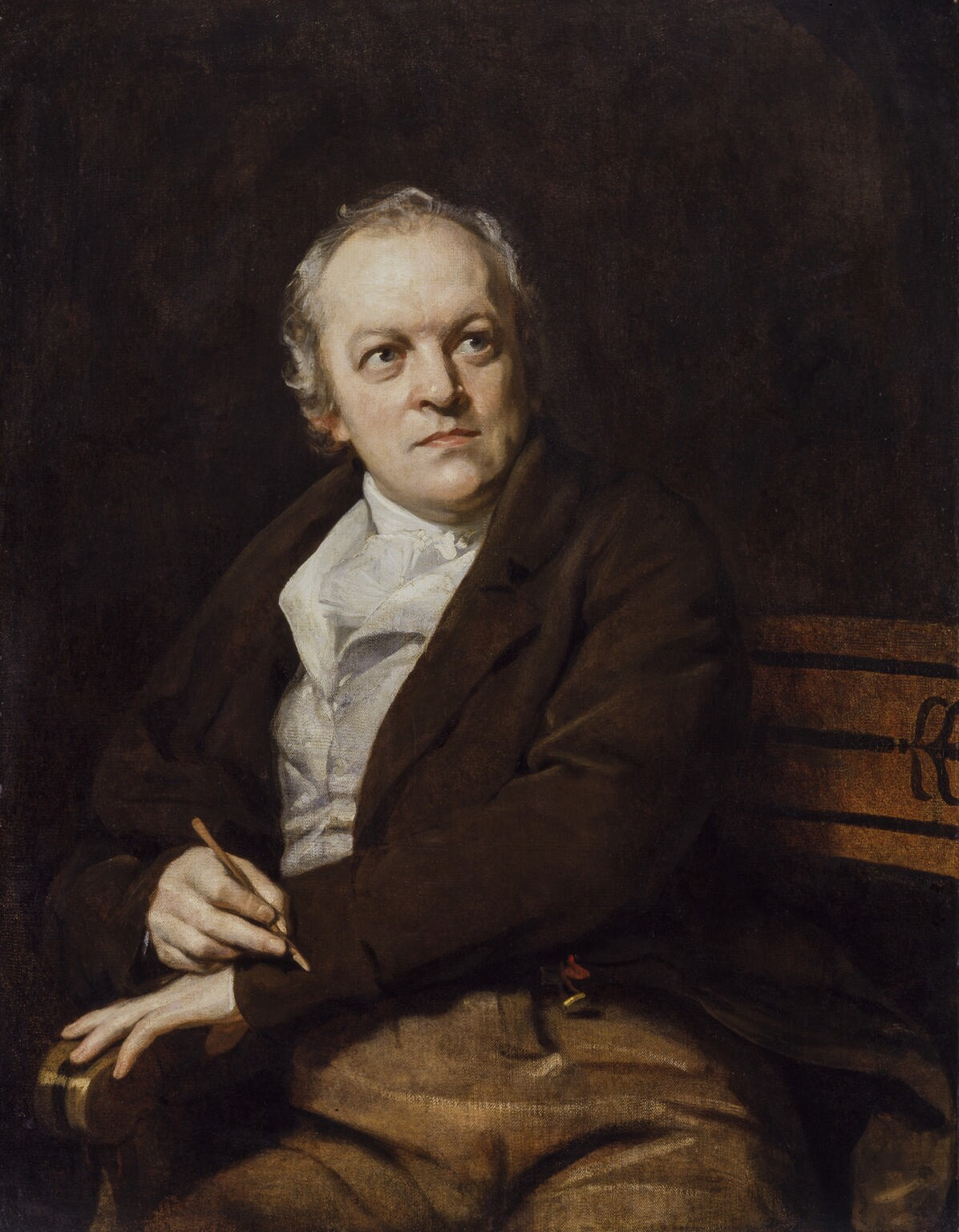
Read this if you…
- are okay with hard to understand highly religious poetry
Skip this if you…
- don't want to sift through super difficult religious poetic writing, a lot of it is tough to understand compared to his contemporaries
Why It Matters
Blake made his own mythology, his own printmaking process, and his own rules. He was the first major English poet to treat imagination as more real than reason, and you can trace his line straight through the Beats, the counterculture, and anyone who ever distrusted institutions. "The road of excess leads to the palace of wisdom" is the whole man in one line.
The  Take
Take
Only read less than a 20th, the greatest hits. Everything seemed too complicated and airy or simple. I much preferred the simple
The lineage through The Complete Poems
- Paradise Lost by John Milton. The Complete Poems built on it. - Blake didn't just admire *Paradise Lost* — he argued with it, decided Milton was secretly "of the Devil's party without knowing it" - That reading runs through Blake's prophetic work, and his own epic *Milton* sends the dead poet back to earth to correct his mistakes - Read Milton first and Blake's quarrel makes sense: he's rewriting the most ambitious poem in English from the inside
- Job by Unknown. The Complete Poems built on it. - The book Blake read his own neglected life through — he reperused *Job* obsessively and identified with its tested man - The whirlwind voice conjuring Behemoth and Leviathan haunts 'The Tyger' and its question of what fearful hand could frame such a thing - Blake closed the loop with 22 engraved 'Illustrations of the Book of Job' (1826) — reading the original shows you the source of his most awestruck verse
- Ezekiel by Ezekiel. The Complete Poems built on it. - One of Blake's chosen prophets — Ezekiel turns up as a dinner guest in *The Marriage of Heaven and Hell* - Ezekiel's four living creatures and burning wheels are the raw material Blake reforges into his Four Zoas and the cherubim of *Jerusalem* - Read the vision first and Blake's strangest images stop being random — you're watching him remake an ancient one
- Isaiah by Isaiah. The Complete Poems built on it. - Blake's whole theory of the poet-as-prophet is voiced, in *The Marriage of Heaven and Hell*, by Isaiah himself — a literal guest at his table - Read Isaiah first and you hear the visionary register Blake is channeling: the prophet who speaks for God becomes Blake's model for what a poet is - The seer's authority Blake claims for himself is borrowed straight from the book of Isaiah
- Revelation by John. The Complete Poems built on it. - Blake's prophetic machinery — the *Four Zoas* above all — is built directly from John's Revelation - The throne-beasts and apocalyptic visions he paints in watercolour are the same ones he reforges in verse; the line from John's Apocalypse to *Milton* and *Jerusalem* is the spine of his myth - Knowing Revelation first turns Blake's hardest poems from private raving into a reader's recognizable revision of the last book of the Bible
- Genesis by Moses. The Complete Poems built on it. - Blake's whole mythology is a reworking of Genesis — the Fall reimagined as the very act of material creation - "The Book of Urizen" apes Scripture's chapter-and-verse layout to turn the Creation myth inside out; he also illustrated Genesis entire and painted "Elohim Creating Adam" - Read Genesis first and Blake's inversions land — you can see exactly which myth he's rewriting
Depicted in Art
A bearded creator god kneels in a fiery red sun, leaning down through clouds to measure the dark void below with a pair of golden compasses.
William Blake, 1794
A piper stands in a pastoral landscape playing for a small child who floats on a cloud above him; vines and tendrils frame the verse.
William Blake, 1789
A seated nurse on a hillside watches a chain of children dancing hand-in-hand under a great willow at evening; the verses run above the scene.
William Blake, 1789
Across two plates: a Black mother seated under a tree points her son toward the rising sun, and in the second a white child and a Black child stand together before the enthroned Christ.
William Blake, 1789
A young woman in a long dress holds a small child upright by the hands, teaching it to walk on a strip of grass; a girl with a battledore plays beside them.
William Blake, 1794
A drooping rose stem coils around the text; a small worm-like figure burrows into one bloom while tiny human figures recoil among the thorns.
William Blake, 1794
Recommended Editions

Penguin Classics
2004
Alicia Ostriker edits this Penguin, and she's both a Blake scholar and a working poet, which keeps the notes from killing the poems. The Songs, the prophetic books, and the lyrics are all here in one affordable volume.

Please support us by purchasing through these links, at no extra cost to you!
Deep Dive
What It's About
This summary gives away plot details.
Notable Quotes
“Tyger Tyger, burning bright, / In the forests of the night; / What immortal hand or eye, / Could frame thy fearful symmetry?”
“Tyger Tyger, burning bright, In the forests of the night; What immortal hand or eye, Could frame thy fearful symmetry?”