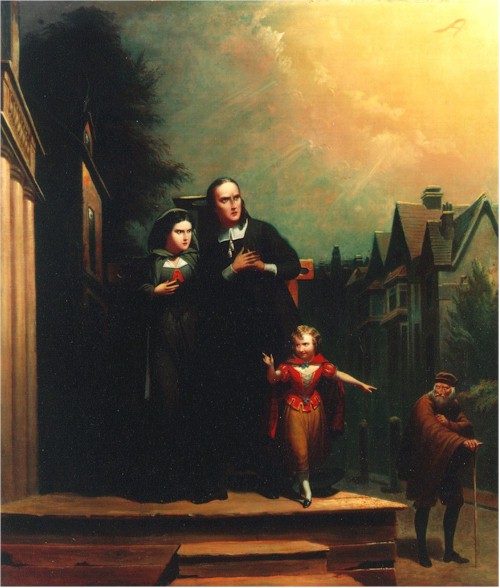

Read this if you…
- love stories that are on-the-nose parables, this one centered around guilt/shame
- want overly flowery, archaic, and Christian inspired prose. (I personally love it, but lots hate it)
- want a short book
- have enjoyed the other transcendentalists
Skip this if you…
- don't want explicitly Christian guilt-and-redemption parables
- don't like insanely flowery archaic English
Why It Matters
Hawthorne turned Puritan guilt into America's first great novel about hypocrisy and moral absolutism. Hester Prynne is one of the earliest heroines in American fiction who comes off better than the society judging her. The book set the template for American stories about public shame and the private guilt nobody sees.
The  Take
Take
Some of my favorite prose I’ve ever read. So lofty and metaphorical and clever. Very Christian and allegorical plot, short and sweet. Without a doubt and all time great book
The lineage through The Scarlet Letter
- The Pilgrim's Progress by John Bunyan. The Scarlet Letter built on it. - Hawthorne points you straight here — Chillingworth's eyes are likened to "that ghastly fire that darted from Bunyan's awful door-way in the hillside" - *The Pilgrim's Progress* taught Hawthorne to make the soul visible: sin, guilt, and grace rendered as things you can see and name - Read Bunyan first and the scarlet A reads as what it is — an allegory wearing a novel's clothes
- The Gospels by Matthew. The Scarlet Letter built on it. - *The Scarlet Letter* is built on Gospel ground — Hester's pillorying reworks the "cast the first stone" scene, and Dimmesdale's scaffold is staged as a Golgotha - Pearl is named straight out of Matthew 13's "pearl of great price," a phrase Hawthorne quotes verbatim - The novel's whole grammar of sin, judgment, and grace comes from *The Gospels* standing behind it
- Moby-Dick or, The Whale by Herman Melville. The Scarlet Letter shaped it. - Melville met Hawthorne in August 1850, mid-composition, and the encounter changed everything — the seafaring tale he was writing became *Moby-Dick* - He poured out his admiration in the rapturous essay "Hawthorne and His Mosses" and a letter thanking Hawthorne for dropping "germinous seeds" into his soul - Then he made it permanent: *Moby-Dick* is dedicated to Hawthorne "in token of my admiration for his genius"
- The Portrait of a Lady by Henry James. The Scarlet Letter shaped it. - James studied Hawthorne closely enough to write a whole book on him in 1879 — his only book-length study of a novelist — then wrote *The Portrait of a Lady* two years later - Hester Prynne's trapped, morally fraught heroism is the template James inherits for Isabel Archer - The forest scene where Hester begs Dimmesdale to flee echoes forward into Isabel's final choice: escape with the free man, or return to a punishing marriage
Depicted in Art
Hester Prynne holds Pearl in a Madonna-and-child pose at the scaffold; Dimmesdale and Chillingworth look on in the background.
Hugues Merle, 1861
Dimmesdale, alone at night, stands on the same scaffold where Hester was shamed, gripped by guilt and unable to confess.
1874
Hester and Dimmesdale converse in the forest while Pearl, illuminated, stands across the brook — the moment Pearl refuses to cross until her mother repins the A.
T. H. Matteson, 1860
Ornamental title-page device with intertwined scrollwork framing the embroidered scarlet A, designed for the 1878 Osgood edition.
Ludvig Sandoe Ipsen, 1878
Hester and Dimmesdale meet in the forest gloom; she has cast off the scarlet letter and loosened her hair as they plan to flee together.
Hugh Thomson, 1915
Hester confronts the aged Roger Chillingworth on the seashore, refusing the bond of silence she once swore him.
Felix Octavius Carr Darley, 1884
Hester stands beside the pillory holding Pearl, head bowed but composed, the scarlet A elaborately embroidered on her dress.
Mary Hallock Foote, 1878
Recommended Editions

Penguin Classics
2002
Thomas Connolly's Penguin gives a tight introduction on Hawthorne's Salem ancestry and the novel's symbolic machinery, with a clean text and useful notes. The easiest way into the book.

Please support us by purchasing through these links, at no extra cost to you!
Deep Dive
What It's About
This summary gives away plot details.
Notable Quotes
“No man, for any considerable period, can wear one face to himself and another to the multitude, without finally getting bewildered as to which may be the true.”
“No man, for any considerable period, can wear one face to himself, and another to the multitude, without finally getting bewildered as to which may be the true.”