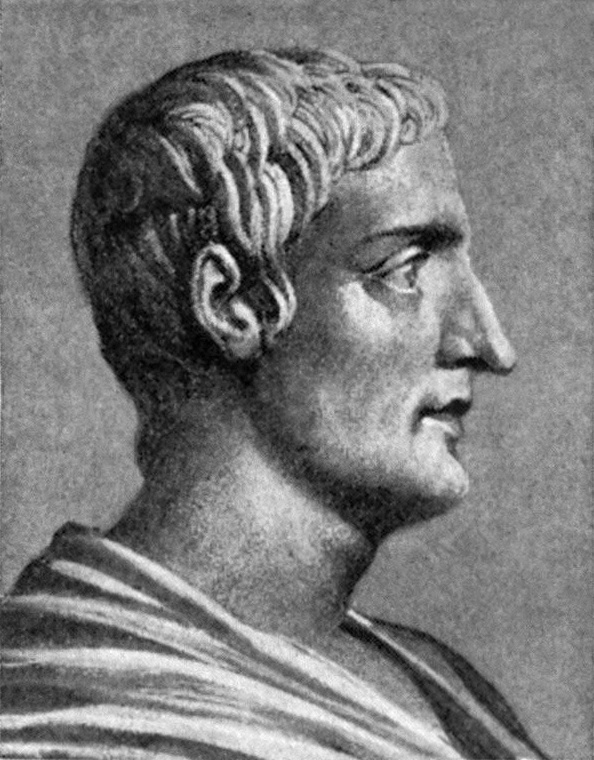
Publius Cornelius Tacitus
c. 56–c. 120 · Ancient Rome
“They make a desert and call it peace.”
Peak-work percentile in the canon.
The lineage through Publius Cornelius Tacitus
Drew From(2)
who shaped Publius Cornelius Tacitus
via The Aeneid
- Tacitus writes as Virgil's deliberate heir, lacing the Annals with Aeneid echoes — the dying Galba cast as "another Priam," Troy's fall behind a Roman one
- He borrows the epic's heroic language precisely so the grim history can undercut it
- Read the Aeneid first and you hear the irony: the destiny Virgil promised Rome, reported as it curdled into tyranny
- Tacitus learned his craft on Cicero — the Ciceronian rhetoric of his teacher Quintilian stands behind everything he wrote, and his own Dialogus is patterned on De Oratore and Brutus
- The Annals both alludes to Cicero and pushes hard away from him: the famous broken, compressed style is a deliberate refusal of the flowing Ciceronian sentence
- Read Cicero first and you hear what Tacitus is rebelling against in every clipped line
Portraits
The most widely reused likeness on Wikimedia — an 18th-c. imagined head-and-shoulders portrait of the historian; no contemporary likeness of Tacitus survives, so this is a traditional/invented face.
1750
Right-facing drawn profile of the historian after an antique bust, from The Book of History (Grolier, 1920) — a frequently used textbook-style likeness. Imagined likeness, no contemporary portrait exists.
1920
Famous Quotes
“The more corrupt the state, the more numerous the laws.”
“Christus, from whom the name had its origin, suffered the extreme penalty during the reign of Tiberius at the hands of one of our procurators, Pontius Pilatus.”
“Great empires are not maintained by timidity.”
“What is to-day supported by precedents will hereafter become a precedent.”
About Publius Cornelius Tacitus
Roman historian and senator whose Annals and Histories chronicle the Roman Empire from Tiberius through Domitian. His terse, epigrammatic prose and penetrating analysis of imperial corruption make him arguably the greatest Roman historian. His work is essential for understanding the political dynamics of the early Roman Empire.