
Read this if you…
- are a freak that would prefer to read this dry ancient text rather than using wikipedia/AI
- are interested in the emperors Tiberius, Claudius and Nero
Skip this if you…
- are a normal person
- are fine just looking up history on wikipedia instead of reading original texts
Why It Matters
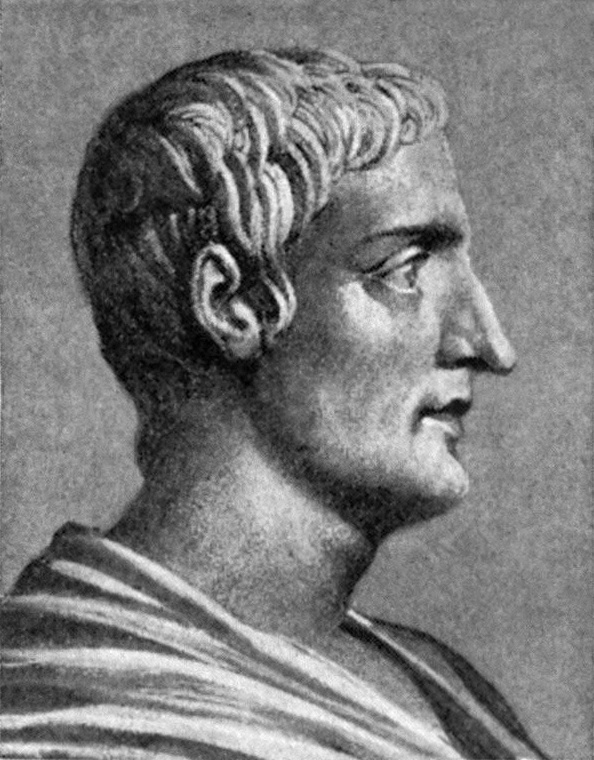
Tacitus wrote the most unflinching account of imperial Rome: the corruption, the tyranny, the slow rot of its institutions. His prose is tight, bitter, and endlessly quotable, and his picture of power corrupting from the inside has shaped how historians write about empires ever since. If you want to understand why Rome fell apart, Tacitus watched it happen.
The  Take
Take
Some interesting stuff about Tiberius Claudius and Nero, but a lot of boring war battles
The lineage through The Annals of Imperial Rome
- The Aeneid by Virgil. The Annals of Imperial Rome built on it. - Tacitus writes as Virgil's deliberate heir, lacing the *Annals* with *Aeneid* echoes — the dying Galba cast as "another Priam," Troy's fall behind a Roman one - He borrows the epic's heroic language precisely so the grim history can undercut it - Read the *Aeneid* first and you hear the irony: the destiny Virgil promised Rome, reported as it curdled into tyranny
- The Works of Cicero by Marcus Tullius Cicero. The Annals of Imperial Rome built on it. - Tacitus learned his craft on Cicero — the Ciceronian rhetoric of his teacher Quintilian stands behind everything he wrote, and his own *Dialogus* is patterned on *De Oratore* and *Brutus* - The *Annals* both alludes to Cicero and pushes hard away from him: the famous broken, compressed style is a deliberate refusal of the flowing Ciceronian sentence - Read Cicero first and you hear what Tacitus is rebelling against in every clipped line
Depicted in Art
Naked Seneca stands upright in a bronze basin, illuminated against darkness, as a doctor opens the vein in his arm and a scribe records his final words.
Peter Paul Rubens, 1615
Germanicus dies on his bed in Antioch surrounded by grieving soldiers and family; his wife Agrippina sobs at the foot as comrades raise their hands in oaths of vengeance.
Nicolas Poussin, 1627
Nero stares down at the laid-out corpse of his mother Agrippina, her body pale against dark drapery.
Antonio Rizzi
Double half-length portrait of the doomed Roman general Germanicus and his wife Agrippina the Elder, set against a dark ground.
Peter Paul Rubens, 1614
Nero walks alone through the smoldering ruins of the fire, lyre at his side, gazing back at the destruction.
Karl von Piloty, 1861
Agrippina, half-undressed, bares her womb to her assassins and is struck down by Nero's soldiers in a candlelit chamber.
Antonio Zanchi
Agrippina, veiled in black and clutching the urn of Germanicus's ashes, descends the gangplank at Brundisium with her children as a hushed crowd watches.
Benjamin West, 1768
A frightened Claudius is dragged from behind a curtain by a Praetorian guard who hails him as the new emperor over the bloodied corpse of Caligula.
Lawrence Alma-Tadema, 1867
Recommended Editions

Michael Grant
Penguin Classics · 2003
Grant's Penguin is the readable Tacitus. He keeps the compression and the dry venom of the original prose without letting the English seize up. The intro frames the empire-as-tyranny argument that still hits.
A.J. Woodman
Hackett Publishing · 2004

Please support us by purchasing through these links, at no extra cost to you!
Deep Dive
What It's About
This summary gives away plot details.
Notable Quotes
“They make a desert and call it peace.”
“The more corrupt the state, the more numerous the laws.”