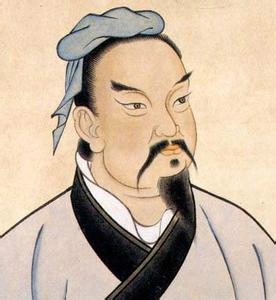
Sun Tzu
c. 544–c. 496 BCE · China
“If you know the enemy and know yourself, you need not fear the result of a hundred battles.”
Peak-work percentile in the canon.
Portraits
Public-domain (CC0) photograph of a memorial statue of Sun Tzu in China — a clean, freely licensed modern sculptural likeness; commemorative imagined depiction.
Gary Todd, 2008
Half-length Qing portrait of Sun Tzu in scholar-general's robes, holding a tablet, beard and topknot in the conventional historical-portrait style.
Stone statue of Sun Tzu in scholar-general dress, standing on a plinth in a Chinese-style garden in Tottori, Japan.
2008
Famous Quotes
“All warfare is based on deception.”
“The supreme art of war is to subdue the enemy without fighting.”
“Appear weak when you are strong, and strong when you are weak.”
“If you know the enemy and know yourself, you need not fear the result of a hundred battles. If you know yourself but not the enemy, for every victory gained you will also suffer a defeat. If you know neither the enemy nor yourself, you will succumb in every battle.”
About Sun Tzu
Ancient Chinese military strategist and philosopher traditionally credited as the author of The Art of War. Whether he was a historical figure or a composite of several strategists remains debated. His treatise on warfare and strategy has influenced military and business thinking for over two millennia.