Antigone
 Sophocles441 BCE
Sophocles wrote the definitive play about conscience against authority: a young woman buries her brother against the king's orders because divine law beats human law.
Read this if you…
- are interested in how humans throughout time have really cared about burying the dead
- want the best female protagonist in Greek Tragedy
- like the exploration of duty to family vs. state
- are reading the Oedipus Trilogy
Skip this if you…
- need a fast moving plot
Why It Matters
Sophocles wrote the definitive play about conscience against authority: a young woman buries her brother against the king's orders because divine law beats human law. Antigone has been claimed by just about every resistance movement, from the French Resistance to the civil rights era. It is the most politically charged play in the Western canon.
The  Take
Take
Always interesting how all these ancient texts, proper burial rites are paramount. Great inspection of family vs state. Classic Greek tragic ending. Super short and easy read
Where to go next
- The Seven Against Thebes by Aeschylus. Antigone built on it. - *Antigone* opens on the aftermath of the battle Aeschylus dramatized in *The Seven Against Thebes* - The brothers' mutual slaughter — the climax of Aeschylus's play — is Sophocles's starting premise; he assumes you already know how they died - Reading the *Seven* first puts you in the seat of Sophocles's original audience, who carried Aeschylus's version into the theater with them
- Poetics by Aristotle. Antigone shaped it. - *Antigone* becomes a teaching example in the foundational work of literary theory - In *Poetics* Ch. 14 Aristotle reaches for the Haemon-Creon scene — but as a cautionary case: Haemon threatens his father, then nothing follows, so Aristotle ranks it the worst, least-tragic kind of dramatic intent - A reminder that even the greats supply theory with its negative examples
Depicted in Art
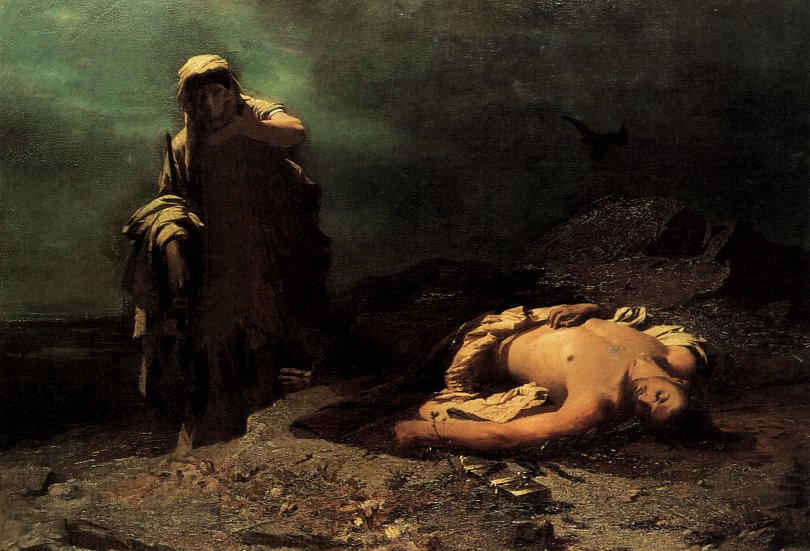
Antigone kneels beside her brother's bare corpse on a rocky shore, hand raised toward the sky in grief, the battlefield receding behind.
Nikiforos Lytras, 1865
Creon enthroned at left passes sentence on Antigone, who stands bound at center beneath a colonnade as courtiers recoil.
Giuseppe Diotti, 1845
Bust-length portrait of Antigone gazing skyward in profile, draped in white against a dark richly patterned ground, expression caught between sorrow and resolve.
Frederic Leighton, 1882
Antigone bends to sprinkle dust over Polynices's body as guards rush from the background to seize her.
Sébastien Norblin, 1825
Recommended Editions

Robert Fagles
Penguin Classics · 1984
Fagles in the Three Theban Plays volume, with Bernard Knox's introduction doing real critical work. Antigone's defiance lands like a modern voice without losing the weight of the ritual it's set inside.


Please support us by purchasing through these links, at no extra cost to you!
Deep Dive
What It's About
This summary gives away plot details.
Notable Quotes
“Wonders are many, and none is more wonderful than man; the power that crosses the white sea, driven by the stormy south-wind.”
“I was born to join in love, not hate — that is my nature.”
More by Sophocles
- Women of Trachis
c. 450 BCE · Tragedy
- Ajax
c. 440 BCE · Tragedy
- Oedipus Rex
c. 429 BCE · Tragedy
- Electra
c. 410 BCE · Tragedy
- Philoctetes
409 BCE · Tragedy
- Oedipus at Colonus
401 BCE · Tragedy