Poetics
Aristotle wrote the first systematic theory of literature, and we are still using his vocabulary: plot, character, catharsis, tragedy, comedy.
Read this if you…
- want the foundational text of Western literary criticism, Aristotle inventing the field
- want to hear Aristotle defend the Greek playwrights and Homer against Plato's school
- want an analysis of why humans like fucked up depressing tragic stories
Skip this if you…
- don't care about literary criticism
Why It Matters
Aristotle wrote the first systematic theory of literature, and we are still using his vocabulary: plot, character, catharsis, tragedy, comedy. The Poetics defined what a good story is for over two thousand years, and screenwriters still follow its rules. It is the most influential work of literary criticism ever written.
The  Take
Take
Awesome analysis of ancient tragedy and epic. Great points
Where to go next
- Oedipus Rex by Sophocles. Poetics built on it. - The *Poetics* keeps naming one play as the model: *Oedipus Rex*. Aristotle's whole theory of plot (Ch. 13–16) is reverse-engineered from how Sophocles built it - His prized device — *peripeteia* and *anagnorisis* arriving in the same stroke — is simply a description of Oedipus discovering the truth about himself - Read the play first and the *Poetics* stops being abstract: you'll recognize the exact scenes Aristotle is theorizing from
- The Iliad by Homer. Poetics built on it. - The *Poetics* is built on Homer — Aristotle holds up the *Iliad* as his chief model of how an epic should be made - His prized 'unity of action' is just a description of what the *Iliad* does: one event, the wrath of Achilles, gives the sprawling war a single spine - Read the poem first and Aristotle's rules stop sounding abstract — you've already felt the thing he's theorizing
- The Odyssey by Homer. Poetics built on it. - The *Poetics* keeps reaching for one poem to make its point, and it's the *Odyssey* - Aristotle's theory of plot, reversal, and recognition is reverse-engineered from Homer — the bath-scene scar, the handling of improbable incident, the tight single action are his go-to illustrations - Read the *Odyssey* first and the *Poetics* stops being abstract: you've already watched the machine Aristotle is taking apart
- Antigone by Sophocles. Poetics built on it. - Aristotle builds his rules from real plays — and *Antigone* is one of his specimens, cited by name in Ch. 14 - He singles out the Haemon-Creon confrontation as the *worst* sort of tragic moment: intent without deed, threat without disaster, no catharsis - Read *Antigone* first and you can judge the verdict yourself — the *Poetics* is sharper when you know the scene it's dissecting
- Medea by Euripides. Poetics built on it. - When Aristotle warns that a plot's unraveling must arise from the plot itself and not from a *deus ex machina*, his example is *Medea*'s escape by god-sent chariot - Read Euripides first and the *Poetics* stops being abstract — you've seen the very ending Aristotle is faulting - He returns to *Medea* for the child-murder too, as a deed done knowingly; the play is one of the concrete cases the theory is reasoning from
Depicted in Art
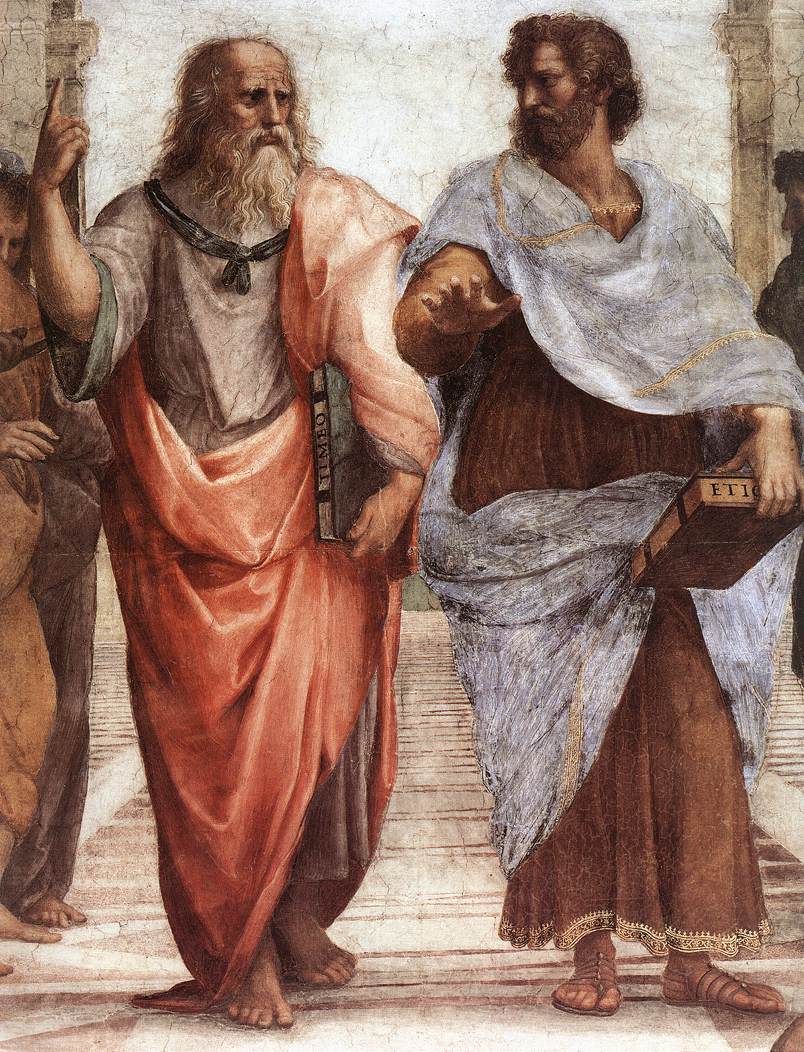
Aristotle, in blue and brown, walks beside Plato beneath classical arches; he gestures down toward the earth while Plato points up.
Raphael, 1511
Aristotle in scholar's robes seated at a lectern, an open book before him, head turned in profile in mid-thought.
Justus van Gent and Pedro Berruguete, 1476
Recommended Editions

Anthony Kenny
Oxford University Press · 2013
Kenny's 2013 translation is the clearest in print. He's a philosopher and a literary scholar both, and his notes resolve the famous cruxes about catharsis and the lost second book on comedy.


Please support us by purchasing through these links, at no extra cost to you!
Deep Dive
What It's About
This summary gives away plot details.
Notable Quotes
“Tragedy, then, is an imitation of an action that is serious, complete, and of a certain magnitude; in language embellished with each kind of artistic ornament, the several kinds being found in separate parts of the play; in the form of action, not of narrative; through pity and fear effecting the proper purgation of these emotions.”
“A whole is that which has a beginning, a middle, and an end.”
More by Aristotle
- The Nicomachean Ethics
c. 330 BCE · Treatise