Read this if you…
- want the first real history book (Herodotus winged it, though that was kind of the fun)
- are a freak who likes the most boring stuff of all time
Skip this if you…
- are a normal person
- are willing to just google the history and don't care about the original writing
Why It Matters
Thucydides wrote the first rigorous work of history: no gods, no myths, just power, strategy, and the grim logic of war. His account of how Athens went from democracy to imperial overreach to disaster has been read by every serious strategist since. The Melian Dialogue ("the strong do what they can, the weak suffer what they must") is the most quoted passage in political realism.
The  Take
Take
Very different from Herodotus, way more scientific. The stuff about the plague was interesting and just his analysis of why and how factions war with each other
The lineage through History of the Peloponnesian War
- The Histories by Herodotus. History of the Peloponnesian War built on it. - The history Thucydides is picking up — and arguing with - His narrative deliberately begins where Herodotus left off (Sestos, 479 BCE), then drives to 431; the *Histories* are the explicit precursor he continues - He kept the enterprise and threw out the method — read Herodotus first and Thucydides' colder, stricter approach reads as a direct rebuke
- The Iliad by Homer. History of the Peloponnesian War built on it. - Thucydides starts not with his own war but with Homer's, using the *Iliad* as the raw material against which he forges a new, evidentiary method - He names Homer, doubts the 1,186-ship catalogue, and corrects the poet's exaggeration — and in doing so invents the historian's skepticism - Read the *Iliad* first and the opening "Archaeology" reads as what it is: history arguing its way out of epic
- Plutarch's Lives by Plutarch. History of the Peloponnesian War shaped it. - When Plutarch reaches the Athenian generals, he doesn't compete with Thucydides — he defers to him - On Nicias, Plutarch says outright he won't "vainly rival Thucydides," and across the Greek *Lives* he cites the *History* by name as the authority - Thucydides supplies the hard chronicle of the war; Plutarch lifts his Pericles and Nicias straight off the page and turns them into character studies
- Leviathan by Thomas Hobbes. History of the Peloponnesian War shaped it. - Hobbes loved this book enough to translate it himself — his English Thucydides (1629) came decades before *Leviathan* - The Melian Dialogue's cold verdict that the strong do what they can and the weak suffer what they must is the seed of Hobbes's state of nature - Thucydides taught Hobbes that men act from fear and self-interest, and that taught him why they need a sovereign
Depicted in Art
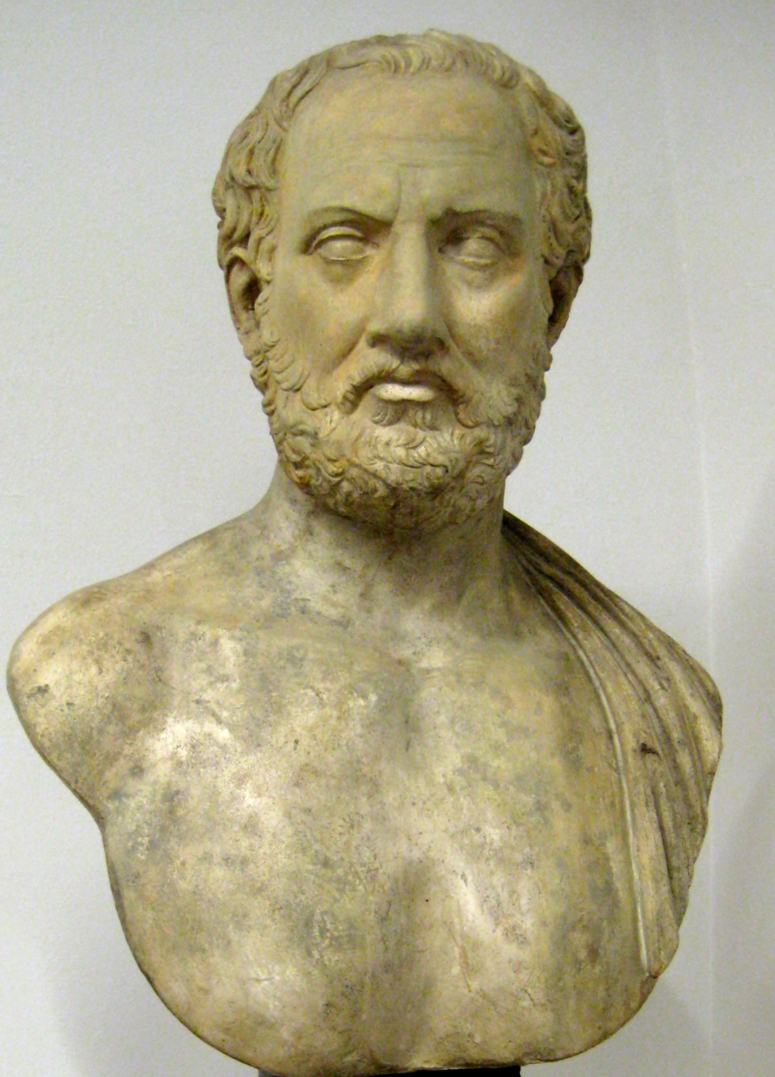
Marble portrait head of a bearded, balding man with a broad forehead and three deep furrows, late Hellenistic Roman copy of a 4th-century BC Greek original.
Socrates pulls a reluctant Alcibiades from a couch in Aspasia's salon; a greyhound and retinue of women look on.
Jean-Léon Gérôme, 1861
Socrates physically drags a half-clothed Alcibiades away from a reclining woman in an opulent interior.
Jean-Baptiste Regnault, 1791
Socrates straddles the fallen Alcibiades on a battlefield, sword raised to fend off attackers.
Pyotr Basin, 1828
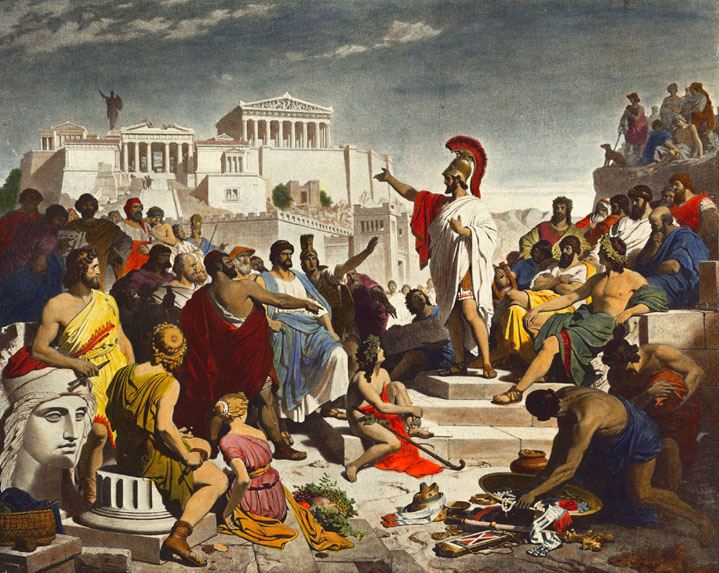
Pericles addresses a crowd of mourning Athenians from a raised platform, gesturing over the war dead at the close of the first campaign season.
Philipp Foltz, 1852
Recommended Editions

Robert B. Strassler (editor), Richard Crawley (translator)
Free Press · 1996
The Landmark Thucydides. Strassler's maps, headers, and appendices turn a famously hard book into something you can actually navigate, and Crawley's 19th-century prose still reads as well as any translation on offer.


Please support us by purchasing through these links, at no extra cost to you!
Deep Dive
What It's About
This summary gives away plot details.
Notable Quotes
“The strong do what they can and the weak suffer what they must.”
“Right, as the world goes, is only in question between equals in power, while the strong do what they can and the weak suffer what they must.”