
Read this if you…
- want the saga of the Israelite monarchy from Solomon's golden age to Jerusalem in ashes
- like Elijah's showdown with the prophets of Baal on Mount Carmel (fire from heaven, prophet-on-prophet trash talk)
- care about the prophetic theology of history: kings rise and fall based on whether they 'did right in the eyes of the Lord'
Skip this if you…
- don't want to read explicitly religious/Christian texts
The lineage through Kings
- Moby-Dick or, The Whale by Herman Melville. Kings shaped it. - Melville named his captain after the wicked king of *Kings* on purpose — Peleg tells Ishmael, "He's Ahab, boy; and Ahab of old, thou knowest, was a crowned king!" - The whole apparatus comes with the name: the prophet Elijah's warning, the dogs-licking-blood death, even Ahab's "ivory" leg echoing King Ahab's ivory house - The Israelite king who defied God and was destroyed for it is the blueprint for the monomaniac who hunts the whale to his doom
Depicted in Art
Solomon on his throne raises his hand as a soldier holds the living infant by one leg, sword poised; the true mother lunges forward in protest while the false mother stands rigid with the dead child.
Nicolas Poussin, 1649
Sheba kneels on the palace steps offering tribute as Solomon receives her from his throne; attendants carry gold and spices, and a turbaned retinue crowds the columned hall.
Peter Paul Rubens, 1620
Solomon kneels before a golden idol on a colonnaded terrace, surrounded by his foreign wives and concubines who direct him toward the altar; smoke from incense rises into the sky.
Frans Francken the Younger, 1622
Elijah stands triumphant beside his altar as fire from heaven consumes the offering; the priests of Baal sprawl in defeat around their cold altar beneath Mount Carmel.
Juan de Valdes Leal, 1655
Solomon reclines asleep in his chamber as God appears in a burst of cloud and angels above the bed, offering the gift of wisdom; books and a crown rest at the king's feet.
Luca Giordano, 1695
Sheba kneels in awe at the foot of Solomon's vast Assyrian-styled throne hall; a procession of bearers carries treasure across the marble floor under a canopy of carved cedar.
Edward Poynter, 1890
Elijah stands above the brook Kishon directing the slaughter of the Baal priests after their defeat on Carmel; bodies tumble down the rocks as soldiers carry out the prophet's command.
Gustave Doré, 1866
Solomon leans forward from his high throne as a soldier grips the living child by an ankle, sword raised; the true mother throws herself at the king's feet in horror.
Gustave Doré, 1866
Recommended Editions

King James Version
Oxford University Press · 1611
The most influential and commonly quoted translation in English. The prose rhythm everyone else is responding to, even modern translations.
Please support us by purchasing through these links, at no extra cost to you!
Notable Quotes
And after the earthquake a fire; but the LORD was not in the fire: and after the fire a still small voice.
Screen & Stage
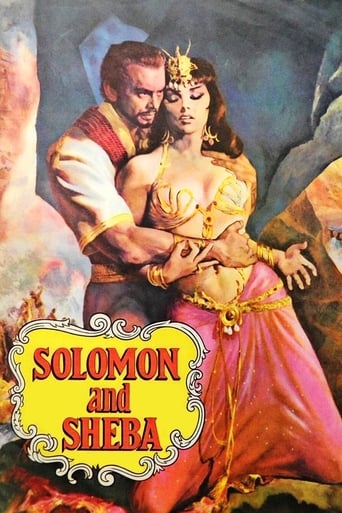
Posters via The Movie Database (TMDB)
- Sir Arthur Quiller-Couch, Cambridge professor of English literature, 1863–1944: "The Authorised Version of the Holy Bible is, as a literary achievement … with the possible exception of the complete works of Shakespeare, the very greatest."
- Erich Auerbach, Comparative literature scholar, 1892–1957: The Hebrew Bible's stories are "fraught with background" — spare on the surface, inexhaustibly deep, granting figures like David a psychological development Homer never attempts.
- Northrop Frye, Literary critic, University of Toronto, 1912–1991: The Bible is the single most important influence on the imaginative tradition of Western art and literature — the “great code” that conditioned the Western imagination.
- Robert Alter, Hebrew Bible translator, UC Berkeley, b. 1935: "The story of David is probably the greatest single narrative representation in antiquity of a human life evolving by slow stages through time."