Read this if you…
- want the Bible's most surprising book — explicitly sensual love poetry with no mention of God
- like that the woman's voice is as prominent as the man's, rare in ancient literature
- care about the lush garden/vineyard imagery that centuries of mystics read as soul-and-Christ allegory
Skip this if you…
- don't want to read explicitly religious/Christian texts
Why It Matters
Having the Song in the canon at all has kept interpreters busy for centuries. Jewish tradition reads it as an allegory of God's love for Israel, Christian tradition as Christ's love for the Church. Read plainly, it is the Bible treating human sexuality as a gift from God.
Depicted in Art
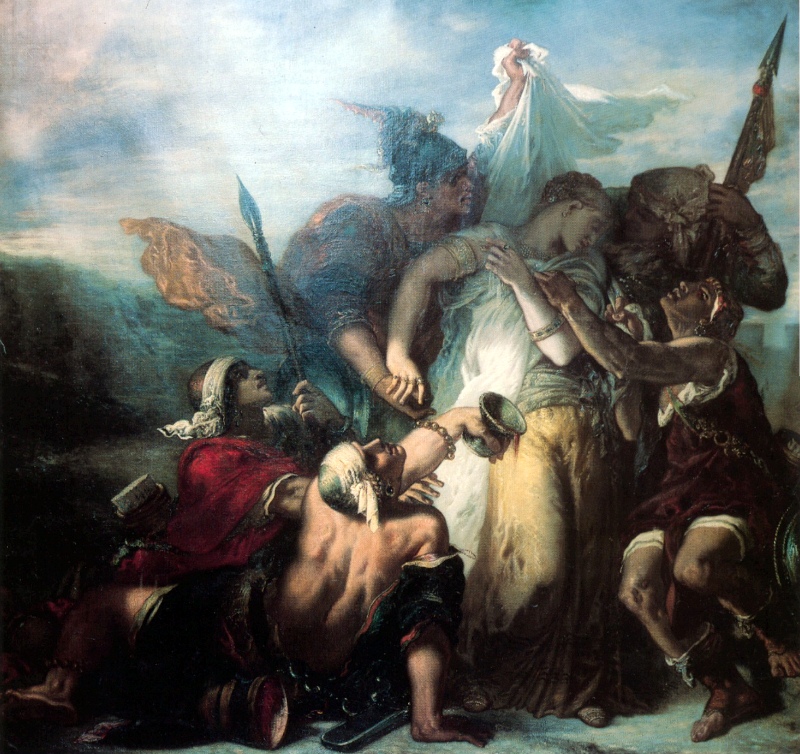
The Shulamite is set upon by the drunken city watchmen in a dim Jerusalem street; her veil falls as she struggles.
Gustave Moreau, 1853
The Shulamite stands alone in a watercolor reverie, jewelled and contemplative, against an ornamental Eastern backdrop.
Gustave Moreau
A musician plucks a stringed instrument before the enthroned King Solomon, opening the illuminated Song of Songs.
1490
The Shulamite, robed and standing in profile, recounts the glories of King Solomon to her attendant maidens.
Albert Joseph Moore, 1864
The Bride, draped and crowned, descends a moonlit colonnade searching for her lover by night.
Gustave Moreau, 1892
Recommended Editions

King James Version
Oxford University Press · 1611
The most influential and commonly quoted translation in English. The prose rhythm everyone else is responding to, even modern translations.
Please support us by purchasing through these links, at no extra cost to you!
Deep Dive
What It's About
This summary gives away plot details.
Notable Quotes
“Set me as a seal upon thine heart, as a seal upon thine arm: for love is strong as death; jealousy is cruel as the grave: the coals thereof are coals of fire, which hath a most vehement flame.”
“Many waters cannot quench love, neither can the floods drown it.”
More by Solomon
- Wisdom of Solomon~50 BCSolomonModerate·Quick·—Influence—Popularity—BibleWisdomAncient Greek
- Song of Solomon~300 BCSolomonModerate·Quick·—Influence—Popularity—BibleLyricHebrew
- Proverbs~450 BCSolomonEasy·Short·—Influence—Popularity—BibleWisdomHebrew
- Ecclesiastes~250 BCSolomonModerate·Quick·—Influence—Popularity—BibleWisdomHebrew