Read this if you…
- are reading all the Shakespeare contemporaries
- want the other great non-Donne poet of the era
Skip this if you…
- haven't read shakespeare or donne already
Why It Matters
Jonson was Shakespeare's main rival, and the poet who kept insisting that craft, discipline, and classical learning mattered more than raw inspiration. His mark on the formal side of English poetry, the clean structure and moral seriousness and satirical precision, was huge. No Jonson, no Dryden, no Pope, no Augustan age.
The  Take
Take
Just fine, well structured and very readable, but nothing really grabbed me
The lineage through The Complete Poems
- The Odes of Horace by Horatius. The Complete Poems built on it. - Jonson built his whole self-image on Horace — translator of the *Ars Poetica*, the self-styled English 'second Horace' - His odes, epistles, and epigrams are densely woven with Horace; a poem like 'Inviting a Friend to Supper' carries Horatian lines right inside it - Read the *Odes* first and Jonson's classical poise stops looking like a pose — you're hearing the model he chose to live up to
- The Complete Poems by Andrew Marvell. The Complete Poems shaped it. - Jonson founded the "Tribe of Ben" — the disciples who took his classical discipline as a model — and Marvell was among the inheritors - "To Penshurst," the poem that invented the English country-house genre, is the direct template for Marvell's "Upon Appleton House" - Marvell carried over Jonson's logic, order, and classical restraint and built his own estate poem on that frame
Depicted in Art
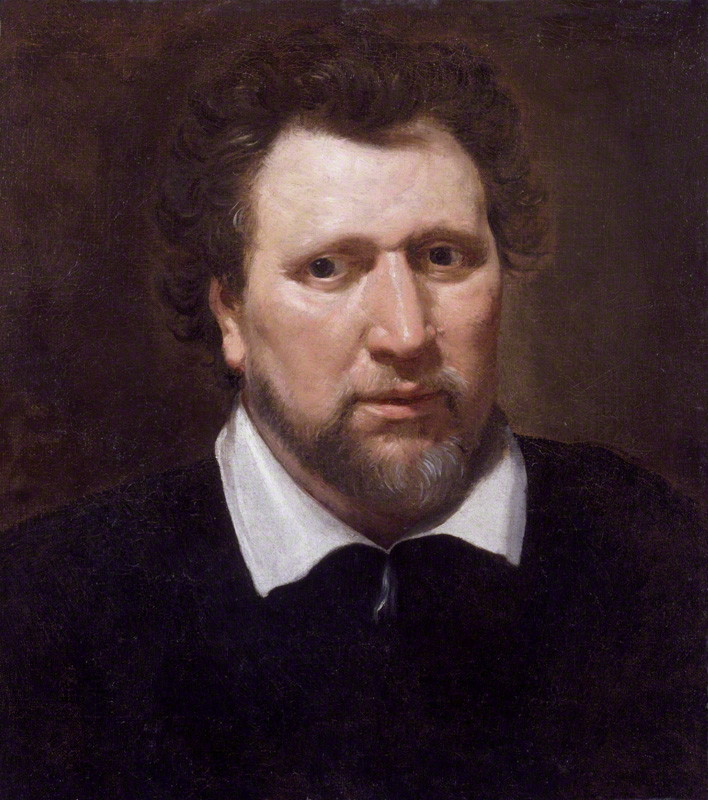
Half-length portrait of Jonson in a black doublet against a dark ground, head turned slightly to the viewer's left, balding with a trim moustache and beard.
Abraham van Blyenberch, 1617
Cropped bust portion of Vertue's oval engraving — just the head and shoulders, laurel and inscriptions trimmed away.
George Vertue (after Gerard van Honthorst), 1730
Jonson and Shakespeare at a tavern table mid-debate, surrounded by fellow wits — the legendary gathering of the Mermaid Tavern circle.
Wall monument in Poets' Corner: a portrait medallion of Jonson above three linked theatrical masks and a broken-flame lamp, set in a pale marble surround.
James Gibbs and John Michael Rysbrack, 1723
Recommended Editions
Penguin Classics
1988
George Parfitt's Penguin pulls together the Epigrams, the Forest, the Underwood, and the uncollected verse. His intro argues Jonson rivals Shakespeare in the lyric mode, and the poems themselves make the case.

Please support us by purchasing through these links, at no extra cost to you!
Deep Dive
What It's About
This summary gives away plot details.
Notable Quotes
“He was not of an age, but for all time!”
“Drink to me only with thine eyes, / And I will pledge with mine.”