The Odes of Horace
Horace perfected the short lyric poem: personal, polished, built to last.
Read this if you…
- like Short lyric poems with a bunch of famous quotable lines
- are interested in one of the most studied/famous Latin poets ever
- can accept that lots of poetry is lost in translation from Latin to English
Skip this if you…
- are expecting the poetry to hit like modern english poetry (translation takes away a lot)
Why It Matters
Horace perfected the short lyric poem: personal, polished, built to last. Phrases like "carpe diem" and "dulce et decorum est" come from these odes and people still use them two thousand years later. He set the bar for what a lyric poem should do, say something true in the fewest, best words you can find.
The  Take
Take
The themes of time passing and beauty dying and death in general were decent, but it got a little repetitive. I hear it’s better in Latin but I wasn’t that entertained
Where to go next
- Sappho's Poems by Sappho. The Odes of Horace built on it. - Behind Horace's most famous meter stands a poet of Lesbos - A quarter of the *Odes* are written in the Sapphic stanza, and Horace names Sappho and Alcaeus outright as the masters he set out to import - Read Sappho first and you'll hear what Horace is reaching for — the Aeolic lyric he claims (*Odes* 1.1, 3.30) to have carried into Latin before anyone else
- On the Nature of Things by Lucretius. The Odes of Horace built on it. - Horace knew Lucretius's verses intimately and alludes to him constantly — Odes 1.4 opens with a winter-melting spring lifted from the proem of *On the Nature of Things* - Epicureanism, Lucretius's philosophy, is the dominant current in the Odes, coloring roughly twice as many poems as Stoicism - Read *On the Nature of Things* first and Horace's carpe-diem mood reveals its source — the cold physics of a world that renews itself without you
- The Iliad by Homer. The Odes of Horace built on it. - The epic Horace keeps gesturing at — and deflating - *Odes* 1.6 translates the *Iliad*'s opening only to puncture it, turning Achilles' world-shaking wrath into a small private annoyance; you catch the joke best with Homer in your ear - Horace's whole stance — the lyric poet declining to march into epic — is a posture struck against the *Iliad* behind him
- The Complete Poems by Ben Jonson. The Odes of Horace shaped it. - Horace gave Ben Jonson an entire literary identity — Jonson cast himself as 'Horace' in *Poetaster* and was hailed by his peers as a 'second Horace' - He translated Horace's *Ars Poetica* into English verse and modeled his own odes, epistles, and epigrams on the Roman's - The Horatian ideal — measured, classical, sociable — runs straight from the *Odes* into Jonson's voice
- The Complete Poems by Andrew Marvell. The Odes of Horace shaped it. - Horace's *Odes* gave Andrew Marvell his most famous poem its shape and its name — 'An Horatian Ode upon Cromwell's Return from Ireland' - Marvell carried the Horatian stanza into English — two long lines, two short — and, more telling, Horace's wary ambivalence before a new ruler - The Roman's Augustan poise, admiring and uneasy at once, is exactly the tone Marvell turns on Cromwell
- Selected Poems by John Dryden. The Odes of Horace shaped it. - Dryden didn't just admire Horace — he translated him - Three of the *Odes* turn up in his *Sylvae* (1685), crowned by the Pindaric paraphrase of Ode 3.29, *Happy the Man* - Read Horace's Latin Epicurean calm here, then watch Dryden turn it into easy, weighty English
- The Complete Essays by Michel de Montaigne. The Odes of Horace shaped it. - Montaigne ranks Horace among the four poets who "by many degrees excel the rest," and elsewhere calls him nearly the only lyric poet worth reading - The *Odes* surface again and again in the *Essays* — on fortune (III.16), on living well — quoted dozens of times as Montaigne's go-to voice - He earned the tag "the French Horace," and lets Horace speak the final words of the whole book
- Letters from a Stoic by Seneca. The Odes of Horace shaped it. - Horace's carpe diem becomes Stoic counsel a generation later - Seneca, probably familiar with Horace's epistles, quotes him among the Latin poets and reworks the Odes' "seize the day" into the discipline of treating each day as a windfall
Depicted in Art
18th-19th century engraved bust portrait of Horace, head three-quarters, wreathed.
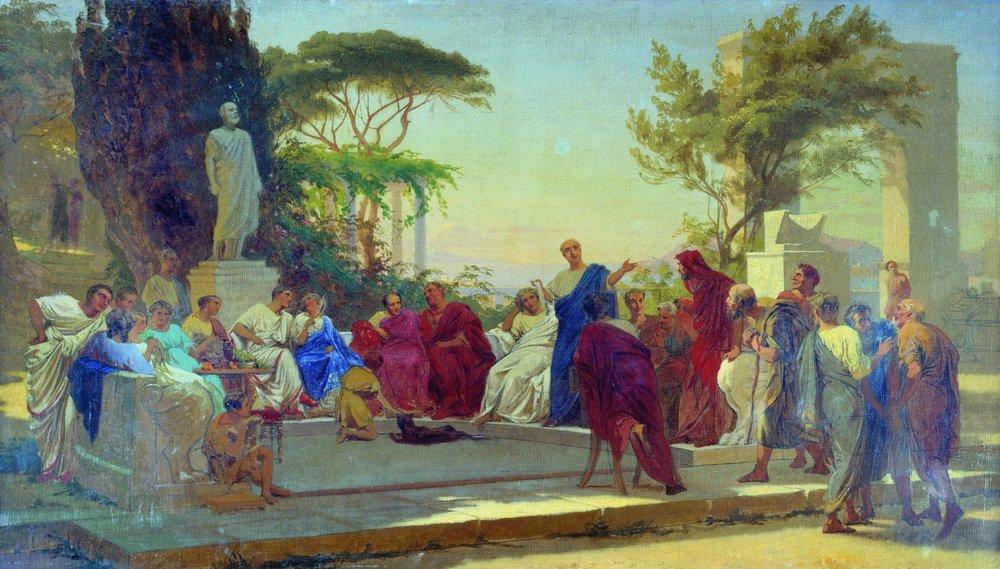
Horace stands reading from a scroll to Maecenas, who reclines listening, in a sunlit colonnaded Roman interior.
Fyodor Bronnikov, 1863
Horace reclines in a villa garden at Tibur (Tivoli) among Campanian goblets and beakers, scroll in hand.
Auguste Leloir, 1900
Half-length portrait of Horace seated with a stylus and tablet, looking up as if mid-composition.
Giacomo Di Chirico, 1871
Full-length idealized portrait of Horace in Roman dress against a landscape ground.
Adalbert von Roessler
Horace and Lydia recline together on a couch in a marble Roman interior, the poet reading aloud to her.
Gustave Boulanger, 1863
Three poets gather in conversation in Maecenas' richly appointed Roman house, Horace seated with a scroll.
Charles Francois Jalabert, 1846
Painted dome panel showing classical and modern poets in Elysium; Horace appears among Homer, Ovid and Lucan.
Eugène Delacroix, 1846
Recommended Editions

David Ferry
Farrar, Straus and Giroux · 1997
Ferry is a working American poet, and the Odes actually sing in his English. He catches the trick Horace pulls where the surface looks casual and the craft underneath is iron.


Please support us by purchasing through these links, at no extra cost to you!
Deep Dive
What It's About
This summary gives away plot details.
Notable Quotes
“Carpe diem, quam minimum credula postero. (Seize the day, trusting as little as possible in tomorrow.)”
“Dulce et decorum est pro patria mori. (It is sweet and fitting to die for one's country.)”