
Read this if you…
- want some of the wittiest one liners there are
- only want to read the first half (it's better)
- like the topic of vanity
Skip this if you…
- want a good plot
- are hoping his book is as good as his quotes you've already heard
Why It Matters
Wilde wrote a Gothic novel that doubles as a brutal takedown of Victorian hypocrisy: a beautiful man stays young while his portrait rots. The idea that your sins turn up somewhere, even if not on your face, is one of the most potent metaphors in English fiction. The book is also Wilde's sharpest run of epigrams, which is saying a lot.
The  Take
Take
Great witticisms, decent concept, but really I wanted way more lord Henry, and less Dorian gray
The lineage through The Picture of Dorian Gray
- Dr. Faustus by Christopher Marlowe. The Picture of Dorian Gray built on it. - Dorian's last unheeded plea replays Faustus's death-bed scene — both men believe repentance has come too late, and Wilde borrows the very phrase: "It is too late" from Marlowe's "Is't not too late?" - Lord Henry is a transplanted Mephistopheles, the tempter steering a man toward his own ruin - Wilde called the soul-for-youth idea "old in the history of literature" — Marlowe's *Dr. Faustus* is where that bargain got its definitive English form
- The Symposium by Plato. The Picture of Dorian Gray built on it. - Basil's love of Dorian's beauty is a rewriting of *The Symposium*'s ladder — the soul climbing from a beautiful body toward the highest form of love - Wilde knew the dialogue in the original Greek from his Oxford classics training, and the mentor-and-youth eros at its heart shapes the Lord Henry–Dorian–Basil triangle - Read Plato first and *Dorian Gray* reads as the ascent gone wrong — beauty pursued, never transcended
- Phaedrus by Plato. The Picture of Dorian Gray built on it. - Lord Henry and Dorian are a corrupted Socrates and Phaedrus — Wilde wants you to feel the echo - Read the *Phaedrus* first and the novel reads as a deliberate inversion: Plato's account of love and beauty as a ladder upward, turned into a descent - Wilde (after Pater) defines his beauty and eros in Platonic terms precisely so he can poison them — the dialogue is the thing standing behind Lord Henry's every aphorism
Depicted in Art
A full-length portrait of the corrupted Dorian: bloated, leering, fingers dripping blood, the canvas itself rotting around him in a baroque parlor.
Ivan Albright, 1944
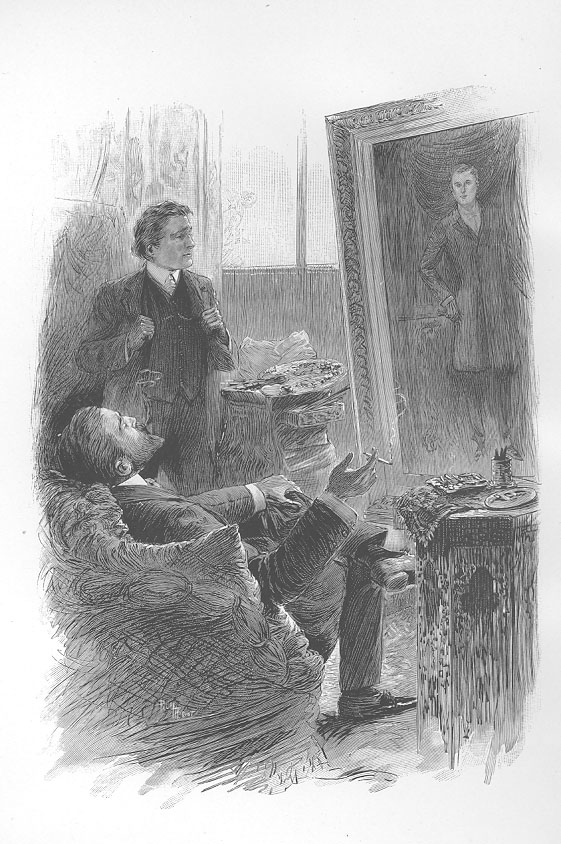
Basil Hallward unveils the finished portrait of Dorian in his studio, Lord Henry looking on.
Eugène Dété (after Paul Thiriat), 1908
A stylized engraved portrait of Dorian Gray, head and shoulders, in the manner of a fin-de-siècle society painter.
Fernand Siméon, 1922
Dorian lies dead on the attic floor before the restored portrait of his youthful self, a knife in his withered chest.
Eugène Dété (after Paul Thiriat), 1908
The pictorial cover of Lippincott's for July 1890, where The Picture of Dorian Gray first appeared in print as a novella.
1890
Recommended Editions

Penguin Classics
2003
Mighall's Penguin runs the 1891 text with a sharp introduction on aestheticism, decadence, and how the novel was used against Wilde in court. The cleanest read if you just want Dorian Gray.

Please support us by purchasing through these links, at no extra cost to you!
Deep Dive
What It's About
This summary gives away plot details.
Notable Quotes
“The only way to get rid of a temptation is to yield to it.”
“There is only one thing in the world worse than being talked about, and that is not being talked about.”