Phaedrus
 Platoc. 370 BCE
This is Plato's most concentrated treatment of love, beauty, soul, rhetoric, and writing all at once.
Read this if you…
- want a great metaphor on the importance of irrational love/desire
- are working through all of Plato's best
Skip this if you…
- haven't read other plato to decide if you like his style
The  Take
Take
Classic annoying Socrates making great points about the importance of irrational desire, truth, and knowing your audience
The lineage through Phaedrus
- Sappho's Poems by Sappho. Phaedrus built on it. - Socrates names his source: "the fair Sappho" at 235c, invoked as a wellspring before he speaks on love - The *Phaedrus*' famous account of erotic madness draws on Sappho 31's anatomy of desire — the trembling, the fire, the body overcome - Plato turns the lyric poet's experience of love into philosophy; reading Sappho first lets you hear what Socrates is building on
- The Iliad by Homer. Phaedrus built on it. - Plato treats the *Iliad* as the epic authority in the room — his dialogues quote it some 91 times, and the *Phaedrus* itself reworks a Homeric hexameter at 241d - Socrates's great palinode is set against Homer's telling of Helen: the *Iliad* is the version of the story he must take back - Come to the *Phaedrus* with Homer fresh and you feel the recantation — Plato wrestling with the poet who educated all of Greece
- The Works of Cicero by Marcus Tullius Cicero. Phaedrus shaped it. - The dialogue Cicero couldn't stop imitating — he opens *De Oratore* under a plane tree and has a character ask outright, "why do we not imitate Socrates as he appears in the *Phaedrus* of Plato?" - Cicero translated passages of the *Phaedrus* directly, quoting them in his *Orator* - Plato's roadside conversation on rhetoric and the soul became the Roman model for how a serious dialogue should sound and where it should sit
- The Golden Ass by Apuleius. Phaedrus shaped it. - Plato's chariot of the soul — the white horse straining upward, the dark horse dragging it down — became the secret architecture of a Roman comic novel - Lucius, turned into an ass for his appetites, is Plato's unruly dark horse made flesh; the white horse Candidus that returns at the end echoes the steed that draws the soul toward the divine - The *Phaedrus*'s myth of the winged, fallen soul climbing back to heaven is what Apuleius dramatizes through Psyche's ascent
- The Picture of Dorian Gray by Oscar Wilde. Phaedrus shaped it. - Plato's dialogue on love, beauty, and the soul becomes Wilde's template — and his target - Lord Henry and Dorian insistently evoke Plato's Socrates and Phaedrus, the older voice seducing the beautiful young listener - Wilde takes the *Phaedrus*'s arguments about eros and beauty and inverts them: where Plato's love lifts the soul, Lord Henry's corrupts it
Depicted in Art
Socrates and a young man (Phaedrus) sit beneath a plane tree by a river; a goddess-like woman addresses them, with a chariot drawn by white horses behind her.
Franz Caucig, 1810
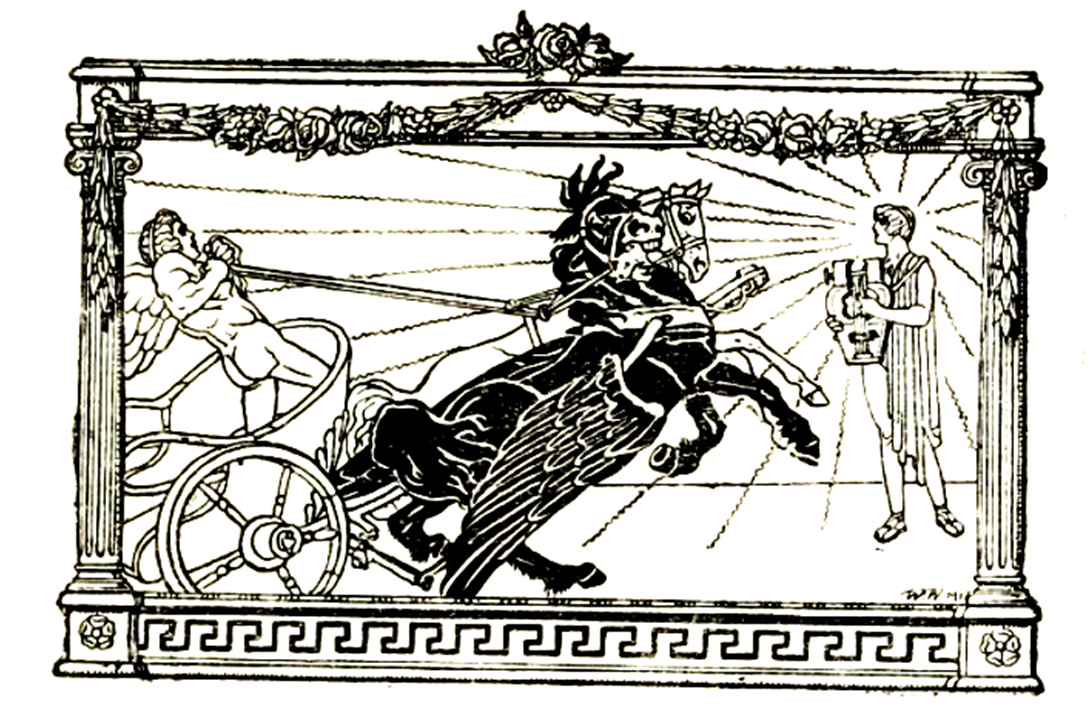
Illustration of the soul's chariot procession from Phaedrus 247: the gods and souls ride in chariots along the rim of heaven, beholding the Forms.
Władysław Witwicki, 1922
The winged north wind Boreas sweeps the Athenian princess Orithyia into the air above the banks of the Ilissus.
Workshop of Peter Paul Rubens, 1615
Recommended Editions

Robin Waterfield
Oxford World's Classics · 2002
Waterfield reads fluently and the Oxford notes do a lot of work, especially on the rhetoric stuff in the back half. Lighter on philosophical precision than Nehamas-Woodruff, easier to actually finish.
Please support us by purchasing through these links, at no extra cost to you!
Notable Quotes
Of the nature of the soul, though her true form be ever a theme of large and more than mortal discourse, let me speak briefly, and in a figure. And let the figure be composite—a pair of winged horses and a charioteer.
- Ralph Waldo Emerson, American essayist and philosopher, 1803–1882: "Out of Plato come all things that are still written and debated among men of thought."
- Sigmund Freud, founder of psychoanalysis, 1856–1939: "The enlarged sexuality of psycho-analysis coincides with the Eros of the divine Plato."
- Marcus Tullius Cicero, Roman statesman, orator & philosopher, 106–43 BCE: "This plane-tree seems to me to have grown not so much from the rivulet … as from the language of Plato."
More by Plato
- 16Phaedo~385 BCPlatoHard·Quick·94 pagesInfluence89Popularity40Ancient GreecePhilosophyAncient Greek
- 36The Symposium~385 BCPlatoHard·Quick·109 pagesInfluence88Popularity40Ancient GreecePhilosophyAncient Greek
- 58The Republic~375 BCPlatoHard·Medium·300 pagesInfluence96Popularity72Ancient GreecePhilosophyAncient Greek
- 71Phaedrus~370 BCPlatoHard·Quick·176 pagesInfluence32Popularity39Ancient GreecePhilosophyAncient Greek
- 117Apology~399 BCPlatoHard·Quick·39 pagesInfluence90Popularity41Ancient GreecePhilosophyAncient Greek