Read this if you…
- want most influential political book of all time
- like ruthlessly honest analysis on how to wield/gain power
- want a Short Renaissance classic
Skip this if you…
- can't get over a lot of people you hate, love this book
- find ultra honest realpolitik off putting
Why It Matters
Machiavelli split politics off from morality and told rulers the plain truth about how power actually works. Its reputation as an evil book is mostly unearned; it reads more like a clear-eyed diagnosis than a how-to. Every realist in politics since, from Hobbes to Kissinger, owes him something.
The  Take
Take
Awesome historical and political analysis of wielding state power. Super short, like 80 minute read. Backed up with evidence and just seems like the first real political vision around realpolitik
The lineage through The Prince
- Plutarch's Lives by Plutarch. The Prince built on it. - *The Prince*'s arsenal of examples is largely Plutarch's: Machiavelli cited him by name throughout the *Discourses* and mined the *Lives* for the *exempla* that make his case - Plutarch supplies the raw material for some of *The Prince*'s most shocking moves — conquering fortune, the calculus of fear — and even the lion-and-fox figure, first recorded as Lysander's maxim - Read Plutarch and you watch the same lives Machiavelli stripped of their moral varnish and read for power
- The Works of Cicero by Marcus Tullius Cicero. The Prince built on it. - Machiavelli's notorious counsel — be a fox and a lion — is a direct repudiation of Cicero's *De Officiis*, which used the same two beasts to *forbid* exactly that deceit - *The Prince*'s chapters on liberality and mercy are arguments with Cicero, not departures from him; Cicero is the orthodoxy being overturned - Read Cicero on the duties of a good man first and you feel the floor drop out — Machiavelli takes the standard Roman handbook and flips every page
- Richard III by William Shakespeare. The Prince shaped it. - *The Prince* didn't just travel to England — it became a stage type. Elizabethan literature carries some 400 references to Machiavelli, and the "Machiavel" was a stock villain audiences knew on sight - Shakespeare's Richard is that type's masterpiece: power as pure calculation, conscience treated as a luxury for weaker men - Shakespeare even names the debt — in *3 Henry VI*, Richard boasts he can "set the murderous Machiavel to school"
Depicted in Art
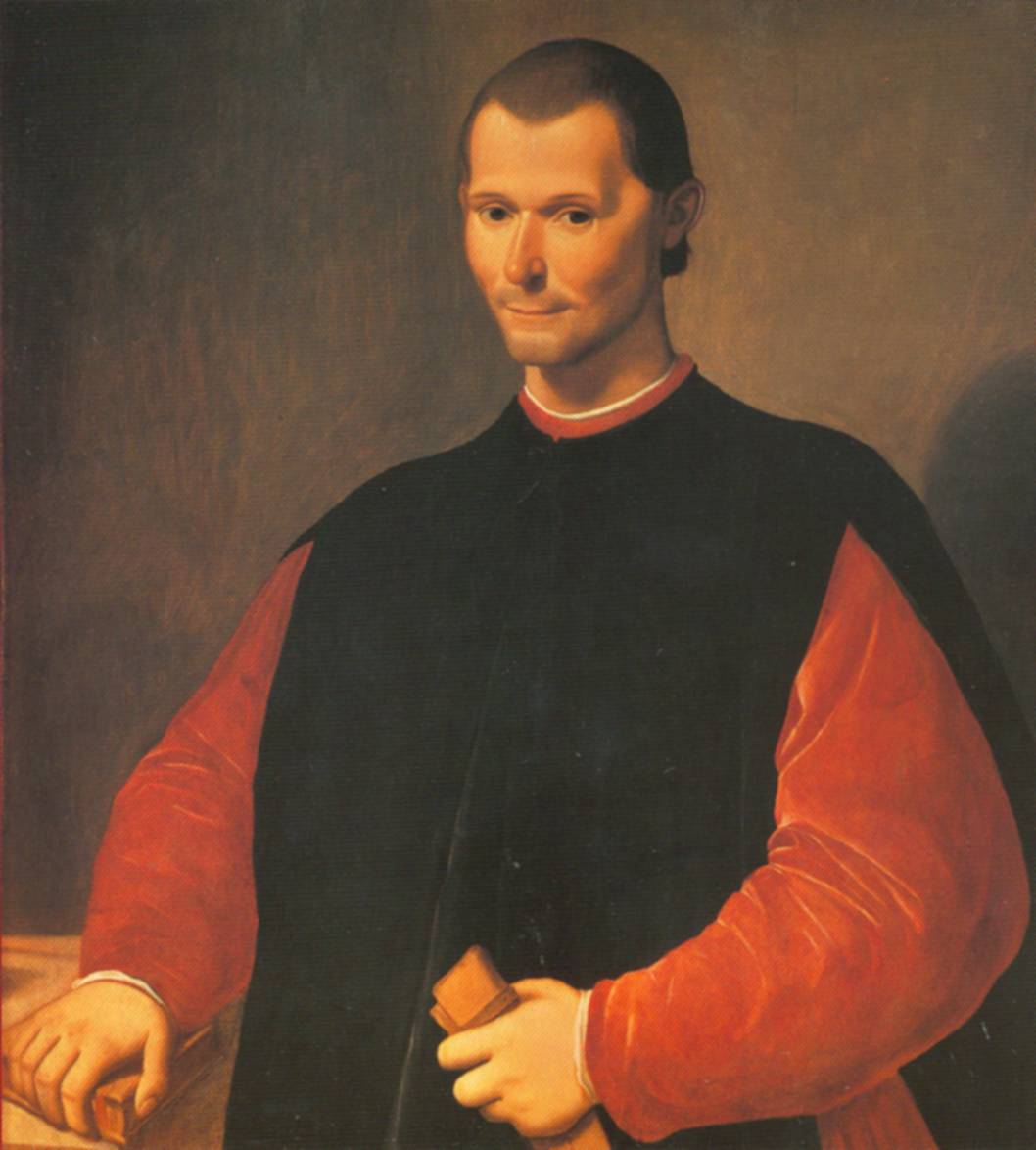
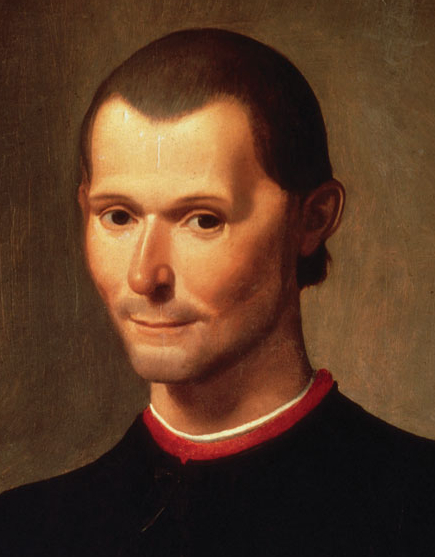
Half-length Machiavelli in black robes against a dark ground, holding a folded letter in his right hand and resting his left on a closed book, a wry half-smile on his pale, sharp-featured face.
Santi di Tito
Three-quarter-length portrait of a dark-haired young man in black slashed doublet against a green ground, gloved hand on a sword hilt, the other holding a folded letter; piercing direct gaze.
Altobello Melone, 1513
Life-sized marble statue: Machiavelli stands cloaked in a long robe, an open book held against his hip, head turned to his right with a contemplative downward gaze.
Lorenzo Bartolini, 1845
Machiavelli seated alone at a wooden writing desk in a quiet study, quill in hand over a sheet of paper, books and a candle nearby, lit from a high window — the writer caught mid-composition.
Stefano Ussi, 1894
Three-quarter-length portrait of a young dark-haired prince in a fur-collared brocade cloak and red cap, one hand resting on a gold box, the other holding a folded letter, gaze slightly averted.
Raphael (workshop), 1518
Bust-length portrait of a bearded young man in plain dark armor and a small white collar, head turned slightly to the viewer's left, brown hair to the shoulder, level appraising gaze.
Sebastiano del Piombo (attributed)
Cesare Borgia seated at a table in Imola gestures sharply at Machiavelli, who stands as Florentine envoy with cap in hand, eyes narrowed; armed retainers and a wall map behind them set the scene of statecraft.
Federico Faruffini, 1864
Bust-length Machiavelli in dark scholar's robes and skullcap, gripping a quill above an open book, gaze turned slightly off-frame in characteristic three-quarter view.
Antonio Maria Crespi Castoldi
Recommended Editions

Tim Parks
Penguin Classics · 2009
Tim Parks is a novelist who lives in Italy, and his Machiavelli reads like a modern political memo. Blunt, fast, unsentimental, which is exactly the register the Italian sits in.


Please support us by purchasing through these links, at no extra cost to you!
Deep Dive
What It's About
This summary gives away plot details.
Notable Quotes
“It is much safer to be feared than loved, if one of the two has to be wanting.”
“It is much safer to be feared than loved, when, of the two, either must be dispensed with.”