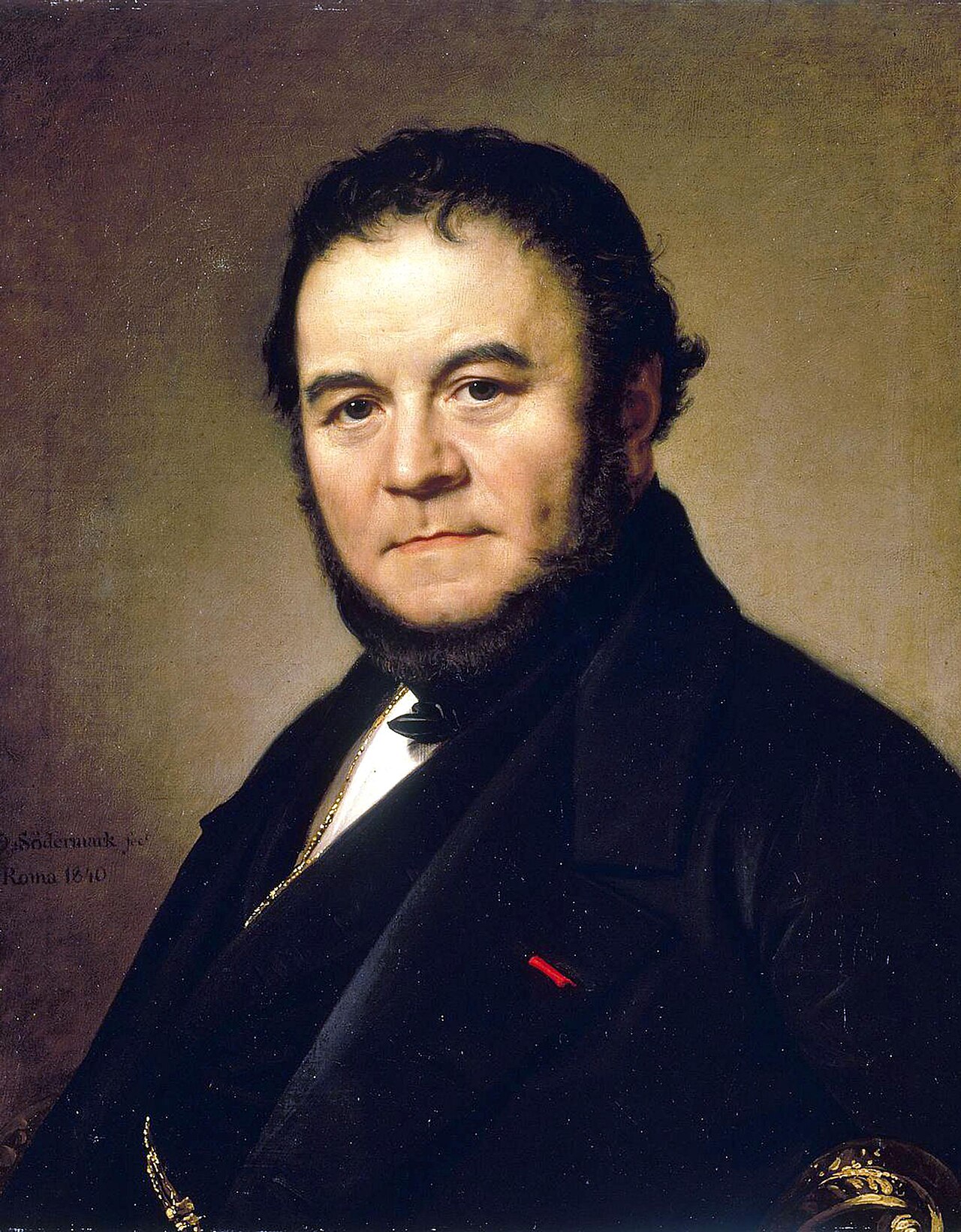
Stendhal
1783–1842 · France
“A novel is a mirror carried along a high road.”
Peak-work percentile in the canon.
The lineage through Stendhal
Drew From(1)
who shaped Stendhal
via Confessions
- To understand Julien Sorel, read the book Julien reads: Rousseau's Confessions is the one volume that shapes his imagination, his pride, even his love affair
- Stendhal names it outright — Julien's "horror of eating with the servants" is lifted from Rousseau, his entire sense of wounded merit borrowed from it
- The Red and the Black is in part a study of what the Confessions did to the young men who took it as scripture
Inspired(1)
who Stendhal shaped
via War and Peace
- Tolstoy said he learned how to write war from Stendhal — by his own account, The Charterhouse of Parma taught him how battle actually feels on the page
- Stendhal's Waterloo — confused, fragmentary, seen by a bewildered boy who never grasps the larger picture — is the direct model for Tolstoy's Borodino
- The antiheroic philosophy of War and Peace, its refusal of grand strategy and heroic clarity, traces back to Stendhal's irony
Famous Quotes
“A novel is a mirror carried along a high road. At one moment it reflects to your vision the azure skies, at another the mire of the puddles at your feet.”
“And the man who carries this mirror in his pack will be accused by you of being immoral! His mirror shews the mire, and you blame the mirror!”
“Politics in a work of literature are like a pistol-shot in the middle of a concert, something loud and vulgar and yet a thing to which it is not possible to refuse one's attention.”
“To the Happy Few”
About Stendhal
French writer (born Marie-Henri Beyle) whose novels The Red and the Black and The Charterhouse of Parma pioneered psychological realism in fiction. An admirer of Napoleon and Italian culture, he served in Napoleon's campaigns and spent much of his life in Italy. His penetrating analysis of ambition, love, and hypocrisy anticipated the modern novel.