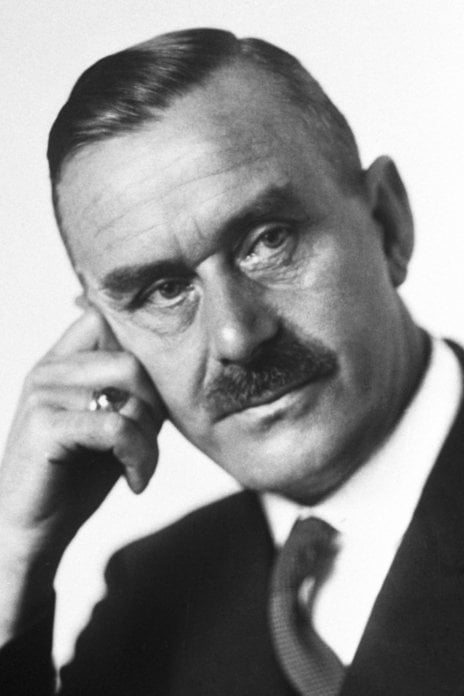
Thomas Mann
1875–1955 · Germany
“My son, attend with zeal to thy business by day; but do none that hinders thee from thy sleep by night.”
Peak-work percentile in the canon.
The lineage through Thomas Mann
Drew From(2)
who shaped Thomas Mann
via Anna Karenina
- The treatment of Tony Buddenbrook openly resembles Tolstoy's Anna Karenina, but from a more ironic, less tragic angle, where Anna is destroyed, Tony survives, battered, to the last page.
- Mann revered Tolstoy as a chief source of his artistic formation, and the portrait of a woman crushed by family obligation and shifting social norms is lifted from the realist tradition Anna Karenina defined.
via Madame Bovary
- Buddenbrooks is an instance of French style, Flaubert's, moving into German: Mann adopts the affective interiority and the leitmotif technique of Madame Bovary to render his decaying family from the inside.
- Tony Buddenbrook openly resembles Emma Bovary, the realist heroine trapped in marriages of convenience, but Mann is Flaubert's opposite in attitude, where Flaubert is cool and pitiless, Mann loves Tony in spite of her folly.
Portraits
The official Nobel Foundation laureate portrait from the year Mann won the 1929 Literature prize — the image Wikidata uses as his primary likeness and the one most reprinted.
Nobel Foundation, 1929
Philipp Kester's 1906 Munich portrait (Münchner Stadtmuseum) of Mann holding a book, just after Buddenbrooks made his name — the defining young-author likeness.
Philipp Kester, 1906
An early-career photographic portrait of the young Mann — a clean, formal alternate to the c. 1900 and 1906 sittings.
Companion to Van Vechten's 1937 LoC sitting — the elegant 'man of letters' pose with hat, gloves, and cigar that fixed Mann's dapper public image.
Carl Van Vechten, 1937
Famous Quotes
And—and—what comes next?
gain he had learned that beauty can pierce one like a pain, and that it can sink profoundly into shame and a longing despair that utterly consume the courage and energy necessary to the life of every day.
"I shall live!" said Thomas Buddenbrook, almost aloud, and felt his breast shaken with inward sobs.
hat is success? It is an inner, an indescribable force, resourcefulness, power of vision; a consciousness that I am, by my mere existence, exerting pressure on the movement of life about me.
About Thomas Mann
German novelist and essayist, widely regarded as the foremost German writer of the twentieth century. Born into a patrician merchant family in the Baltic trading city of Lübeck, Mann turned his own dynasty's decline into his first novel, Buddenbrooks (1901), a panorama of three generations that made him famous at twenty-six. He spent his most productive years in Munich, refining the recurring subject of his fiction: the tension between the disciplined bourgeois citizen and the morbid, fascinating artist, treated with elaborate symbolism and a cool, pervasive irony. Death in Venice (1912) and The Magic Mountain (1924) confirmed his stature, and in 1929 he won the Nobel Prize in Literature, cited principally for Buddenbrooks. He acknowledged a deep, ambivalent debt to Schopenhauer, Nietzsche, and Wagner. When the Nazis came to power in 1933 Mann went into exile; his German citizenship was revoked in 1936, and he settled in the United States, becoming a citizen in 1944 and a leading literary voice against Hitler. He wrote Doctor Faustus (1947) abroad and died near Zürich in 1955.