
Read this if you…
- want an book who's characters resemble real life people
- Like a story about family dynamics
- Are interested in the idea that becoming self-aware can atrophy your will
Skip this if you…
- want a single through-line for plot
- want a happy book
The  Take
Take
Awesome book, starts a little slow and confusing and then is incredibly insightful, funny, ironic, poignant and intellectual.
Feels Tolstoy like in his ability to notice and describe the realities of life and how people ACTUALLY think, mixed with a thesis around how “civilizing” or becoming more interesting/artistic/introspective commonly atrophies the will
Tony is a great character who is both the least self-aware yet deserving of pity
The lineage through Buddenbrooks
- Anna Karenina by Leo Tolstoy. Buddenbrooks built on it. - The treatment of Tony Buddenbrook openly resembles Tolstoy's _Anna Karenina_, but from a more ironic, less tragic angle, where Anna is destroyed, Tony survives, battered, to the last page. - Mann revered Tolstoy as a chief source of his artistic formation, and the portrait of a woman crushed by family obligation and shifting social norms is lifted from the realist tradition _Anna Karenina_ defined.
- War and Peace by Leo Tolstoy. Buddenbrooks built on it. - _Buddenbrooks_ is young Mann reaching for Tolstoy's scale: a generational family saga built on the sweeping-epic ambition and obsessive attention to domestic texture he learned from the Russian master. - Mann revered Tolstoy as a chief source of his artistic formation, and the resemblance is structural as well as tonal, the novel's opening family gathering echoes the society soirée that opens _War and Peace_.
- Madame Bovary by Gustave Flaubert. Buddenbrooks built on it. - _Buddenbrooks_ is an instance of French style, Flaubert's, moving into German: Mann adopts the affective interiority and the leitmotif technique of _Madame Bovary_ to render his decaying family from the inside. - Tony Buddenbrook openly resembles Emma Bovary, the realist heroine trapped in marriages of convenience, but Mann is Flaubert's opposite in attitude, where Flaubert is cool and pitiless, Mann loves Tony in spite of her folly.
Depicted in Art
The oldest known photograph of the Mengstraße merchant house in Lübeck — the actual home of Thomas Mann's grandparents that the novel is set in, its rococo gabled facade rising over the street.
1870
The Lübeck market square in 1870, the Gothic town hall and merchant gables crowded with townsfolk and stalls — the civic heart of the Hanseatic city the Buddenbrooks rule over.
Cornelis Springer, 1870
Lübeck's market square in 1886, the brick town hall and stepped gables under a soft Northern sky with figures moving among the stalls — the public stage of the city's merchant elite.
August Fischer, 1886
Recommended Editions

John E. Woods
Vintage International · 1994
The Woods translation is the one to start with. It is closer to Mann's earth-bound style and far better in dialogue than the old Lowe-Porter, and this affordable in-print paperback is the default English Buddenbrooks. One quirk: Woods renders the Bavarian Permaneder in broad American hick speech, which a few readers find grating.
Please support us by purchasing through these links, at no extra cost to you!
Notable Quotes
My son, attend with zeal to thy business by day; but do none that hinders thee from thy sleep by night.
Screen & Stage

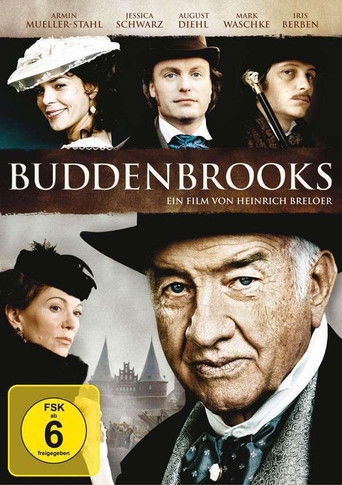
Posters via The Movie Database (TMDB)
Faulkner considered Buddenbrooks the greatest novel of the twentieth century.