
Read this if you…
- want context for pretty much the rest of Western ethics
- want the "Down to Earth" Greek Philosopher's best work
- have read Plato and want to see how his greatest student Differs
Skip this if you…
- don't care about ancient peoples well-thought out views on how to live a flourishing life
Why It Matters
Aristotle built the most influential ethical system the West has. His big idea is that virtue is a habit you build by practice, not a rule you obey, and that the good life is about finding the right balance instead of going to extremes. The "golden mean" comes straight from here. Philosophers, theologians, and self-help writers have been restating him ever since.
The  Take
Take
Great philosophical discussion on leading a flourishing life, amazing for a book that’s 2300+ years old
The lineage through The Nicomachean Ethics
- The Republic by Plato. The Nicomachean Ethics built on it. - The *Ethics* defines itself against the *Republic* from its opening pages - Aristotle, Plato's pupil of twenty years, names the *Republic*'s 'Idea of the Good' in Book 1.6 and takes it apart — the good is too many different things to be a single Form, and no use to a doctor or carpenter even if it were - Read the *Republic* first to meet the claim Aristotle is refuting: his empirical, this-worldly ethics is a direct answer to Plato's transcendent one
- The Odyssey by Homer. The Nicomachean Ethics built on it. - Aristotle illustrates his doctrine of the mean with a line from the *Odyssey* — steer clear of the worse hazard — turning Homer's navigation into a rule for ethical choice - The Scylla-and-Charybdis predicament becomes the model for picking the lesser of two vices - A small but telling debt: the philosopher anchors his ethics in the poet everyone in his audience already knew
- The Iliad by Homer. The Nicomachean Ethics built on it. - Aristotle assumes you know your Homer — he quotes the *Iliad* directly to ground his discussion of virtue - Priam is his go-to example for what wrecks a happy life; the courage of Hector and Diomedes illustrates his account of bravery - Reading the *Iliad* first means these aren't abstract citations — you've already met the men Aristotle is using to make his point
- The Divine Comedy by Dante Alighieri. The Nicomachean Ethics shaped it. - Aristotle drew the floor plan of Dante's Hell - In *Inferno* 11, Virgil pauses the descent to cite the *Ethics* by name — Book VII's three dispositions Heaven opposes (incontinence, malice, "mad brutishness") become the literal ordering of the lower circles - The sins of weakness sit higher, the sins of violence and fraud lower — a moral map Dante took straight from Aristotle's account of vice
- The Consolation of Philosophy by Boethius. The Nicomachean Ethics shaped it. - Boethius didn't just read Aristotle — he translated him and wrote commentaries on him, then put the *Ethics* to work in prison - Book III of the *Consolation* reworks the *Ethics*' opening argument directly: that wealth, honor, and power are false goods that never satisfy, and that every road is really chasing one complete good - Aristotle's eudaimonia is the destination Lady Philosophy leads Boethius back toward
- Leviathan by Thomas Hobbes. The Nicomachean Ethics shaped it. - Hobbes built part of *Leviathan* by naming Aristotle and tearing him down - He flatly rejects the *Ethics*' central claim: "There is no such Finis ultimus nor Summum Bonum as is spoken of in the old books of the old moral philosophers" — happiness, for Hobbes, is "a continual progress of the desire, from one object to another" - Influence by opposition: the *Ethics*' final good is the exact target Hobbes sets up to demolish
- The Works of Cicero by Marcus Tullius Cicero. The Nicomachean Ethics shaped it. - Cicero names the *Nicomachean Ethics* outright in *De Finibus*, even pausing to debate whether Aristotle or his son Nicomachus actually wrote it - The teaching of the *Ethics* runs visibly through *De Finibus*, especially Book II, where Cicero works through Peripatetic theories of virtue - Even the gesture is borrowed: Cicero casts *De Officiis* as a father-to-son ethics, mirroring Aristotle's dedication to Nicomachus
Depicted in Art
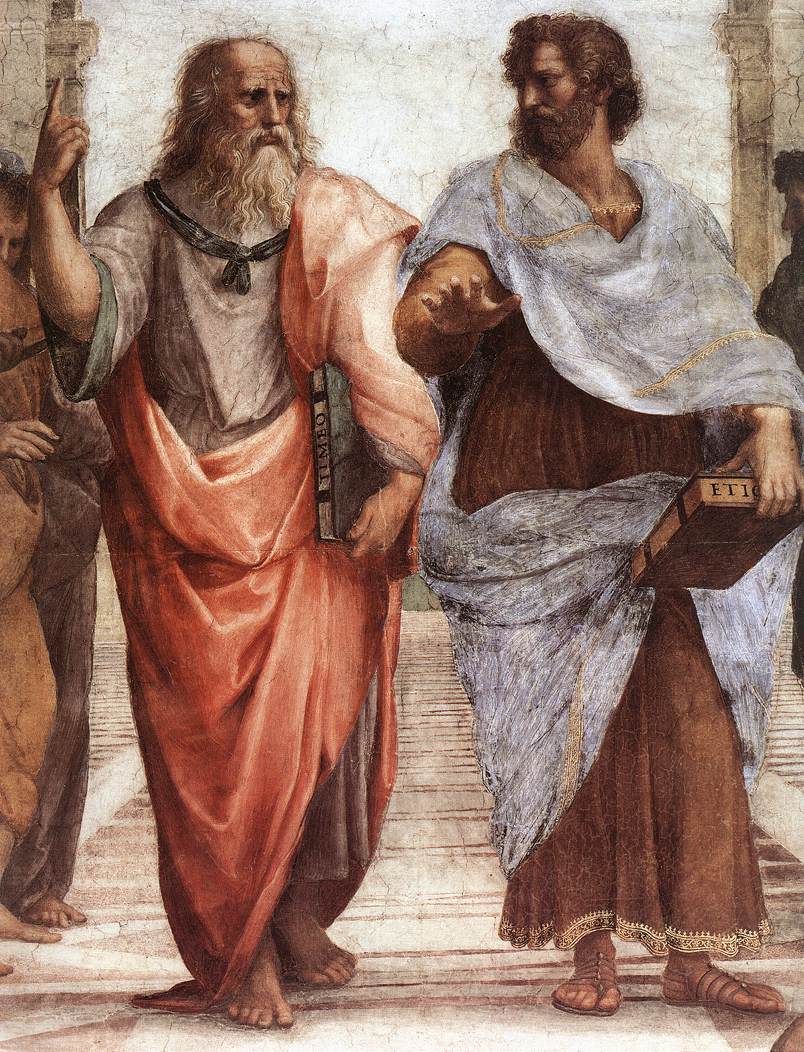
Aristotle, in blue and brown, walks beside Plato beneath classical arches; he gestures down toward the earth while Plato points up.
Raphael, 1511
Aristotle in scholar's robes seated at a lectern, an open book before him, head turned in profile in mid-thought.
Justus van Gent and Pedro Berruguete, 1476
A vast classical hall of philosophers; Socrates stands in olive-green robe at left, counting arguments on his fingers to a circle of listeners.
Raphael, 1511
Aristotle in a draped robe leans forward gesturing with a scroll toward the boy Alexander, who sits on an ornate throne with a helmet and arms at his feet.
Jean-Léon Gérôme Ferris, 1895
Recommended Editions

Roger Crisp
Cambridge University Press · 2014
Crisp writes the cleanest English of the three. The argument about eudaimonia, virtue, and the mean tracks page by page, and the Cambridge intro situates Aristotle against modern ethics without academic fog.
Terence Irwin
Hackett Publishing · 2019

Please support us by purchasing through these links, at no extra cost to you!
Deep Dive
What It's About
This summary gives away plot details.
Notable Quotes
“We are what we repeatedly do. Excellence, then, is not an act, but a habit.”
“It is the mark of an educated mind to be able to entertain a thought without accepting it.”