
The Brothers Karamazov
Read this if you…
- want Dostoevskys magnum opus
- want a frenetic, shit-show plot
- are interested in philosophical discussion of BIG themes such as faith, reason, freedom
Skip this if you…
- don't want to love a book that everyone else says they love too often
- don't want Dostoevsky's most overtly religious and philosophical novel
- want a happy positive book
The  Take
Take
Lives up to the hype.In classic Dostoevsky fashion, yet even moreso than his other works, this novel is a dark, entertaining , and frenetic shit show of a plot interspersed with some of the deepest psycho-spiritual insights I have ever read.The philosophical insights come from both specific passages and also the whole. The main through line is existential angst and its moral implications for living one’s life.Really looks at human motives from a variety of angles.
The lineage through The Brothers Karamazov
- The Gospels by Matthew. The Brothers Karamazov built on it. - The book opens on John 12:24 — the grain of wheat that dies to bear fruit — and Zosima's faith in suffering as the road to life is built on that line - "The Grand Inquisitor" is a direct restaging of the wilderness temptation in Luke 4: bread, miracle, and earthly power offered to Christ - Dostoevsky knew the Gospels by heart from four years' exile; reading them first lets you hear how closely Ivan and Alyosha are arguing over the same text
- Job by Unknown. The Brothers Karamazov built on it. - The seed Elder Zosima carries — he tells of first hearing *Job* read in church as a boy, "the seed of God's word" planted in his heart - Dostoevsky named *Job* a lifelong touchstone, and that Book VI episode is his own memory; the novel's whole quarrel over innocent suffering grows out of it - Read *Job* first and Zosima's meditation lands as a response to the oldest version of the question, not a sermon out of nowhere
- Don Quixote by Miguel de Cervantes Saavedra. The Brothers Karamazov built on it. - The narrator who keeps butting in, the stories folded inside the story — that machinery is borrowed from Cervantes, whom Dostoevsky studied closely - He wrote about *Don Quixote* with open reverence, calling out Cervantes' grasp of the human heart - Read Quixote and the comic, intrusive voice running under Karamazov's tragedy reveals its source — Dostoevsky is working a Cervantine inheritance
- Faust, First Part by Johann Wolfgang von Goethe. The Brothers Karamazov built on it. - Ivan's hallucinated devil is Goethe's Mephistopheles in shabby Russian dress — a tempter reworked for the modern unbeliever - Dostoevsky knew *Faust* cold (he read it in German at seventeen) and built Ivan as "a Russian Faust," the man whose intellect becomes his damnation - Read Goethe first and the devil chapter snaps into focus — you can hear Mephistopheles behind every line
- The Origin of Species by Charles Darwin. The Brothers Karamazov built on it. - Darwin's struggle for existence is one of the forces this novel pushes against — Dostoevsky knew the theory well enough to grant 'man's descent from the ape' - The recurring 'viper will eat viper' imagery and the Grand Inquisitor's reduction of man to animal trace directly to *Origin of Species* - Reading Darwin first sharpens the stakes: this is faith answering the book that made man a beast competing to survive
- Les Misérables by Victor Hugo. The Brothers Karamazov built on it. - Behind Zosima's mercy and the courtroom's reckoning stands Hugo: Dostoevsky prefaced the Russian *Les Misérables* and named its theme the great idea of the century - The restoration of the fallen person — crushed by circumstance, redeemed through suffering — is the frame *Karamazov* inherits and deepens - Read *Les Misérables* first and you see the social-justice and grace that Dostoevsky carried into a darker, more interior key
- The Interpretation of Dreams by Sigmund Freud. The Brothers Karamazov shaped it. - Freud reached for Dostoevsky inside *The Interpretation of Dreams* itself, naming *The Brothers Karamazov* one of "three masterpieces of the literature of all time" - He bracketed it with *Oedipus Rex* and *Hamlet* as works that "deal with the same subject, parricide" — the killing of the father he placed at the center of the psyche - Dostoevsky dramatized the murderous son before Freud had a theory for it; the novel became evidence in the new science of the mind
Depicted in Art
Elder Ambrose in monastic robe and skoufia, frail-faced, hand at chest — the Optina starets who counseled Dostoevsky in 1878.
Dostoevsky sits hunched in a dark coat, hands clasped, gaze turned inward — a closed, brooding figure isolated against a featureless background.
Vasily Perov, 1872
Drawing made the day Dostoevsky died — the writer in profile, eyes closed, face still composed against the pillow.
Ivan Kramskoi, 1881
Pencil drawing of the 26-year-old Dostoevsky — slender, intent, drawn by a classmate from the Military Engineering Academy a few years before his arrest.
Konstantin Trutovsky, 1847
Pilate, hand on hip, confronts a shadowed Christ pressed against a stone wall; harsh light slashes between them.
Nikolai Ge, 1890
A page of Dostoevsky's handwritten notes for the fifth book of Karamazov — dense Cyrillic script, marginalia, crossings-out.
Fyodor Dostoevsky, 1879
A barefoot Christ sits hunched on a stony desert ridge at dawn, hands knotted between his knees, weighing temptation.
Ivan Kramskoi, 1872
A dusty crowd surges down a Russian road behind icon-bearing priests; peasants, beggars, soldiers, and pilgrims press together under the heat.
Ilya Repin, 1883
Pope Sixtus IV listens as the black-robed Dominican Grand Inquisitor reads to him — the historical Spanish Inquisition that Ivan's 'Grand Inquisitor' poem evokes.
Jean-Paul Laurens, 1882
A lone peasant in a torn kaftan and bast shoes stands on a snowy forest road in winter, gazing at nothing, sunk in thought.
Ivan Kramskoi, 1876
Recommended Editions

Constance Garnett
Modern Library · 1912
Fast, clean, and slightly Victorian. Garnett loses some of Dostoevsky's fever but keeps the pages turning, which counts in a 700-page novel. Every major English novelist of the early 20th century read this one.
Please support us by purchasing through these links, at no extra cost to you!
Notable Quotes
If God does not exist, everything is permitted.
Screen & Stage
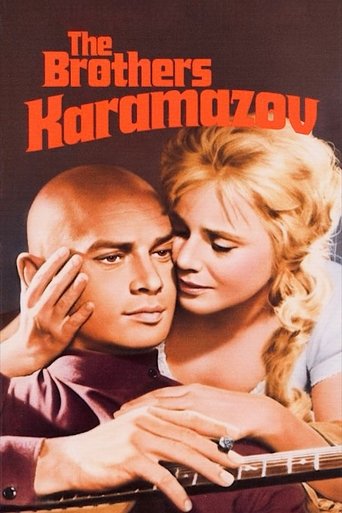
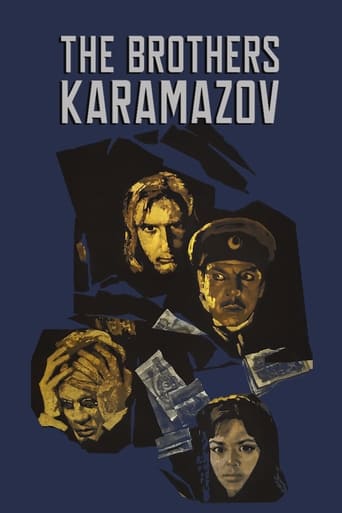
Posters via The Movie Database (TMDB)
- Albert Einstein, theoretical physicist, 1879–1955: Held it the supreme summit of all literature — saying Dostoevsky gave him more than any scientist, more than Gauss.
- Sigmund Freud, founder of psychoanalysis, 1856–1939: "The Brothers Karamazov is the most magnificent novel ever written."
- Ernest Hemingway, novelist, 1899–1961: "In Dostoevsky there were things unbelievable and not to be believed, but some so true they changed you as you read them."
- William Faulkner, novelist, 1897–1962: One of the few books Faulkner reread again and again, ranking Dostoevsky beside Shakespeare and the Bible.
- Kurt Vonnegut, American novelist, 1922–2007: "Everything there was to know about life was in The Brothers Karamazov. ‘But that isn’t enough any more,’ said Rosewater."
- Virginia Woolf, novelist & critic, 1882–1941: "The novels of Dostoevsky are seething whirlpools, gyrating sandstorms, waterspouts which hiss and boil and suck us in."
- Albert Camus, novelist & philosopher, 1913–1960: Made Ivan Karamazov's revolt the founding text of The Rebel, calling Dostoevsky — not Marx — the true prophet of the century.
- David Foster Wallace, American novelist & essayist, 1962–2008: "Dostoevsky possessed degrees of passion, conviction, and engagement with deep moral issues that we, here today, do not permit ourselves."
- James Joyce, novelist, 1882–1941: "He is the man more than any other who has created modern prose, and intensified it to its present-day pitch."
- Ludwig Wittgenstein, philosopher, 1889–1951: Knew long passages by heart and carried the novel with him to the front in the First World War.
- Jordan Peterson, psychologist, author, 1962–: Has called it the greatest book ever written, lecturing on the Grand Inquisitor as the deepest case ever made against God.
- Nicolas Cage, actor, filmmaker, 1964–: Names Dmitri Karamazov his favorite character in all of literature — ‘I was very Dmitri Karamazov in high school.’
- Franz Kafka, novelist, 1883–1924: Counted himself and Dostoevsky ‘blood relatives,’ the warring fathers and sons of Karamazov feeding straight into The Trial.
- Cormac McCarthy, American novelist, 1933–2023: Named it among the handful of truly great novels — the books, like Moby-Dick, that face issues of life and death.

More by Fyodor Dostoevsky
- 4The Brothers Karamazov1880Fyodor DostoevskyHard·Epic·912 pagesInfluence76Popularity90The Age of the NovelNovelRussian
- 28The Idiot1869Fyodor DostoevskyHard·Epic·732 pagesInfluence54Popularity49The Age of the NovelNovelRussian
- 47Devils1872Fyodor DostoevskyHard·Epic·704 pagesInfluence53Popularity48The Age of the NovelNovelRussian
- 76Notes from Underground1864Fyodor DostoevskyHard·Quick·136 pagesInfluence52Popularity78The Age of the NovelNovelRussian
- 85Crime and Punishment1866Fyodor DostoevskyHard·Long·560 pagesInfluence77Popularity94The Age of the NovelNovelRussian