1 Maccabees
This is where the Hanukkah story comes from, the Jewish festival of lights.
Read this if you…
- want the historical backstory behind Hanukkah and the Temple rededication
- curious about Jewish guerrilla warfare against the Seleucid Greeks (175–134 BCE)
- like Apocrypha books that read like straight military chronicle, not theology
Skip this if you…
- don't want to read explicitly religious/Christian texts
Why It Matters
This is where the Hanukkah story comes from, the Jewish festival of lights. It's an account of religious resistance against cultural imperialism, and that has spoken to pretty much every later generation facing persecution for their faith.
Where to go next
- The Divine Comedy by Dante Alighieri. 1 Maccabees shaped it. - Judas Maccabeus, the warrior-hero of *1 Maccabees*, climbs all the way to Dante's heaven - In *Paradiso* XVIII he shines as "il gran Maccabeo" in the Sphere of Mars, among the warriors of faith — Joshua, Charlemagne, Roland, Godfrey - Dante took the figure straight from the Maccabees narrative and set him in eternal light
Depicted in Art
Judas Maccabeus stands in armor as a full-length heroic figure, sword in hand, set against a darkened battlefield ground.
Andrea Vicentino
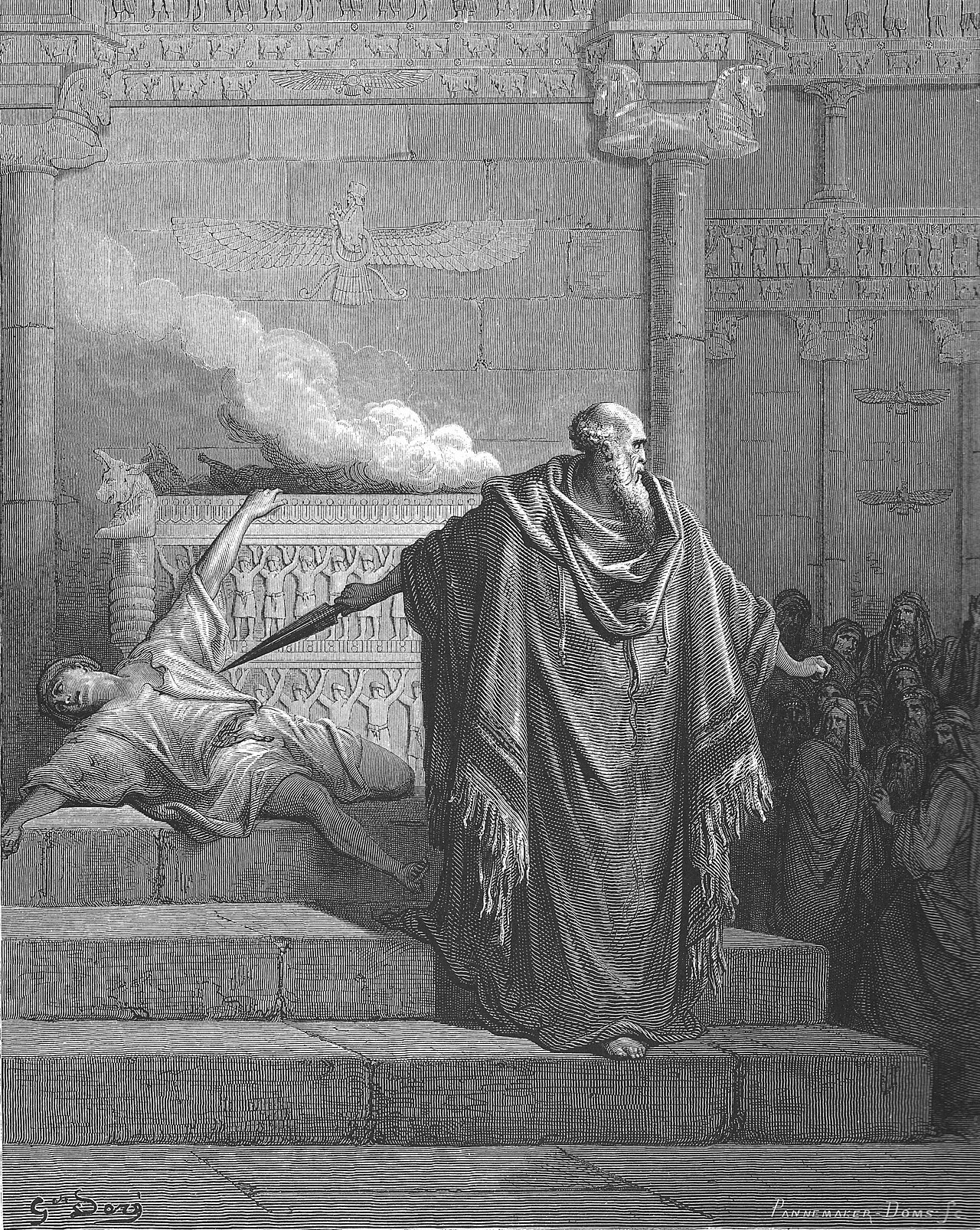
The priest Mattathias raises his sword over a Jew who has stepped forward to sacrifice on the pagan altar at Modein, while a Seleucid officer recoils and onlookers scatter.
Gustave Doré, 1866
Judas stands in the foreground rallying his outnumbered troops as the vast army of Nicanor advances on the hill opposite; banners and spears bristle on both sides.
Gustave Doré, 1866
Recommended Editions

King James Version
Cambridge University Press · 1611
The most influential and commonly quoted translation in English. The prose rhythm everyone else is responding to, even modern translations.
Please support us by purchasing through these links, at no extra cost to you!
Deep Dive
What It's About
This summary gives away plot details.
Notable Quotes
“Moreover Judas and his brethren with the whole congregation of Israel ordained, that the days of the dedication of the altar should be kept in their season from year to year by the space of eight days, from the five and twentieth day of the month Casleu, with mirth and gladness.”
“For the victory of battle standeth not in the multitude of an host; but strength cometh from heaven.”
More by Unknown
- Job
c. 500 BCE · Wisdom
- Esther
c. 400 BCE · Scripture — Narrative
- Tobit
c. 200 BCE · Scripture — Narrative
- 1 Esdras
c. 150 BCE · Scripture — Narrative
- Prayer of Manasses
c. 150 BCE · Lyric
- 2 Maccabees
c. 124 BCE · Scripture — Narrative
- Judith
c. 100 BCE · Scripture — Narrative
- 2 Esdras
c. 100 · Apocalyptic
- Beowulf
c. 1000 · Epic
- The Song of Roland
c. 1100 · Epic
- The Nibelungenlied
c. 1200 · Epic
- The Poetic Edda
c. 1270 · Epic