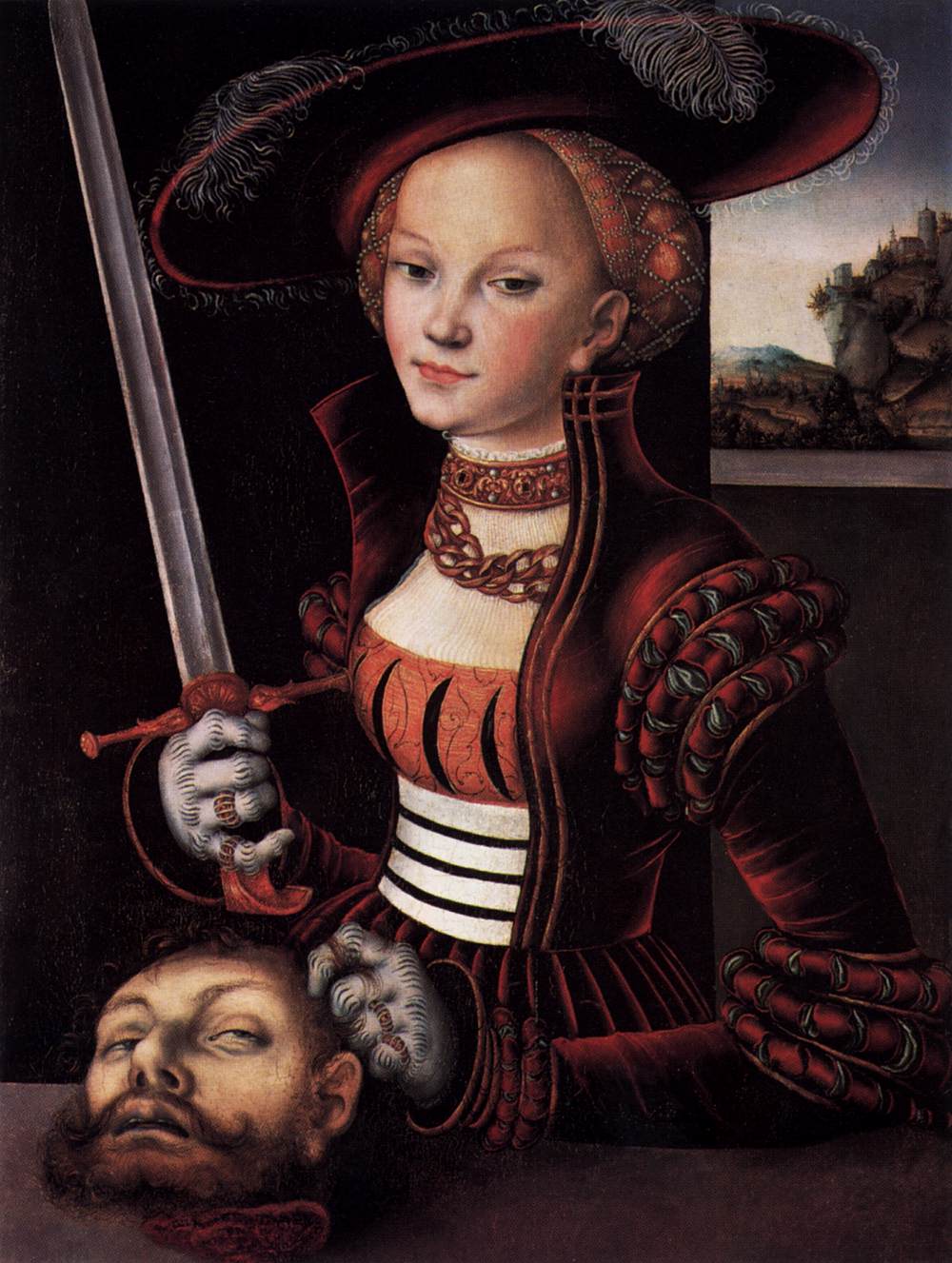
Judith
Judith is the most dramatic woman in the Bible: brave, smart, and coldly effective.
Read this if you…
- want a deuterocanonical book where the heroine seduces and beheads an enemy general — Caravaggio painted this scene, twice
- like a Jewish Esther turned up to eleven: more violence, more cunning, more drinking
- care about Apocrypha that didn't survive the Protestant cut but stayed in Catholic and Orthodox Bibles
Skip this if you…
- don't want to read explicitly religious/Christian texts
Why It Matters
Judith is the most dramatic woman in the Bible: brave, smart, and coldly effective. Her story turned into one of the favorite subjects of Renaissance and Baroque painting, taken up by Caravaggio, Artemisia Gentileschi, and Klimt.
Where to go next
- The Canterbury Tales by Geoffrey Chaucer. Judith shaped it. - The beheading echoes down to Chaucer: in the Monk's Tale, the fall of Holofernes is founded directly on the Book of *Judith* - Chaucer names Judith as the woman who slays the sleeping general — the same scene, recast as a tragedy of fortune's wheel - One of the oldest stories here gets pulled into England's first great poem as a cautionary exemplum
- The Divine Comedy by Dante Alighieri. Judith shaped it. - Dante seats this book's heroine among the blessed in Paradise - Judith appears by name in *Paradiso* XXXII, in the celestial White Rose alongside Sarah, Rebecca, and Ruth as St. Bernard names the Old Testament women - Her victim Holofernes goes the other way — fixed among Dante's exempla of fallen pride
Depicted in Art
Judith grips Holofernes by the hair and saws through his neck mid-stroke as he screams; the maidservant Abra watches with a sack ready.
Caravaggio, 1599
Judith and her maid pin Holofernes to the bed and behead him together; blood spurts across the sheets in arcs.
Artemisia Gentileschi, 1620
Judith stands richly dressed in courtly Saxon costume, sword in one hand and Holofernes' head on a table, gazing directly at the viewer.
Lucas Cranach the Elder, 1530
Judith in a feathered hat and slashed-sleeve dress holds Holofernes' bearded head by the hair against a dark ground.
Lucas Cranach the Elder, 1530
Judith — a presumed self-portrait — stands beside her maid presenting Holofernes' severed head on a tray.
Fede Galizia, 1596
Recommended Editions

King James Version
Cambridge University Press · 1611
The most influential and commonly quoted translation in English. The prose rhythm everyone else is responding to, even modern translations.
Please support us by purchasing through these links, at no extra cost to you!
Deep Dive
What It's About
This summary gives away plot details.
Notable Quotes
“Behold the head of Holofernes, the chief captain of the army of Assur, and behold the canopy, wherein he did lie in his drunkenness; and the Lord hath smitten him by the hand of a woman.”
“And she smote twice upon his neck with all her might, and she took away his head from him.”
More by Unknown
- Job
c. 500 BCE · Wisdom
- Esther
c. 400 BCE · Scripture — Narrative
- Tobit
c. 200 BCE · Scripture — Narrative
- 1 Esdras
c. 150 BCE · Scripture — Narrative
- Prayer of Manasses
c. 150 BCE · Lyric
- 2 Maccabees
c. 124 BCE · Scripture — Narrative
- 1 Maccabees
c. 100 BCE · Scripture — Narrative
- 2 Esdras
c. 100 · Apocalyptic
- Beowulf
c. 1000 · Epic
- The Song of Roland
c. 1100 · Epic
- The Nibelungenlied
c. 1200 · Epic
- The Poetic Edda
c. 1270 · Epic