The Decameron
 Giovanni Boccaccioc. 1351
Boccaccio gathered 100 stories told by young people fleeing the Black Death and built the blueprint for the framed story collection.
Read this if you…
- want 100 short stories that are dirty, trashy, low-brow
- want the precursor to chaucer's canterbury tales
- want to read about cucks, and people who cheat etc
Skip this if you…
- don't like dirty/sexual humor (cucks, horny priests, sex stuff generally)
Why It Matters
Boccaccio gathered 100 stories told by young people fleeing the Black Death and built the blueprint for the framed story collection. The Decameron proved vernacular prose could hit as hard as poetry, and its blunt treatment of sex, class, and human cunning fed Chaucer, Shakespeare, and the whole European novella tradition. It's the book that shows storytelling is how people get through catastrophe.
The  Take
Take
Awesome collection of medieval stories. Similar to Arabian nights (which I like better if I were to compare ). Decameron is very low brow and dirty mostly, wild for such a time
Where to go next
- The Divine Comedy by Dante Alighieri. The Decameron built on it. - Boccaccio was Dante's first great champion — he copied the *Commedia* by hand, wrote his biography, and gave the poem the name "Divine" - The *Decameron*'s 100 novelle deliberately answer the *Commedia*'s 100 cantos: a "human comedy" set against the divine one - Read Dante first and Boccaccio's design comes clear — the same scale and structure, turned from the afterlife back toward the flesh-and-blood world
- The Golden Ass by Apuleius. The Decameron built on it. - Two of the *Decameron*'s sharpest sex comedies were lifted, almost intact, from Apuleius's *The Golden Ass* - Boccaccio didn't stumble on them — he found the Monte Cassino manuscript, annotated it, and copied out the entire text by hand - Read the tub trick (VII.2) and the fuller's wife (V.10) in Apuleius first, and you'll watch the medieval frame-tale reach back a thousand years to borrow its filth wholesale
- Metamorphoses by Ovid. The Decameron built on it. - Boccaccio learned his trade on Ovid in Naples, and contemporaries called him "the Italian Ovid" - Reading the *Metamorphoses* first tunes your ear to what the *Decameron* does with love — the same ironic, transforming desire, now dressed in plague-time Florentine clothes - Not the closest source (Apuleius and the fabliaux are nearer), but the Ovidian *love-and-change* matter is woven through the framing and the tales
- All's Well That Ends Well by William Shakespeare. The Decameron shaped it. - Boccaccio's tale of Giletta di Narbona (Day 3, Novella 9) is the whole skeleton of *All's Well* — the king's miraculous cure, the spurned husband, the bed-trick - Shakespeare reached it through William Painter's English *Palace of Pleasure*, the standard route for Italian tales into Elizabethan drama - One of the *Decameron*'s stories handed Shakespeare a complete, ready-made plot
- The Canterbury Tales by Geoffrey Chaucer. The Decameron shaped it. - Boccaccio built the machine Chaucer would borrow: a company of people, thrown together, taking turns telling stories - That frame — and roughly a quarter of Chaucer's individual tales — turns up again in *The Canterbury Tales* a half-century later - *The Decameron* is the Italian original behind the most famous storytelling-contest in English
- Cymbeline by William Shakespeare. The Decameron shaped it. - Boccaccio's wager tale is the engine of *Cymbeline*'s plot - Day 2, Story 9 — Bernabò bets on his wife's virtue, and Ambrogiuolo cheats to win it — is the direct source for Iachimo's slander of Imogen - Even the proof carries over: the villain hides in the bedchamber and reports a private mark on the heroine's body, just as Boccaccio's schemer does
- Selected Poems by John Dryden. The Decameron shaped it. - Boccaccio's tales kept getting picked up and retold for centuries — Dryden is one of the last great translators to mine the *Decameron* directly - In *Fables, Ancient and Modern*, he versified three of these stories — Sigismonda and Guiscardo, Theodore and Honoria, Cymon and Iphigenia — with "Boccace" named right on the title page - See the prose original, then click through to watch a master of the English heroic couplet recast it as verse
Depicted in Art
Nastagio wanders the pine forest of Ravenna and witnesses a naked woman pursued by a horseman and hounds.
Sandro Botticelli, 1483
Young Florentines lounge in a Tuscan garden listening to a storyteller — the brigata that frames the entire book.
John William Waterhouse, 1916
The horseman catches the woman, kills her, and feeds her heart to his hounds while Nastagio looks on in horror.
Sandro Botticelli, 1483
Nastagio's wedding feast under an arched loggia, celebrating his union with the now-yielding noblewoman.
Sandro Botticelli, 1483
Ansaldo leads Dianora through a winter garden made to bloom by magic, courtiers and a magician trailing behind.
Marie Spartali Stillman, 1889
A long frieze-like procession of Florentines pausing under cypress trees in the countryside outside the city.
George Frederic Watts, 1847
Dianora and her attendants enter a winter garden miraculously transformed into spring blossoms — Messer Ansaldo's impossible feat of love.
John William Waterhouse, 1917
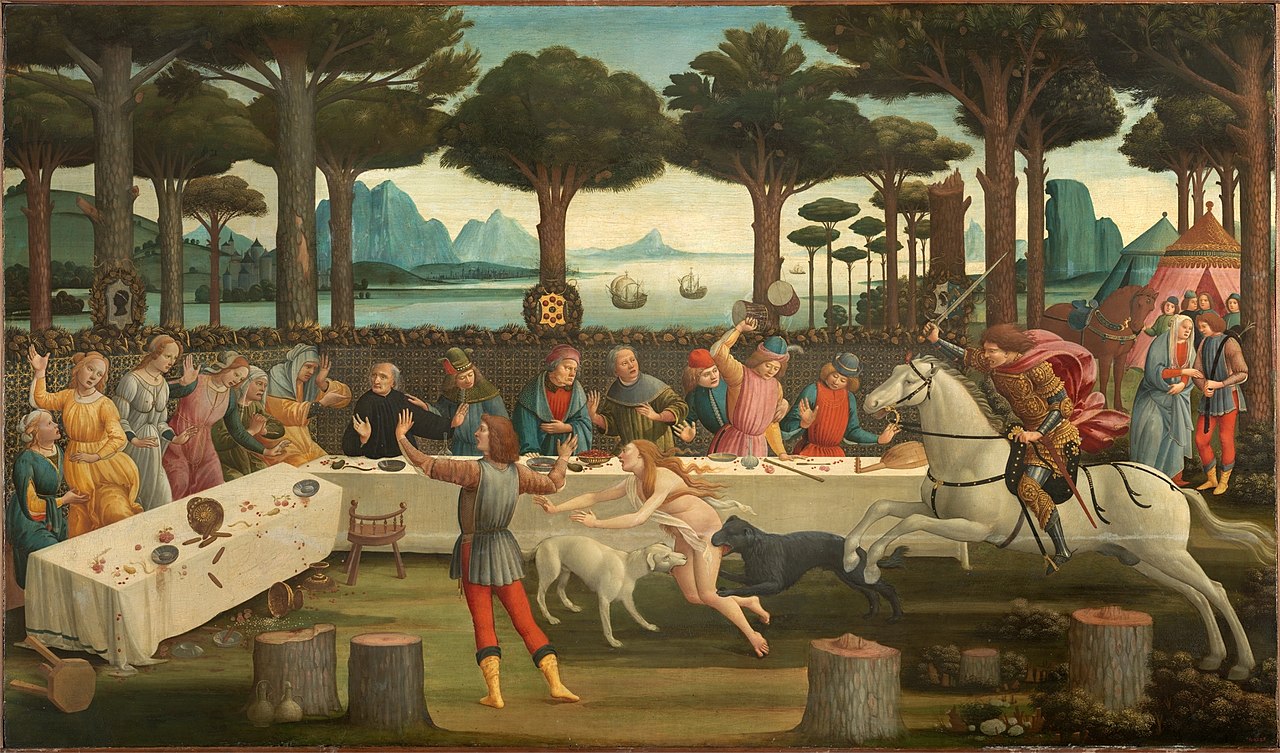
Nastagio stages a banquet in the pine grove so his beloved witnesses the spectral hunt and is moved to accept him.
Sandro Botticelli, 1483
Painted wedding-chest front showing successive Decameron scenes in continuous narrative across a Tuscan landscape.
Workshop of Giovanni Toscani, 1430
Recommended Editions

Wayne A. Rebhorn
W. W. Norton · 2013
Rebhorn's Norton (2013) is the newest complete version and the funniest. The satire reads sharp, the bawdy parts stay bawdy, and the frame story actually moves. Critical essays in back if you want them.


Please support us by purchasing through these links, at no extra cost to you!
Deep Dive
What It's About
This summary gives away plot details.
Notable Quotes
“A kissed mouth doesn't lose its freshness, for like the moon it always renews itself.”
“It is better to do and repent than not to do and repent.”