Metamorphoses
 Ovid8
Ovid8Ovid gathered the myths of the ancient world into one dazzling poem about transformation, gods turning into animals, humans into trees, the world never holding still.
Read this if you…
- want context for pretty much the rest of Western mythological art and literature (Renaissance loved it)
- love ancient Greek/Roman myths
- want one of Shakespeare's biggest influences
- like a bunch of small stories, don't have to commit to whole thing
Skip this if you…
- don't care about greek/roman mythology at all
- need a single prevailing narrative, this is a bunch of short stories basically
- are turned off by dirty myth themes, like rape and murder and such
Why It Matters
Ovid gathered the myths of the ancient world into one dazzling poem about transformation, gods turning into animals, humans into trees, the world never holding still. It was the main source of classical mythology for the whole Middle Ages and Renaissance, feeding Dante, Shakespeare, and Bernini. If you know a Greek myth, you probably know Ovid's version of it.
The  Take
Take
So many classic stories, but a little disjointed and some boring stories in there. The through lines aren’t always there. But still extremely influential and some bangers like narcissus and king Midas
Where to go next
- The Aeneid by Virgil. Metamorphoses built on it. - Buried in Books 13-14 is Ovid's "little *Aeneid*" — Virgil's epic replayed in miniature, bent toward metamorphosis - Reading the *Aeneid* first reveals what Ovid is doing: compressing, re-angling, and quietly competing with the poem that defined Roman epic - The irony only registers if you know the grand original he's playing against
- Theogony/Works and Days by Hesiod. Metamorphoses built on it. - The *Metamorphoses* opens with the world emerging out of Chaos — that cosmogony is straight out of Hesiod's *Theogony* - Ovid knew the *Theogony* exceedingly well and counted Hesiod among his principal sources - Read Hesiod first and Ovid's opening reveals itself as a Roman poet building on the oldest Greek account of how the gods and the world came to be
- The Iliad by Homer. Metamorphoses built on it. - The "little Iliad" at the center of the *Metamorphoses* (Book 12) takes Homer's Trojan War and turns it into a chain of transformations - Ovid keeps the cast and several Homeric lines, then sidelines the famous combat for the odd, marginal stories the *Iliad* left out - Reading Homer first shows you exactly what Ovid is reshaping — and which great scenes he cheekily skips
- The Odyssey by Homer. Metamorphoses built on it. - The *Metamorphoses* picks the *Odyssey* apart for raw material — Circe, the Cyclops, Scylla all surface again, transformed - Ovid retells the voyage sideways, from the perspective of Ulysses' nameless crewmen, so reading Homer first lets you feel what he's twisting - The very title nods back: 'changed shapes' answers Odysseus, the man 'of many turns'
- Medea by Euripides. Metamorphoses built on it. - Book 7's Medea is a tragic palimpsest — Euripides' heroine rewritten underneath Ovid's lines - Her opening soliloquy, weighing passion against reason, echoes the deliberation Euripides put on the Athenian stage - Read the play first and you'll hear the older voice still speaking through Ovid's verse
- On the Nature of Things by Lucretius. Metamorphoses built on it. - Behind Ovid's account of a world in perpetual transformation stands Lucretius's poem of atoms in eternal motion - The closing Pythagoras speech borrows Lucretius's didactic voice and cosmic scope — then bends his materialist physics toward myth, the exact opposite conclusion - Read *On the Nature of Things* first and the *Metamorphoses* reveals itself as a sustained, mythologizing answer to it
- Titus Andronicus by William Shakespeare. Metamorphoses shaped it. - Ovid doesn't just shape *Titus Andronicus* — he walks onto the stage as a physical book - In 4.1, the mutilated Lavinia turns the pages of the *Metamorphoses* to the tale of Philomela and Tereus (Book VI) to name her rape when she can't speak it - Shakespeare lets Ovid's most savage myth — severed tongue, woven revenge — become the literal key to his bloodiest play
- Canzoniere by Francesco Petrarca. Metamorphoses shaped it. - Ovid's Apollo-and-Daphne (Book 1) is the seed of the entire *Canzoniere* — Petrarch rewrites the laurel-into-which-Daphne-flees as Laura, and the *lauro/Laura* pun anchors his whole love sequence - Rvf 23, the "canzone delle metamorfosi," cycles the lover through a chain of Ovidian shape-changes lifted straight from the *Metamorphoses* - Where Ovid told the myths from outside, Petrarch climbs inside one of them and lives there for 366 poems
- The Divine Comedy by Dante Alighieri. Metamorphoses shaped it. - After Virgil, Ovid is Dante's most-used source — and Dante names him in Limbo among the great poets (Inferno IV) - The *Metamorphoses* taught Dante how to write transformation as poetry; in Inferno XXV he stages thieves turning into snakes and openly claims to out-do Ovid at his own art - Scholarly consensus treats the *Metamorphoses* as a primary model standing behind the *Comedy*
- Shakespeare's Sonnets by William Shakespeare. Metamorphoses shaped it. - Ovid was Shakespeare's favorite poet — he met him in Latin at Stratford Grammar School and again in Arthur Golding's 1567 English, the translation he read and borrowed from - The close of *Metamorphoses* Book 15, where Ovid declares his verse will outlast bronze and time itself, is the seed of the *Sonnets*' boldest claim - That immortalizing-power-of-poetry conceit — verse as a defense against decay — Shakespeare takes and reworks into his own thing from Sonnet 60 onward
- The Winter's Tale by William Shakespeare. Metamorphoses shaped it. - Ovid's Pygmalion — the sculptor whose ivory statue warms into living flesh — is the direct source for the climax of *The Winter's Tale* - Shakespeare grafts it onto Greene's romance: Hermione's statue breathes, and Leontes marvels in Ovidian terms — "What fine chisel / Could ever yet cut breath?" - Perdita's flower speech reaches back to Ovid's Proserpina; the play runs on transformation the way the *Metamorphoses* do
- The Tempest by William Shakespeare. Metamorphoses shaped it. - Ovid's most-borrowed gift to Shakespeare — Medea's invocation in Book 7 becomes Prospero's farewell to magic - Prospero's "Ye elves of hills, brooks, standing lakes and groves" is a line-by-line adaptation of Medea's spell, the single most-cited Ovid borrowing in all of Shakespeare - Shakespeare worked from both the Latin and Arthur Golding's 1567 English — when Prospero renounces his art in *The Tempest*, he speaks Ovid's words
- Selected Poems by John Dryden. Metamorphoses shaped it. - Dryden kept coming back to Ovid for a lifetime — Englishing the first book of *Metamorphoses* in 1693 and theorizing translation itself in his Ovid prefaces - His *Fables, Ancient and Modern* (1700) gathers eight verse selections from the poem, including Books 12 and 15 - He called Book 15 "the Master-piece of the whole *Metamorphoses*" — Ovid is the poet Dryden measured his own English against
- A Midsummer Night’s Dream by William Shakespeare. Metamorphoses shaped it. - Ovid's transformations are everywhere in Shakespeare — but in *A Midsummer Night's Dream* the debt is right on the surface - The Act V play-within-a-play, the rude mechanicals' "Pyramus and Thisbe," is a direct adaptation of *Metamorphoses* Book IV - Shakespeare worked from Arthur Golding's 1567 English translation — read Ovid's version of the doomed lovers first, then watch the *Dream* play it for laughs
- The Canterbury Tales by Geoffrey Chaucer. Metamorphoses shaped it. - Ovid was Chaucer's quarry — the *Tales* mine the *Metamorphoses* at the level of named, lifted plots - Ovid's tale of Phoebus and the crow becomes Chaucer's Manciple's Tale; the Midas story is reworked into the Wife of Bath's Tale - The *Metamorphoses* is the storehouse the medieval English poet kept coming back to for ready-made myth
- The Two Gentlemen of Verona by William Shakespeare. Metamorphoses shaped it. - Ovid's shape-shifting sea-god Proteus lent his name and his slippery nature to Shakespeare's fickle lover - The play threads in Ovidian myth throughout — Silvia echoing Philomela through the nightingale, explicit Phaeton allusions - One of the clearest places to watch a young Shakespeare reaching straight for the *Metamorphoses*
- The Taming of the Shrew by William Shakespeare. Metamorphoses shaped it. - Called *Shakespeare's favorite book*, the *Metamorphoses* leaves its strongest traces in his early plays — and the *Shrew* is full of them - The Induction literally hangs Ovid on the walls: paintings of Io and Daphne offered to Christopher Sly - The whole comedy of transformation runs on Ovidian fuel
- The Merry Wives of Windsor by William Shakespeare. Metamorphoses shaped it. - Ovid's Actaeon — the hunter who glimpses Diana and is turned to a stag, then torn apart by his own hounds — is the engine of Shakespeare's climax - Falstaff's humiliation at Herne's Oak is Actaeon played for farce: the fat knight crowned with antlers, hunted by the very wives he tried to seduce - The proof of the debt is a single word — Pistol's hound 'Ringwood', a name found *only* in Golding's English *Metamorphoses*, the version Shakespeare read
- Faust, Part Two by Johann Wolfgang von Goethe. Metamorphoses shaped it. - Goethe said he learned Ovid's *Metamorphoses* by heart as a child — and it surfaces, decades later, at the close of his life's work - Act V of *Faust, Part Two* dramatizes Philemon and Baucis, the old couple of *Metamorphoses* Book VIII — names, cottage, and all, carried straight across - Where Ovid rewarded their hospitality, Goethe darkens the tale into murder: the couple is sacrificed to Faust's modernizing land-grab
- The Complete Essays by Michel de Montaigne. Metamorphoses shaped it. - Ovid's *Metamorphoses* is the book that made Montaigne a reader — he found it at seven or eight and never let go - In 'On Books' he names it as the source of his first taste for reading; it stays a quoted companion across the *Essays* - Its governing idea — that nothing holds still, everything is in flux — becomes one of Montaigne's deepest themes
- Dr. Faustus by Christopher Marlowe. Metamorphoses shaped it. - Marlowe knew Ovid firsthand — he translated the *Amores* — and threads the *Metamorphoses* through *Dr. Faustus* to mark his hero's overreach - The opening Chorus likens Faustus to Icarus: 'His waxen wings did mount above his reach, / And, melting, heavens conspired his overthrow' - Ovid's myths of transformation and fall become Marlowe's shorthand for a man who flies too high
- Cymbeline by William Shakespeare. Metamorphoses shaped it. - Shakespeare didn't just borrow Ovid — he put the book on stage - In *Cymbeline*, Imogen falls asleep reading the tale of Tereus and Philomela from the *Metamorphoses*, dog-earing the very leaf 'where Philomel gave up' before Iachimo creeps from his trunk - Ovid's myth of rape and silenced witness becomes the dread under the bedroom scene — Iachimo is a would-be Tereus, and the book in Imogen's hands tells you exactly what he is
- King Henry VI, Part 2 by William Shakespeare. Metamorphoses shaped it. - Ovid hands Shakespeare his image of self-consuming ambition - The Althaea and Meleager myth from Book 8 — the mother who burns the brand her son's life depends on — surfaces in York's mouth as he plots his rise - A small, precise debt: one Ovidian story doing the work of a whole soliloquy's worth of menace
- Romeo and Juliet by William Shakespeare. Metamorphoses shaped it. - Ovid wrote the original forbidden lovers — Pyramus and Thisbe of Book 4, kept apart, undone by a mistaken death - That double-suicide mechanism is the engine of *Romeo and Juliet*; Shakespeare knew it so well he staged it outright in *A Midsummer Night's Dream* the same season - The line runs through Arthur Brooke's *Romeus and Juliet*, but the death-pact archetype is Ovid's invention
- As You Like It by William Shakespeare. Metamorphoses shaped it. - Ovid is the most-alluded classical text in all of Shakespeare, and Arden is his golden world - Touchstone names him outright — "the most capricious poet, honest Ovid, was among the Goths" — a wink straight to the *Metamorphoses* - Love-as-transformation, the engine of the whole poem, hums under every change of heart in the forest
- Twelfth Night by William Shakespeare. Metamorphoses shaped it. - Ovid's love stories are Shakespeare's raw material — and the Echo-and-Narcissus tale of Book 3 is the secret skeleton of *Twelfth Night* - Shakespeare rebuilds the myth as a love-knot: Viola is Echo, speaking in borrowed terms, while Orsino, Olivia, and Malvolio each play a self-besotted Narcissus - Even the language carries over — read the pool scene here and you'll hear it again in Orsino's "my plenty makes me poor"
- The Golden Ass by Apuleius. Metamorphoses shaped it. - Apuleius paid Ovid the highest compliment a writer can — he stole the title, calling his own novel *Metamorphoses* - The plot, the narrator, the man-turned-donkey came from a lost Greek tale, but the frame around it — transformation as the engine of a whole story — is Ovid's idea carried into Latin prose fiction
- The Consolation of Philosophy by Boethius. Metamorphoses shaped it. - Even from prison awaiting execution, Boethius reached for Ovid — the Orpheus poem in Book III is a remembering of the *Metamorphoses* - He reworks Ovid's singer who loses Eurydice by looking back, verbal echo and all, into a parable about turning toward the light and not glancing behind - A measure of Ovid's reach: for late-antique readers he wasn't a model to imitate but a presence to think with
- The Lusiads by Luís de Camões. Metamorphoses shaped it. - Camões read Ovid as closely as he read Homer and Virgil — and it shows in his boldest invention - Adamastor, the spurned giant petrified into the Cape of Good Hope, is a pure Ovidian metamorphosis: thwarted love turning a body into stone - It's Camões competing with Ovid on his own ground, driving the whole mythological machinery of the epic with a transformation Ovid would have recognized
- Don Quixote by Miguel de Cervantes Saavedra. Metamorphoses shaped it. - Ovid's *Metamorphoses* opens with the Ages of Man — gold, silver, bronze, iron — a world declining from a lost golden age - Cervantes hands that whole scheme to a madman: Don Quixote's Golden Age speech (I.11) laments being "born in this our iron age to revive the age of gold" - The Ovidian engine of transformation runs straight through *Don Quixote* — only now the metamorphoses happen inside a deluded head, where windmills become giants and a peasant girl becomes a princess
- Paradise Lost by John Milton. Metamorphoses shaped it. - Ovid's *Metamorphoses* is woven into Milton's Eden — the simile that paints paradise itself reaches back to Proserpine gathering flowers before her abduction - Eve's first moment, gazing at her own reflection in the water, is modeled on Ovid's Narcissus - Even the dark machinery follows: the Sin-and-Death allegory of Book II expands Ovid's logic of transformation into something monstrous
- Love's Labour's Lost by William Shakespeare. Metamorphoses shaped it. - Shakespeare's most word-drunk comedy keeps a shrine to Ovid at its center - In Act 4 the schoolmaster Holofernes hails *Ovidius Naso* as the master of invention — 'smelling out the odoriferous flowers of fancy, the jerks of invention' - *Love's Labour's Lost* names its source out loud, half in homage, half in parody, to the Ovid every Elizabethan schoolboy absorbed
- Much Ado About Nothing by William Shakespeare. Metamorphoses shaped it. - Ovid's myth-bank stocks the play's quick wit — its Hercules-and-Omphale and labors-of-Hercules jokes come straight from the *Metamorphoses* - Even the heroine's name is Ovidian: 'Hero' belongs to the abandoned-woman tradition Ovid worked again and again - Shakespeare knew it both in Latin and in Golding's 1567 English, and pours that reading into the masked-ball sparring
- Hamlet by William Shakespeare. Metamorphoses shaped it. - More than any other classical text, the *Metamorphoses* is Hamlet's myth-bank — Hecuba's grief, Niobe dissolving in tears, Hyperion's beauty - The Player's Speech reworks Golding's Ovid almost directly (the ~200 lines on Hecuba's tragedy, *Met.* 13) - Hecuba is named four times — more than in any Shakespeare play but *Troilus* — proof of how heavily Ovid sits behind the tragedy
- Letters from a Stoic by Seneca. Metamorphoses shaped it. - Ovid is among the poets Seneca quotes in the *Letters* — the *Metamorphoses* feeds his prose as well as his arguments - Seneca leans on Ovid's picture of primitive humankind in Epistle 90, borrowing the poem's vision to make a Stoic point
- The Decameron by Giovanni Boccaccio. Metamorphoses shaped it. - Boccaccio was nicknamed "the Italian Ovid" — and he earned it before the *Decameron*, reworking Ovidian myth in his vernacular romances - Ovid's great matter of *love and transformation* runs underneath Boccaccio's hundred tales: desire that changes the people it seizes - The closer tale-sources are Apuleius and the fabliaux, but the *ironic, knowing posture toward love* — the lover-physician, the cure that wounds — is pure Ovid
- Troilus and Cressida by William Shakespeare. Metamorphoses shaped it. - One of Shakespeare's favorite books — he read the *Metamorphoses* in Golding's 1567 English, and it shows - Ovid's courtroom "Judgement of Arms" in Book 13 hands Shakespeare his blunt, blustering Ajax and his "sly Ulysses" — the brute and the rhetorician - *Troilus and Cressida* recasts that contest into its sour anatomy of Greek heroism, with Orpheus-and-Eurydice echoes underneath
- Othello by William Shakespeare. Metamorphoses shaped it. - The classical text Shakespeare quarried most — and its vengeful Medea surfaces in his blackest tragedy - Othello's irreversible "Pontic sea" oath and his transformation under Iago draw on Ovid's poem of change, where one passion remakes a soul beyond recall
Depicted in Art
Apollo catches Daphne at full sprint just as her fingers and hair sprout into laurel leaves and bark climbs her thigh; her mouth opens in a final cry.
Gian Lorenzo Bernini, 1625
Europa sprawls back across the white bull's flank as it ploughs through the surf away from shore, a winged cupid riding a dolphin alongside.
Titian, 1562
Phaeton plunges from the sun chariot as his horses rear in panic and the wheels splinter; Zeus's thunderbolt has just struck and the zodiac figures recoil.
Peter Paul Rubens, 1605
The hunter Actaeon stumbles into a grotto and freezes as Diana and her nymphs, caught bathing, scramble to cover themselves — the instant before his transformation into a stag.
Titian, 1559
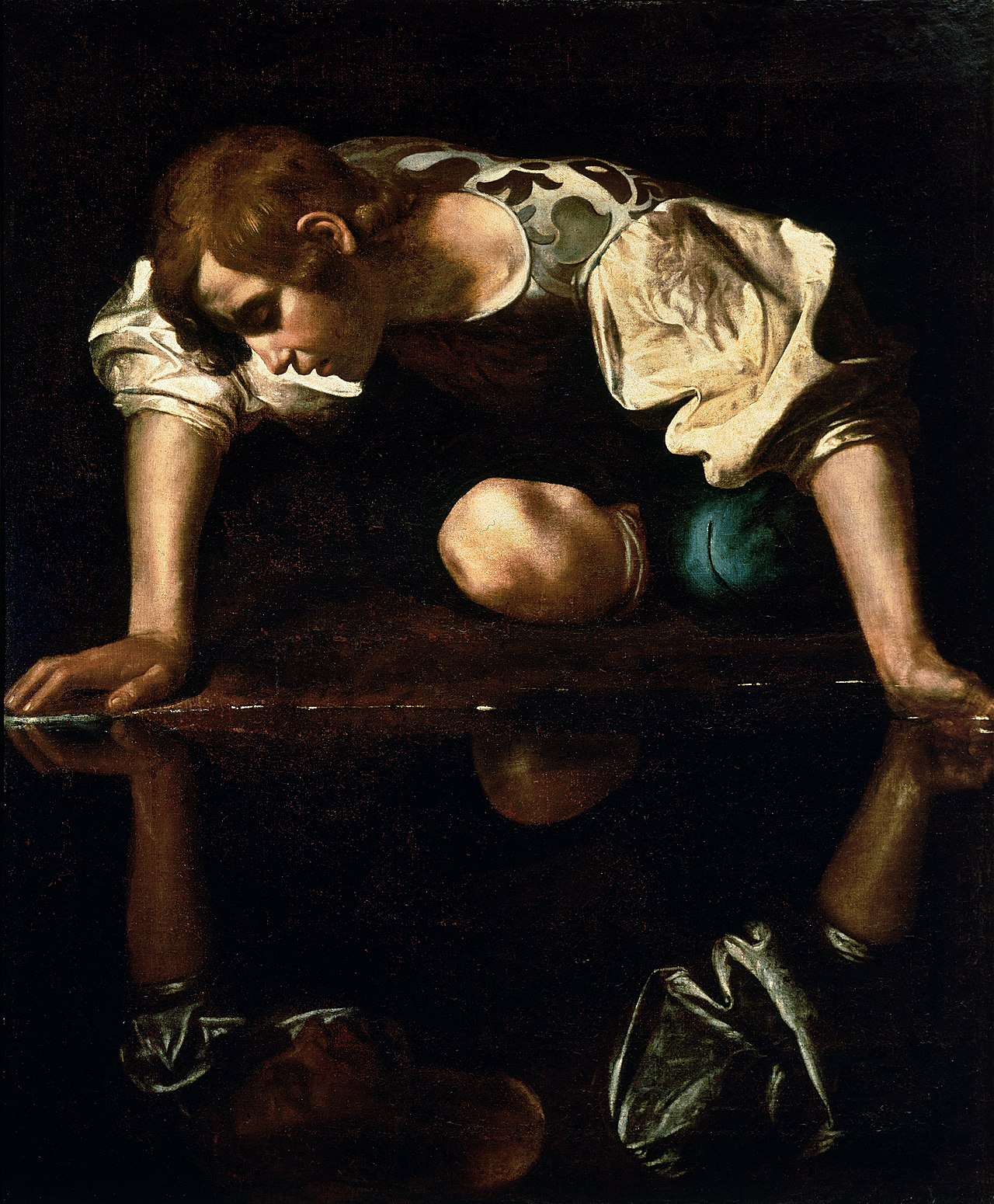
A young man in a brocaded sleeve leans over a dark pool, his lit face and bent forearm forming a closed circle with their own reflection.
Caravaggio, 1599
Apollo lunges from the left as Daphne twists backward, fingers already unfurling into laurel leaves, while the river-god Peneus reclines watching from below.
Giovanni Battista Tiepolo, 1757
Diana points accusingly as nymphs strip the pregnant Callisto bare, exposing Jupiter's deception by the fountain's edge.
Titian, 1559
Io, eyes closed in ecstasy, is enveloped by a dark cloud that resolves into the half-glimpsed face and hand of Jupiter against her cheek and thigh.
Antonio da Correggio, 1532
Pluto hoists the struggling Proserpina off the ground, his fingers visibly sinking into the marble of her thigh as Cerberus barks at their feet.
Gian Lorenzo Bernini, 1622
The armoured Perseus, Pegasus behind him, unbinds Andromeda from her seaside rock while a cupid loosens her chains and Victory crowns him with laurel.
Peter Paul Rubens, 1622
Pygmalion kisses his marble statue as her upper body flushes warm pink into living flesh while her legs remain cold white stone on the pedestal.
Jean-Léon Gérôme, 1890
Recommended Editions

Allen Mandelbaum
Harvest Books · 1995
Mandelbaum's verse is ornate and literary, an Ovid that sounds like a Renaissance poet. Arguably that's how the Metamorphoses has always been read in English, since Shakespeare and Milton were reading it that way too.


Please support us by purchasing through these links, at no extra cost to you!
Deep Dive
What It's About
This summary gives away plot details.
Notable Quotes
“I want to speak about bodies changed into new forms. You, gods, since you are the ones who alter these, and all other things, inspire my attempt, and spin out a continuous thread of words, from the world's first origins to my own time.”
“I see, and I desire the better: I follow the worse.”