
Read this if you…
- want the foundational text of English literature
- want fun dirty short stories
Skip this if you…
- want a single sustained narrative
- don't like reading in verse (modern english translations are still best in poem form)
The  Take
Take
Fantastic poetry and stories, it’s a translation but very sing songs. Can totally see the inspiration from Decameron. Funnier than that though, some great lines
The lineage through The Canterbury Tales
- 1 Timothy by Paul. The Canterbury Tales built on it. - The Pardoner's entire sermon-theme — *Radix malorum est cupiditas*, cited 'Ad Thimotheum, 6°' — is lifted straight from *1 Timothy* 6:10 - Knowing Paul's line ('the love of money is the root of all evil') makes the irony land: the Pardoner preaches it relentlessly while being the greediest man on the pilgrimage - Chaucer is quoting Scripture to indict its own quoter — the source text is the hook on which the whole hypocrisy hangs
- The Decameron by Giovanni Boccaccio. The Canterbury Tales built on it. - The pilgrims-swapping-tales structure isn't Chaucer's invention — scholars trace it straight to Boccaccio's *Decameron* - About a quarter of the Canterbury tales have Decameron counterparts, and the case that Chaucer actually read it is strong - Read Boccaccio first and you see the blueprint: a frame full of travelers, each with a story, that Chaucer carried north and made English
- The Consolation of Philosophy by Boethius. The Canterbury Tales built on it. - Chaucer translated the *Consolation* himself (the *Boece*), so its arguments are woven into the *Tales* by a hand that knew them line by line - The Knight's Tale layers Boethian thought on fortune and providence over its borrowed plot — the philosophy is Boethius - Reading the *Consolation* first surfaces the questions about fate and order that keep resurfacing across the pilgrims' stories
- The Divine Comedy by Dante Alighieri. The Canterbury Tales built on it. - The *Tales* are steeped in Dante — sometimes in homage, sometimes in mischief - Chaucer retells Ugolino from *Inferno* XXXIII in the Monk's Tale and names "Dant" outright, the rare case of one canonical poet citing another by name - Read the *Commedia* first and you'll catch what Chaucer is doing: borrowing Dante's gravity for the Monk, then deflating his cosmic machinery in the *House of Fame*
- Metamorphoses by Ovid. The Canterbury Tales built on it. - Two of the *Tales* are Ovid wearing English dress — the Manciple's Tale retells Ovid's Phoebus and the crow, and the Wife of Bath's Tale reworks his Midas - Chaucer treated the *Metamorphoses* as a working library of plots; reading it first lets you catch exactly what he kept and what he changed - The clearest way to see Chaucer the magpie at work, borrowing from the great Roman storehouse of myth
- Judith by Unknown. The Canterbury Tales built on it. - The Monk's tragedy of Holofernes isn't invented — it's lifted straight from the Book of *Judith* - Chaucer keeps the heart of it: the sleeping general, the woman, the beheading, now reframed as fortune toppling the mighty - Read the source and you see exactly what Chaucer compresses into a few stanzas of medieval fall-of-princes verse
- The Two Noble Kinsmen by William Shakespeare. The Canterbury Tales shaped it. - The single clearest case of Shakespeare reaching back to Chaucer — *The Two Noble Kinsmen* is a straight dramatization of the *Knight's Tale* - Palamon and Arcite, two cousins who fall for the same woman from a prison window, walk out of Chaucer's tale and onto Shakespeare's stage - The play's Prologue says so out loud, naming Chaucer and crediting him with the story
- Troilus and Cressida by William Shakespeare. The Canterbury Tales shaped it. - Shakespeare knew Chaucer well — and lifted the plot of *Troilus and Cressida* straight from Chaucer's *Troilus and Criseyde* - Chaucer is the English ancestor in the room: the lovers, the betrayal, the bitter aftertaste all come down through him
- Selected Poems by John Dryden. The Canterbury Tales shaped it. - Three centuries on, Dryden rebuilt three of these tales in modern English couplets for his *Fables, Ancient and Modern* - The Knight's Tale becomes his *Palamon and Arcite*; his Preface professes open veneration — "I could have done nothing without him" - Chaucer's pilgrims kept finding new poets to carry them: Dryden's versions were later re-adapted again by Voltaire
- A Midsummer Night’s Dream by William Shakespeare. The Canterbury Tales shaped it. - Chaucer's *Knight's Tale* opens with Theseus, Duke of Athens, home from conquering the Amazons and about to wed Hippolyta — the exact frame Shakespeare hangs his comedy on - The play's Athens and its royal wedding come straight from Chaucer, whose language scholars hear echoing in the verse - Not a one-off borrowing: Chaucer was also Shakespeare's direct source for *The Two Noble Kinsmen*
- William Wordsworth, Selected Poems by William Wordsworth. The Canterbury Tales shaped it. - Wordsworth went so far as to translate Chaucer — *The Prioress' Tale*, *The Cuckoo and the Nightingale*, *The Manciple's Tale* — into modern English - He did it, in his own words, "mainly out of my love and reverence for Chaucer" - Five centuries on, one of the great Romantics still bent his ear to the medieval master
Depicted in Art
The Prioress on horseback in nun's habit, demure, holding her rosary; small marginal figure from the manuscript.
1405
Stout, red-bearded Miller on horseback, bagpipes at his shoulder, piping the pilgrims out of Southwark.
The Monk astride a dark horse, hood thrown back, dressed in fine secular riding clothes rather than the cloister.
1405
The Pardoner riding with long yellow hair to the shoulders, holding a relic-cross before him.
1405
The Knight, bearded and armored, rides a draped horse in profile, lance held upright; gold-and-blue marginal portrait from the manuscript.
1405
The Friar mounted, tonsured, in brown habit with cord belt; fleshy, smiling, hand raised in benediction.
1405
The young Squire on horseback, embroidered short gown, curled hair, playing a flute as he rides.
1405
The full company of pilgrims rides out of Southwark in a long horizontal frieze, Tabard Inn behind them, Knight and Squire leading.
Thomas Stothard, 1807
Chaucer himself depicted as a pilgrim on a brown horse, dressed in black, with forked beard and a penner hanging from his neck.
Geoffrey Chaucer (portrait, attrib. Ellesmere artist), 1405
Recommended Editions

Nevill Coghill
Penguin Classics · 2003
Coghill's verse translation has been the doorway into Chaucer for two generations. The bawdy parts stay bawdy and the Middle English stops being a wall, which is most of the battle.
Please support us by purchasing through these links, at no extra cost to you!
Notable Quotes
Whan that Aprill, with his shoures soote / The droghte of March hath perced to the roote, / And bathed every veyne in swich licour / Of which vertu engendred is the flour;
Screen & Stage
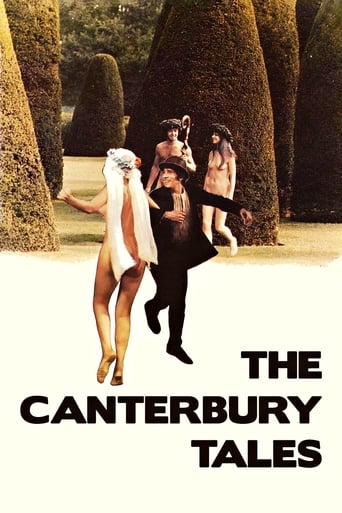
The Canterbury Tales
Film · 1972
Pier Paolo Pasolini

Canterbury Tales
Stage · 1968
Nevill Coghill and Martin Starkie
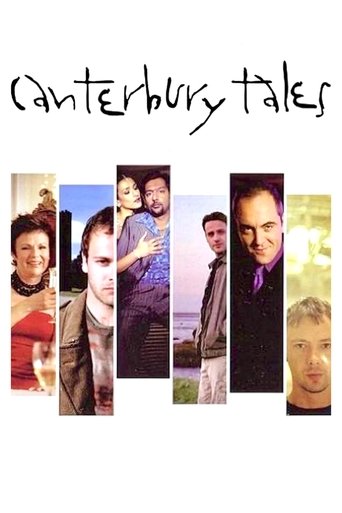
Canterbury Tales
TV · 2003
Geoffrey Chaucer
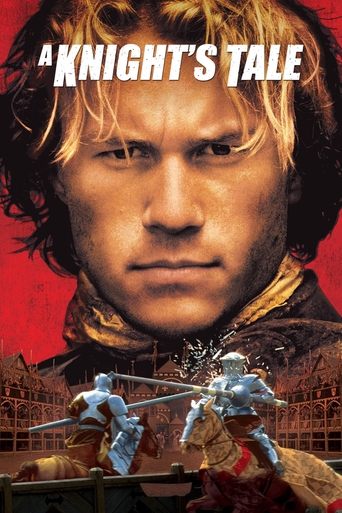 loose
looseA Knight's Tale
Film · 2001
Brian Helgeland
Posters via The Movie Database (TMDB)
- John Dryden, English Poet Laureate, dramatist & critic, 1631–1700: "He is the Father of English Poetry … 'Tis sufficient to say … that here is God's Plenty."
- William Blake, English Romantic poet & engraver, 1757–1827: "They are the physiognomies or lineaments of universal human life, beyond which Nature never steps."
- Edmund Spenser, English Renaissance poet, author of "The Faerie Queene", c. 1552–1599: "Dan Chaucer, well of English undefiled, / On Fame's eternal beadroll worthy to be filed."
- Alexander Pope, English poet, leading Augustan satirist, 1688–1744: "He is a master of manners, of description, and the first tale-teller in the true enlivened natural way."
- Kate Adie, BBC war correspondent, 1945–: Chose The Canterbury Tales as her one book on Desert Island Discs (BBC Radio 4, 1994).
- Harold Bloom, American literary critic, Yale professor, 1930–2019: Only Chaucer, before Shakespeare, invents characters of such depth — the Wife of Bath foreshadows Falstaff, the Pardoner Iago.