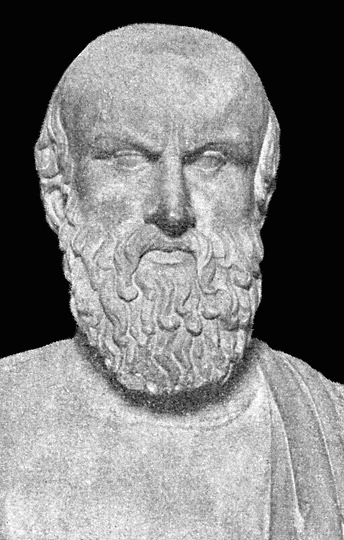
Aeschylus
c. 525–456 BCE · Ancient Greece
“He who learns must suffer. And even in our sleep, pain that cannot forget falls drop by drop upon the heart.”
Peak-work percentile in the canon.
The lineage through Aeschylus
Drew From(2)
who shaped Aeschylus
- The seedbed of the whole play — Hesiod's Theogony is where the Prometheus myth first takes form
- Aeschylus lifts the fire-theft and Zeus's punishment straight from Hesiod, then reworks it: he separates the tortures, brings on Heracles to kill the eagle, and drops the sacrifice-trick
- Read Hesiod first and the changes become visible — you can watch Aeschylus turn a god's punishment into the defiance of a tragic hero
via The Odyssey
- The Oresteia dramatizes a myth the Odyssey can't stop retelling — the failed homecoming that haunts Odysseus's successful one
- Aeschylus keeps Homer's frame but shifts the weight: in the Odyssey the killer is Aegisthus, here the murder belongs to Clytemnestra
- Reading the Odyssey first shows you the version Aeschylus is answering — and how much darker he makes it
Inspired(6)
who Aeschylus shaped
- The matricide Sophocles couldn't leave alone
- Aeschylus' middle play, the Libation Bearers, set the scene — Orestes and Electra meet at their father's tomb, the recognition, the killing of their mother — and Electra reworks it beat for beat
- Where Aeschylus made it Orestes' story, Sophocles answers by handing the whole drama to Electra
via The Frogs
- Aristophanes loved the Oresteia enough to put Aeschylus himself onstage to defend it
- In the underworld contest, Euripides picks apart an Aeschylean prologue line by line — the Hermes lines from the Oresteia — while Aeschylus answers for his own grandeur
- The comedy's closing torchlit procession of the Eleusinian Initiates deliberately echoes the Oresteia's own luminous finale
- The line Hardy borrowed to seal a tragedy — Tess closes with "the President of the Immortals (in Aeschylean phrase) had ended his sport with Tess"
- That phrase is Hardy's own translation out of Prometheus Bound, flagged in the text as Aeschylus's
- Aeschylus's image of a cosmos run by a cruel, indifferent power gave Hardy the exact words to damn the universe that destroys his heroine
via Frankenstein
- The myth in the subtitle — Frankenstein; or, The Modern Prometheus
- Mary Shelley copied out Percy's translation of this play in her own hand while writing the novel, July 1817
- Aeschylus gives Victor his shape: not Hesiod's kindly benefactor but the maker punished for what he brought into being
- Euripides built Medea's revenge on Aeschylus's blueprint — the verbal echoes of the Choephoroi are specific enough to catch
- Medea frames her killing as a 'sacrifice,' an echo of the Agamemnon; she stands over the corpses exactly as Clytemnestra stood over Agamemnon and Cassandra
- The poisoned robe that kills is patterned on the entangling robe Clytemnestra used — Aeschylus's signature image, turned to a new horror
via The Republic
- Plato names Aeschylus directly — and not to praise him
- Book 2 of the Republic faults the Oresteia's poet for endorsing a justice valued only for its reputation, the exact view Socrates sets out to demolish
- And when Plato bars the tragedians from his ideal city, Aeschylus is named on the list of the exiled
Famous Quotes
“Zeus has led us on to know, the Helmsman lays it down as law that we must suffer, suffer into truth.”
“Zeus, who sets mortals on the path to understanding, Zeus, who has established as a fixed law that wisdom comes by suffering.”
“For I am he who found for mortals the source of fire, sealed in a stalk of fennel. And fire has proved for mortals a teacher in every art, a great resource.”
“As fishermen cast their huge circling nets, I spread a deadly abundance of rich robes and caught him fast. I struck him twice.”
About Aeschylus
Ancient Greek tragedian, often called the father of tragedy. He fought at the Battle of Marathon and transformed Greek theater by introducing a second actor, enabling dramatic dialogue. Of the roughly 70-90 plays he wrote, only seven survive, including the Oresteia — the only complete Greek tragic trilogy extant.
Aeschylus, Ranked
According to 
- 50The Oresteia458 BCAeschylusHard·Medium·160 pagesInfluence93Popularity50Ancient GreeceTragedyAncient Greek
- 139Prometheus Bound~460 BCAeschylusHard·Quick·36 pagesInfluence31Popularity8Ancient GreeceTragedyAncient Greek
- 152The Seven Against Thebes467 BCAeschylusHard·Quick·32 pagesInfluence27Popularity1Ancient GreeceTragedyAncient Greek
- 185The Persians472 BCAeschylusModerate·Quick·32 pagesInfluence28Popularity1Ancient GreeceTragedyAncient Greek
- 189The Suppliants463 BCAeschylusModerate·Quick·32 pagesInfluence27Popularity1Ancient GreeceTragedyAncient Greek