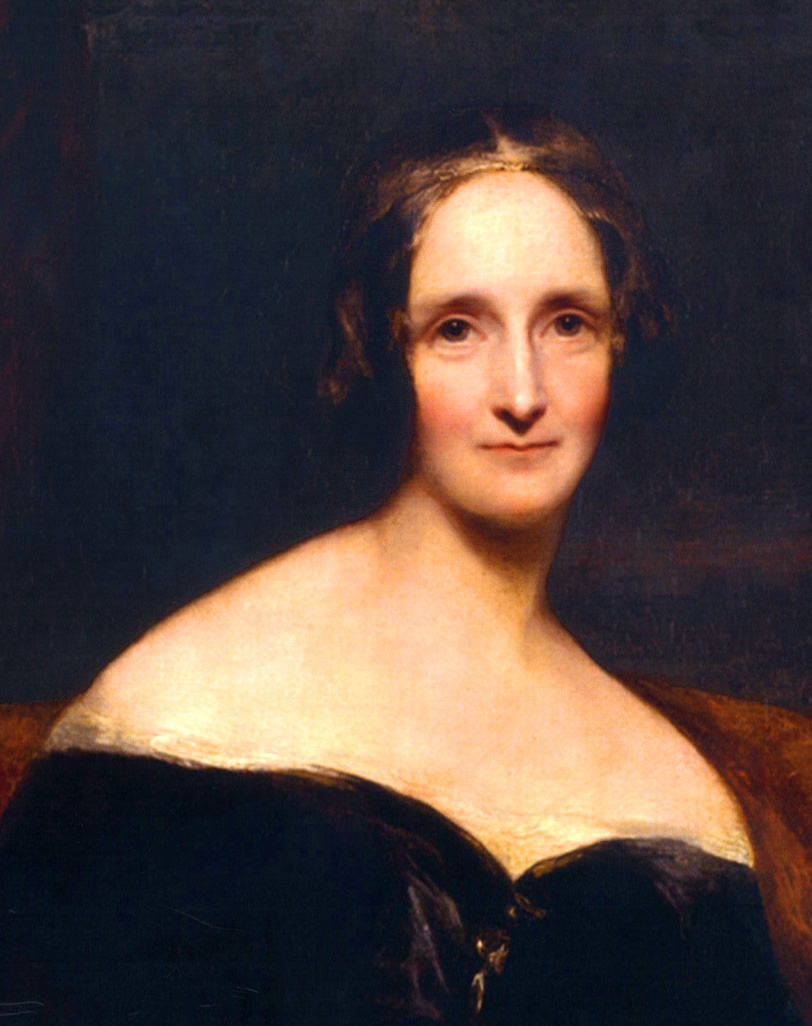
Mary Wollstonecraft Shelley
1797–1851 · England
“Beware; for I am fearless, and therefore powerful.”
Peak-work percentile in the canon.
The lineage through Mary Wollstonecraft Shelley
Drew From(5)
who shaped Mary Wollstonecraft Shelley
via Paradise Lost
- Frankenstein opens on a line from Paradise Lost — Adam's accusation of his Maker — and never stops arguing with Milton after that
- The Creature reads Paradise Lost as true history, identifying first with Adam, then with Satan, asking who is the real victim of creation
- Read Milton first and Shelley's whole question comes into focus: what does the maker owe the made?
via Prometheus Bound
- The Prometheus of the subtitle is Aeschylus's, not Hesiod's — the creator chained for his transgression
- Mary Shelley transcribed Percy's translation of this play by hand as she wrote the novel; Victor is built on its defiant maker
- Read it first and Victor's punishment reads as tragedy, not just horror — the fire-bringer who pays for the spark
- Frankenstein quotes the Rime by name and image — Walton invokes "the land of mist and snow," the albatross, and Coleridge himself as he steers toward the ice
- Coleridge's haunted Mariner stands behind every figure in the novel driven to confess a guilt they can't outrun
- Mary Shelley heard Coleridge recite this poem as a girl; reading it first gives Frankenstein's polar frame its full cold weight
via Plutarch's Lives
- Plutarch's Lives is named on the page — one of the three books the creature discovers and reads in the De Lacey woods, alongside The Sorrows of Young Werther and Paradise Lost
- Shelley has Plutarch give him 'high thoughts,' teaching him of the lawgivers and rulers of antiquity and waking his love of virtue
- Read it and you read what the creature read — the source of the moral ideals it measures its own abandonment against
- Frankenstein's monster keeps measuring himself against the first man — created, then cast off, demanding an account from the one who made him
- The route runs through Milton (the epigraph is Adam's protest, and the creature reads Paradise Lost), but the original pattern is here in Genesis: knowing Adam's making sharpens the creature's bitter inversion of it
Portraits
The definitive likeness of Mary Shelley — Rothwell's oil exhibited at the Royal Academy in 1840, now NPG 1235 (National Portrait Gallery, London); the seated portrait reproduced on virtually every edition and biography.
Richard Rothwell, 1840
Tightly cropped, color-enhanced edit of the canonical Rothwell NPG oil — head-and-shoulders framing well suited to a small portrait thumbnail.
Richard Rothwell, 1840
Famous Quotes
“Beware, for I am fearless and therefore powerful.”
“You are my creator, but I am your master; obey!”
“I ought to be thy Adam, but I am rather the fallen angel.”
“I ought to be thy Adam, but I am rather the fallen angel, whom thou drivest from joy for no misdeed.”
About Mary Wollstonecraft Shelley
English novelist who wrote Frankenstein; or, The Modern Prometheus at the age of eighteen, creating one of the most enduring myths of modern literature. Daughter of philosopher William Godwin and feminist Mary Wollstonecraft, and wife of the poet Percy Bysshe Shelley, she moved in the most radical intellectual circles of her era.