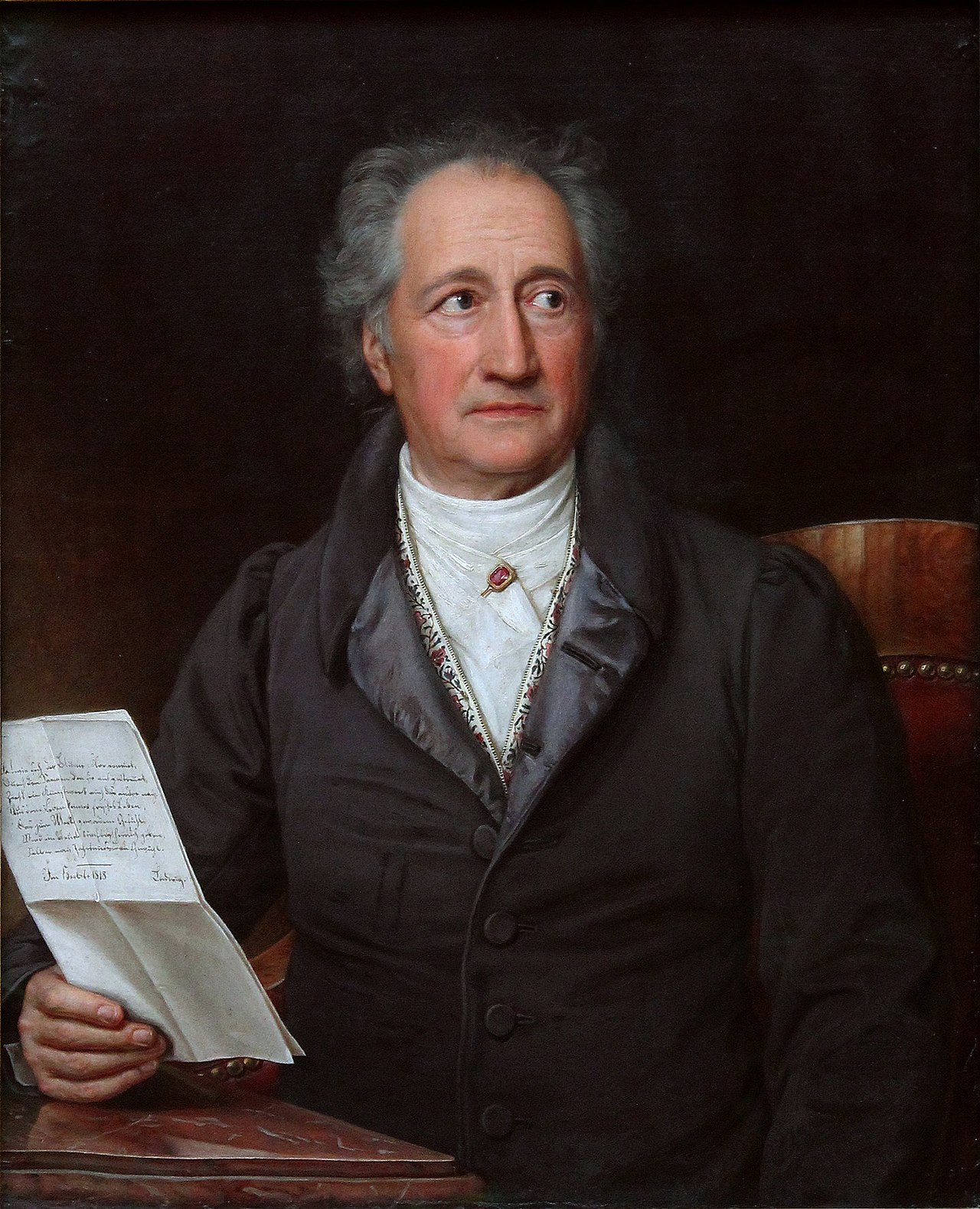
Johann Wolfgang von Goethe
1749–1832 · Germany
“Two souls, alas, dwell in my breast, each one desiring to separate from the other.”
Peak-work percentile in the canon.
The lineage through Johann Wolfgang von Goethe
Drew From(6)
who shaped Johann Wolfgang von Goethe
via Job
- The 'Prologue in Heaven' is Job's heavenly wager, transposed — God and the devil bargaining over one striving man
- Goethe modeled the scene directly on Job's opening, down to the archaic, scriptural German that signals where it came from
- Read Job first and Faust's frame reveals itself: not a fresh invention but a deliberate reworking of the oldest argument about why a good man suffers
- The woman at the center of the Helen act is Homer's Helen of Troy — the prize and the cause of the war the Iliad sings
- Goethe, who memorized Homer young, threads the work with Homeric allusion and stages Helen's return from Troy to Sparta
- Read the Iliad first and you arrive at Faust's marriage to Helen knowing exactly what she has already cost the world
via Dr. Faustus
- The puppet plays Goethe watched as a child trace straight back to Marlowe's Dr. Faustus
- Marlowe's proud scholar bartering his soul is the seed; Goethe only met the actual English drama later, long after the legend had already shaped him
- Read Marlowe to see the bargain in its rawest form — damnation as a closed deal — before Goethe reopens the question and lets Faust strive past it
via Hamlet
- Faust is steeped in Shakespeare — Goethe called him one of the three writers who made him, and Hamlet is the play he reaches for
- Gretchen's ruin is shaped on Ophelia's: the cast-off woman, the descent into madness, the brother who dies trying to avenge her
- Read Hamlet first and the echoes ring clear — Ophelia's mad song in Mephistopheles' mouth, the graveyard turned to Faust's churchyard
via Metamorphoses
- The old couple Philemon and Baucis in Act V come straight out of Ovid's Metamorphoses — Goethe learned the poem by heart as a boy and carried it to the end of his life
- He keeps Ovid's names and their humble cottage, then twists the ancient parable of welcomed strangers into Faust's modernizing crime
- Reading Ovid's gentle Book VIII version first makes Goethe's betrayal of it land — same couple, opposite fate
- The heavenward finale — the choir of souls rising through celestial spheres, Gretchen as intercessor before the Mater Gloriosa — is Goethe modeling the close of Faust on Dante's Paradiso
- That last line about the Eternal Feminine is held to be reminiscent of the Comedy's final lines: the love that moves the sun and the stars
- Read the Paradiso first and Faust's salvation stops being a surprise and becomes the answer to a five-century-old question about how a striving soul gets carried up
Inspired(4)
who Johann Wolfgang von Goethe shaped
- Goethe's tempter gets reborn in Russia — Dostoevsky read Faust in German at seventeen and never let it go
- Ivan Karamazov is, by scholarly consensus, "a Russian Faust": the brilliant intellect who reasons his way to despair
- And Ivan's devil-visitor descends straight from Mephistopheles — Dostoevsky strips the grand demon down to a threadbare gentleman in a checked coat
- Goethe was Nietzsche's near-Übermensch — the figure he revered above all others in German culture
- Faust, Part Two ends "the Eternal Feminine draws us upward"; Nietzsche takes that very line and turns its pull back toward the earth
- Zarathustra alludes to Faust throughout — Nietzsche named the two works as the closest German literature has
- Goethe's Faust became Freud's go-to source for naming the unnamable — he quotes it more than any other work in The Interpretation of Dreams
- Most of those quotations come from Mephistopheles' mouth, the voice Freud reached for when describing how dreams disguise their meaning
- A scholarly study traces "Die Traumdeutung" itself back to Faust — the play is woven through Freud's account of the dream-work
via Middlemarch
- George Eliot was one of Goethe's great English readers — she translated German and spent months in Weimar helping G. H. Lewes research his Life of Goethe (1855)
- That immersion carried Goethe's moral seriousness into her own novels; Middlemarch breathes the same air, even if its closest structural debt is to Wilhelm Meister rather than Faust
Famous Quotes
“In the beginning was the deed.”
“The Eternal Feminine draws us onward.”
“The Eternal Feminine draws us on.”
“I am the spirit that negates! And rightly so, for all that comes to be deserves to perish wretchedly.”
About Johann Wolfgang von Goethe
German writer, scientist, and statesman, the towering figure of German literature. His verse drama Faust, his novel The Sorrows of Young Werther, and his vast body of poetry, scientific writing, and autobiography make him the last true polymath of Western culture. He served as a minister in the court of Weimar for most of his adult life.