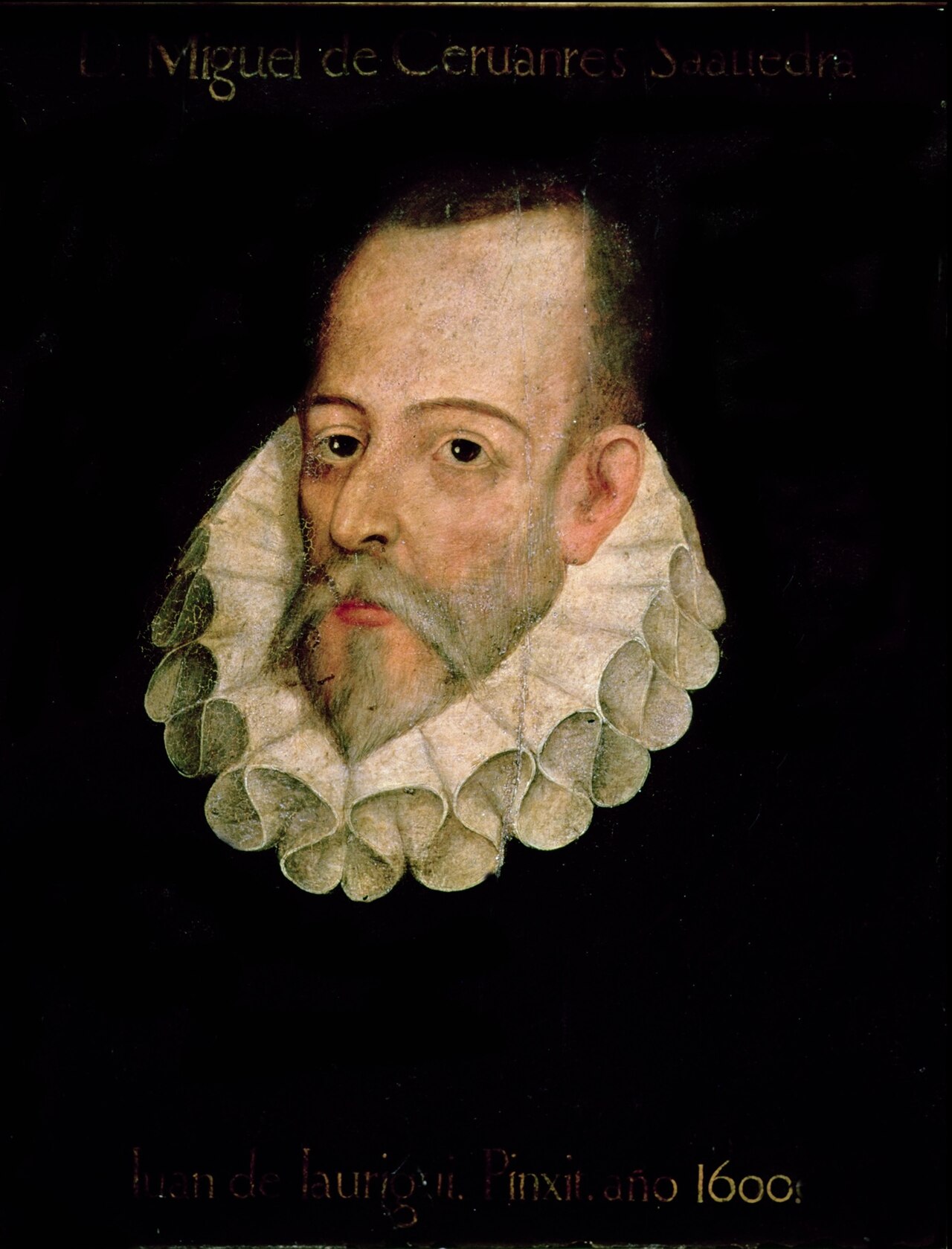
Miguel de Cervantes Saavedra
1547–1616 · Spain
“Fortune is arranging matters for us better than we could have shaped our desires ourselves, for look there, friend Sancho Panza, where thirty or more monstrous giants present themselves.”
Peak-work percentile in the canon.
The lineage through Miguel de Cervantes Saavedra
Drew From(6)
who shaped Miguel de Cervantes Saavedra
via Celestina
- Don Quixote opens by tipping its hat to Celestina — Cervantes praises de Rojas's book as "divine" in his prefatory verses, then teasingly wishes it hid more of "the human"
- That backhanded tribute marks de Rojas as one of the Spanish ancestors standing behind Cervantes
- Reading Celestina first shows you the earthy, human-comedy strain Cervantes admired and was measuring himself against
via The Golden Ass
- That famous wineskin-slashing in Part 1 isn't original to Cervantes — he lifted it, knowingly, from Apuleius's Lucius butchering three wineskins he mistook for robbers
- Apuleius also gave Cervantes the trick of nesting standalone tales inside a wandering main plot, the very shape Don Quixote runs on
- Reading the Golden Ass first reveals just how deep this novel's roots reach into ancient comic prose
via Praise of Folly
- The Quixote's deepest paradox — a madman who is also the truest soul in the book — is Erasmian: Praise of Folly had already argued that folly is a higher wisdom
- Cervantes inherited the lineage directly; his tutor was an Erasmian, and the pervasive humanist irony of Folly is the air Don Quixote breathes
- Read Folly first and the knight stops looking simply insane and starts looking like a holy fool
via Metamorphoses
- Don Quixote's famous Golden Age speech (I.11) is lifted straight from Ovid's Ages of Man — read the Metamorphoses and you'll catch the source the knight is solemnly reciting
- Cervantes takes Ovid's machinery of transformation and reroutes it through delusion: the same world-changing power, but the changes are all in the mind
- A deliberate Ovidian text under the comedy — knowing the original sharpens every one of Quixote's enchantments and metamorphoses
via The Aeneid
- The epic Cervantes is laughing at, lovingly — the Aeneid is the single dominant allusion behind Don Quixote
- Quixote's descent into the Cave of Montesinos is Aeneas's journey to Hades, recast as the daydream of a deluded country gentleman
- Read Virgil first and the parody sharpens: you see exactly which epic-hero ideal Cervantes is dismantling
- Quixote's stubborn faith has a biblical text behind it — and it's this one
- His defense of the chivalric life borrows James almost word for word: faith without works is dead, la fe sin obras es muerta
- Scholars point to it as Cervantes's clearest single-verse biblical borrowing; reading James first lets you catch the knight quoting Scripture to justify his fantasy
Inspired(9)
who Miguel de Cervantes Saavedra shaped
- Twain named Cervantes outright as a master, and the master/sidekick pairing of Tom and Huck is Don Quixote and Sancho Panza moved to the Mississippi
- Quixote's enchantment — seeing windmills as giants — becomes Tom's romantic delusions, with plain-spoken Huck cast as the Sancho who knows better
- The picaresque road of illusion versus reality that Cervantes invented is the road Huck and Jim travel down the river
- Sterne called his own humor "Cervantick" — the word is his confession of where it all came from
- Uncle Toby is a Quixote in miniature: a gentle obsessive riding his hobby-horse the way the Knight rode Rosinante, and Sterne names them both
- The slyest debt is structural — the winking, self-aware narrator of Don Quixote's Part 2 is the model for Tristram's running game with his own reader
via Madame Bovary
- Don Quixote is the seed of Madame Bovary — and Flaubert said so himself
- "I can find my origins in the book I knew by heart before I knew how to read, Don Quixote," he wrote to Louise Colet in 1852
- The Don is undone by chivalric romances; Emma Bovary is undone by sentimental ones — Cervantes invented the disease, Flaubert gave it a new patient
- Don Quixote gave the English novel its founding model — Fielding worshipped Cervantes openly
- His earlier Joseph Andrews announces it on the title page: "Written in Imitation of the Manner of Cervantes, author of Don Quixote"
- The deluded master and his earthy companion become, in Tom Jones, the pairing of Jones and Partridge — the Quixote-and-Sancho dynamic carried onto the English road
via The Idiot
- Cervantes' deluded, gentle knight became Dostoevsky's explicit blueprint
- Attempting a "positively beautiful man" in Prince Myshkin, Dostoevsky named Don Quixote — in an 1868 letter to his niece — as the chief model for the type
- Read it first and you'll catch what Dostoevsky was after: the holy fool the world can only laugh at
via Middlemarch
- Eliot took up Cervantes's project consciously — idealism corrected by reality, the dreamer measured against the world
- She opens Chapter 2 of Middlemarch, where Dorothea first meets Casaubon, with a Don Quixote epigraph: the Mambrino's-helmet exchange between the Don and Sancho
- Dorothea is Quixote's heir — her lofty vision of marriage to a great scholar is exactly the kind of grand delusion Cervantes anatomized first
- One of Dickens's lifelong favorites — and one of the books that built him
- Don Quixote sits in young David Copperfield's childhood book-cache, the small hoard that "kept alive my fancy" through a miserable boyhood
- Cervantes's quixotic comedy — the deluded idealist played for both laughs and tenderness — feeds straight into Dickens's gallery of lovable, self-fooling eccentrics
via Dead Souls
- Don Quixote became the template for the Russian comic novel
- Gogol modeled Chichikov's journey directly on Cervantes — Pushkin handed him the Dead Souls plot precisely so he could run a Quixote-style picaresque across the whole sprawl of Russia
- The road, the rogue, the gallery of fools encountered along the way: Gogol inherited all of it from the Don's wanderings
via Fathers and Sons
- Cervantes gave Turgenev one of his two master-types — in the 1860 essay "Hamlet and Don Quixote," the Don is the self-sacrificing idealist, all conviction and doomed altruism
- Turgenev praised Cervantes' "instinct of genius" and built a whole character theory on the Quixote/Hamlet split
- That framework is the lens critics use to read Bazarov and the generational clash of Fathers and Sons
Famous Quotes
“In a village of La Mancha, the name of which I have no desire to call to mind, there lived not long since one of those gentlemen that keep a lance in the lance-rack, an old buckler, a lean hack, and a greyhound for coursing.”
“Too much sanity may be madness — and maddest of all: to see life as it is, and not as it should be.”
“Look, your worship, what we see there are not giants but windmills, and what seem to be their arms are the sails that turned by the wind make the millstone go.”
“Finally, from so little sleeping and so much reading, his brain dried up and he went completely out of his mind.”
About Miguel de Cervantes Saavedra
Spanish novelist, poet, and playwright, author of Don Quixote, widely considered the first modern novel. His life was as dramatic as his fiction — he was a soldier, wounded at Lepanto, enslaved in Algiers, and imprisoned for debt. Don Quixote's blend of comedy, pathos, and meta-fiction makes it one of the most influential works in world literature.