Read this if you…
- want one of Shakespeare's best characters, Rosalind
- want "All the world's a stage" full speech, banger
Skip this if you…
- aren't willing to go slow, read notes, look up analyses of famous passages (only way to "get" shakespeare)
- foolishly think shakespeare is overrated
- don't like his comedies compared to his tragedies
Why It Matters
Shakespeare drops a comedy into a forest where the social rules dissolve, people pretend to be someone else, and everyone figures out what they actually want. Rosalind is his smartest and most self-aware comic heroine. The play keeps circling the gap between performing a role and being yourself, which makes it one of his most philosophical comedies.
The  Take
Take
A bunch of great characters, Jacques and touchstone. Rosalind’s scheming was also great. Some great poetry. Still not the highest of highs I’ve seen in other Shakespeare
The lineage through As You Like It
- Metamorphoses by Ovid. As You Like It built on it. - Touchstone names Ovid by name, and the joke only works if you know the *Metamorphoses* standing behind it - Shakespeare's most-quarried classical source supplies the play's deep theme: love that transforms whoever it touches - Read Ovid first and Arden reveals itself as his golden world transplanted to an English forest
- The Gospels by Matthew. As You Like It built on it. - Orlando frames his first scene as the Prodigal Son's story — the parable from the *Gospels* sets the comedy's exile-and-return in motion - "What prodigal portion have I spent that I should come to such penury?" — the line all but quotes Luke 15, husks and hogs and all, straight from Shakespeare's Geneva Bible - Knowing the parable first lets you hear Orlando's complaint as the scriptural echo it is
Depicted in Art
Orlando squares off against Charles the wrestler before Duke Frederick's court; Rosalind and Celia clutch each other in the centre while Touchstone sits at the front.
Daniel Maclise, 1854
A reluctant schoolboy with satchel creeps along a country lane on his way to school.
Robert Smirke, 1801
Standing portrait of the court fool Touchstone in motley with cap and bauble.
John William Waterhouse
Rosalind and Celia embrace as they plot their flight from Duke Frederick's court at the close of Act I, Scene 3.
Margaret Gillies
Rosalind, dressed as the boy Ganymede, sits pensively beneath a tree in the Forest of Arden contemplating her exile.
John Everett Millais, 1868
Rosalind, in boyish dress, presents her chain or necklace to Orlando after his victory over Charles the wrestler.
Eleanor Fortescue-Brickdale, 1899
A bearded soldier, 'full of strange oaths', strides forward in armor seeking the bubble reputation.
Robert Smirke, 1801
Touchstone in motley pays court to the rustic goatherd Audrey in a country lane, with goats at her feet.
John Collier
Pen-and-ink illustration: Rosalind in boy's dress and Celia in country garb pause together in the Forest of Arden.
Hugh Thomson, 1909
Oliver presents the bloody napkin from Orlando's wound; Rosalind, still disguised as Ganymede, faints into Celia's arms.
William Hamilton, 1791
Rosalind in boy's dress sits in the forest reading the love verses Orlando has pinned to the trees.
Henry Nelson O'Neil, 1856
Rosalind, still disguised as Ganymede, stands beside Celia coaching Orlando through a mock wedding rehearsal in the forest.
Walter Howell Deverell, 1853
The melancholy Jaques leans on his staff in a forest glade beside a wounded deer weeping into a brook, watched by Duke Senior's exiled lords.
William Hodges, 1790
The shepherdess Phoebe coldly turns away from her kneeling suitor Silvius in a pastoral setting.
John Pettie, 1872
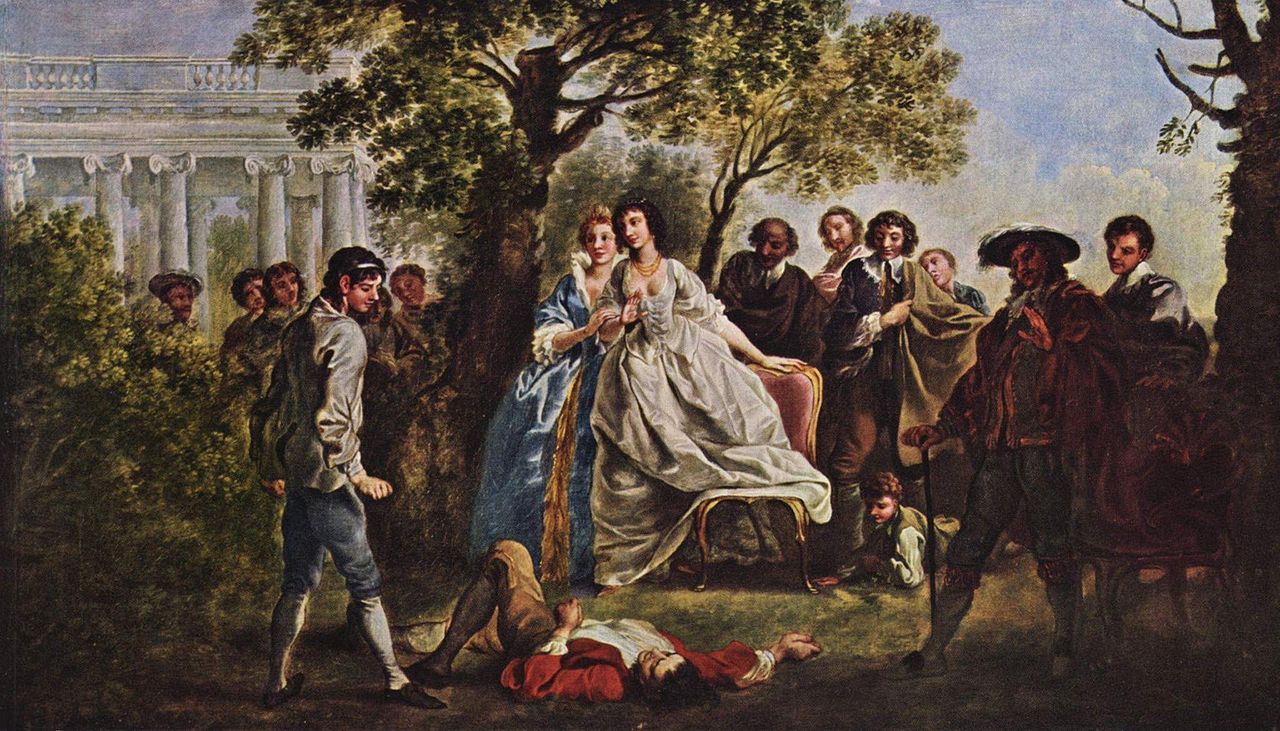
Orlando stands triumphant over the fallen Charles; Rosalind and Celia look on from one side, the court grouped on the other.
Francis Hayman, 1742
Recommended Editions

Folger Shakespeare Library
2004
Folger's the readable one. Text on one page, notes on the facing page, written in plain English instead of textbook-speak. Catches every word and reference you'd otherwise google, without breaking the scene to do it.


Please support us by purchasing through these links, at no extra cost to you!
Deep Dive
What It's About
This summary gives away plot details.
Notable Quotes
“All the world's a stage, and all the men and women merely players.”
“All the world's a stage, and all the men and women merely players: they have their exits and their entrances; and one man in his time plays many parts, his acts being seven ages.”

More by William Shakespeare
- 11A Midsummer Night’s Dream~1595William ShakespeareGrueling·Short·204 pagesInfluence24Popularity81ShakespeareComedyEnglish
- 13Hamlet~1600William ShakespeareGrueling·Medium·342 pagesInfluence97Popularity95ShakespeareTragedyEnglish
- 20Othello~1603William ShakespeareGrueling·Medium·314 pagesInfluence88Popularity75ShakespeareTragedyEnglish
- 23King Lear~1605William ShakespeareGrueling·Medium·384 pagesInfluence95Popularity72ShakespeareTragedyEnglish
- 26Macbeth~1606William ShakespeareGrueling·Short·223 pagesInfluence94Popularity87ShakespeareTragedyEnglish
- 40Richard II~1595William ShakespeareGrueling·Short·352 pagesInfluence22Popularity25ShakespeareHistory PlayEnglish
- 41Twelfth Night~1601William ShakespeareGrueling·Short·272 pagesInfluence20Popularity59ShakespeareComedyEnglish
- 49Romeo and Juliet~1595William ShakespeareGrueling·Short·287 pagesInfluence87Popularity99ShakespeareTragedyEnglish
- 51The Tempest~1611William ShakespeareGrueling·Short·259 pagesInfluence87Popularity61ShakespeareRomanceEnglish
- 56Love's Labour's Lost~1594William ShakespeareGrueling·Short·291 pagesInfluence8Popularity18ShakespeareComedyEnglish
- 67All's Well That Ends Well~1604William ShakespeareGrueling·Short·282 pagesInfluence15Popularity19ShakespeareComedyEnglish
- 69Much Ado About Nothing~1598William ShakespeareGrueling·Short·246 pagesInfluence19Popularity60ShakespeareComedyEnglish
- 75Julius Caesar~1599William ShakespeareGrueling·Short·288 pagesInfluence22Popularity61ShakespeareTragedyEnglish
- 76King Henry IV, Part 1~1596William ShakespeareGrueling·Short·274 pagesInfluence23Popularity24ShakespeareHistory PlayEnglish
- 78The Merchant of Venice~1596William ShakespeareGrueling·Short·288 pagesInfluence21Popularity60ShakespeareComedyEnglish
- 79Measure for Measure~1604William ShakespeareGrueling·Short·336 pagesInfluence19Popularity19ShakespeareComedyEnglish
- 90As You Like It~1599William ShakespeareGrueling·Short·320 pagesInfluence20Popularity58ShakespeareComedyEnglish
- 108Antony and Cleopatra~1606William ShakespeareGrueling·Short·400 pagesInfluence21Popularity33ShakespeareTragedyEnglish
- 116Richard III~1593William ShakespeareGrueling·Medium·369 pagesInfluence23Popularity58ShakespeareHistory PlayEnglish
- 125Henry V~1599William ShakespeareGrueling·Medium·292 pagesInfluence24Popularity51ShakespeareHistory PlayEnglish
- 133The Winter's Tale~1610William ShakespeareGrueling·Short·264 pagesInfluence17Popularity17ShakespeareRomanceEnglish
- 134The Taming of the Shrew~1591William ShakespeareGrueling·Short·304 pagesInfluence16Popularity59ShakespeareComedyEnglish
- 138Troilus and Cressida~1602William ShakespeareGrueling·Medium·416 pagesInfluence18Popularity18ShakespeareSatireEnglish
- 145The Comedy of Errors~1594William ShakespeareHard·Short·272 pagesInfluence16Popularity20ShakespeareComedyEnglish
- 147Coriolanus~1608William ShakespeareGrueling·Medium·342 pagesInfluence18Popularity32ShakespeareTragedyEnglish
- 151King John~1596William ShakespeareGrueling·Short·352 pagesInfluence14Popularity23ShakespeareHistory PlayEnglish
- 158Timon of Athens~1606William ShakespeareGrueling·Short·304 pagesInfluence10Popularity14ShakespeareTragedyEnglish
- 168The Two Gentlemen of Verona~1590William ShakespeareGrueling·Short·400 pagesInfluence9Popularity20ShakespeareComedyEnglish
- 169Henry IV, Part Two~1597William ShakespeareGrueling·Medium·338 pagesInfluence15Popularity23ShakespeareHistory PlayEnglish
- 171Titus Andronicus~1592William ShakespeareGrueling·Short·267 pagesInfluence12Popularity15ShakespeareTragedyEnglish
- 172The Merry Wives of Windsor~1597William ShakespeareGrueling·Short·263 pagesInfluence12Popularity21ShakespeareComedyEnglish
- 173Cymbeline~1610William ShakespeareGrueling·Medium·384 pagesInfluence11Popularity16ShakespeareRomanceEnglish
- 174Pericles~1607William ShakespeareGrueling·Short·456 pagesInfluence11Popularity16ShakespeareRomanceEnglish
- 175The Two Noble Kinsmen~1613William ShakespeareGrueling·Medium·384 pagesInfluence9Popularity15ShakespeareRomanceEnglish
- 182Henry VI, Part 1~1592William ShakespeareGrueling·Short·352 pagesInfluence14Popularity22ShakespeareHistory PlayEnglish
- 183King Henry VI, Part 2~1591William ShakespeareGrueling·Medium·512 pagesInfluence13Popularity22ShakespeareHistory PlayEnglish
- 184King Henry VI, Part 3~1591William ShakespeareGrueling·Short·384 pagesInfluence13Popularity21ShakespeareHistory PlayEnglish
- 193Henry VIII~1613William ShakespeareGrueling·Short·352 pagesInfluence10Popularity24ShakespeareHistory PlayEnglish
- Shakespeare's Sonnets1609William ShakespeareModerate·Short·512 pagesInfluence—Popularity—PoetsLyricEnglish