Read this if you…
- want to read all of Falstaff's plays (by far the worst)
- want a farcical comedy making fun of the lecherous fat guy
Skip this if you…
- aren't willing to go slow, read notes, look up analyses of famous passages (only way to "get" shakespeare)
- foolishly think shakespeare is overrated
- haven't already read all the classic comedies (this is the worst one)
Why It Matters
This is Shakespeare's one purely domestic comedy, Falstaff in the suburbs getting pranked by middle-class wives who run circles around him. It's about as close as Shakespeare gets to a sitcom, and watching ordinary townsfolk outsmart a blustering aristocrat gives it a leveling streak you didn't see much in 1597. Critics tend to shrug at it, but audiences have always liked it.
The  Take
Take
It was fun to just mess w falstaff the whole time but didn’t get into any of the other characters
The lineage through The Merry Wives of Windsor
- Metamorphoses by Ovid. The Merry Wives of Windsor built on it. - The cuckold's-horns climax at Herne's Oak is Ovid's Diana-and-Actaeon myth in disguise — the antlered man hunted down by his own pursuers - Pistol names the hound 'Ringwood', a dog-name lifted straight from Arthur Golding's English *Metamorphoses* — the smoking gun that Shakespeare had Ovid's text in hand - Knowing the Actaeon myth turns Falstaff's antlers from a sight gag into a punishment with a 1,500-year pedigree
Depicted in Art
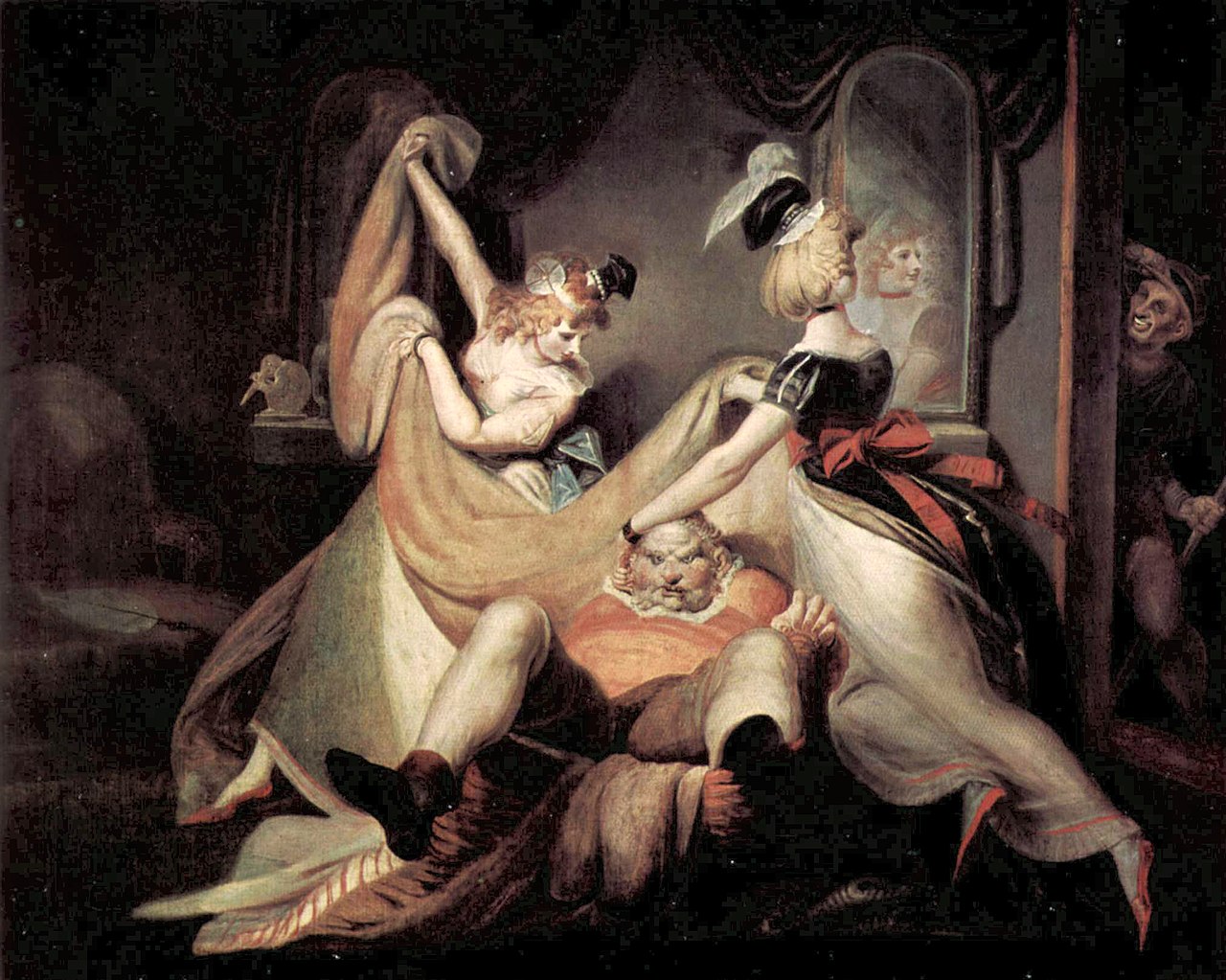
The two merry wives bundle the panicked, oversize Falstaff into a buck-basket of dirty linen as Ford's approach is announced; the women lean in with theatrical urgency.
Henry Fuseli, 1792
Drawing of Falstaff disguised with antlers between the two wives at Herne's Oak, the moment before the fairy tormentors arrive.
Henry Fuseli, 1790
Shallow nudges the reluctant Slender toward Anne Page in a country garden; Slender's hangdog expression undercuts the courtship pretense.
Charles Robert Leslie, 1825
Falstaff in stag's head and antlers stands between the two wives in Windsor Park at night, the moment before the staged fairy ambush.
Robert Smirke
Falstaff in stag's antlers is mobbed by torch-bearing fairies and Windsor children at the base of the great oak; the wives and husbands watch from the edge of the firelight.
George Cruikshank, 1857
Group composition of Windsor townspeople around Falstaff, capturing the play's domestic-comedy social texture.
Charles Robert Leslie
Recommended Editions

Folger Shakespeare Library
2004
Folger's the readable one. Text on one page, notes on the facing page, written in plain English instead of textbook-speak. Catches every word and reference you'd otherwise Google, without breaking the scene to do it.
SparkNotes (No Fear Shakespeare)
2003

Please support us by purchasing through these links, at no extra cost to you!
Deep Dive
What It's About
This summary gives away plot details.
Notable Quotes
“Why, then the world's mine oyster.”
“Why, then the world's mine oyster, Which I with sword will open.”

More by William Shakespeare
- 11A Midsummer Night’s Dream~1595William ShakespeareGrueling·Short·204 pagesInfluence24Popularity81ShakespeareComedyEnglish
- 13Hamlet~1600William ShakespeareGrueling·Medium·342 pagesInfluence97Popularity95ShakespeareTragedyEnglish
- 20Othello~1603William ShakespeareGrueling·Medium·314 pagesInfluence88Popularity75ShakespeareTragedyEnglish
- 23King Lear~1605William ShakespeareGrueling·Medium·384 pagesInfluence95Popularity72ShakespeareTragedyEnglish
- 26Macbeth~1606William ShakespeareGrueling·Short·223 pagesInfluence94Popularity87ShakespeareTragedyEnglish
- 40Richard II~1595William ShakespeareGrueling·Short·352 pagesInfluence22Popularity25ShakespeareHistory PlayEnglish
- 41Twelfth Night~1601William ShakespeareGrueling·Short·272 pagesInfluence20Popularity59ShakespeareComedyEnglish
- 49Romeo and Juliet~1595William ShakespeareGrueling·Short·287 pagesInfluence87Popularity99ShakespeareTragedyEnglish
- 51The Tempest~1611William ShakespeareGrueling·Short·259 pagesInfluence87Popularity61ShakespeareRomanceEnglish
- 56Love's Labour's Lost~1594William ShakespeareGrueling·Short·291 pagesInfluence8Popularity18ShakespeareComedyEnglish
- 67All's Well That Ends Well~1604William ShakespeareGrueling·Short·282 pagesInfluence15Popularity19ShakespeareComedyEnglish
- 69Much Ado About Nothing~1598William ShakespeareGrueling·Short·246 pagesInfluence19Popularity60ShakespeareComedyEnglish
- 75Julius Caesar~1599William ShakespeareGrueling·Short·288 pagesInfluence22Popularity61ShakespeareTragedyEnglish
- 76King Henry IV, Part 1~1596William ShakespeareGrueling·Short·274 pagesInfluence23Popularity24ShakespeareHistory PlayEnglish
- 78The Merchant of Venice~1596William ShakespeareGrueling·Short·288 pagesInfluence21Popularity60ShakespeareComedyEnglish
- 79Measure for Measure~1604William ShakespeareGrueling·Short·336 pagesInfluence19Popularity19ShakespeareComedyEnglish
- 90As You Like It~1599William ShakespeareGrueling·Short·320 pagesInfluence20Popularity58ShakespeareComedyEnglish
- 108Antony and Cleopatra~1606William ShakespeareGrueling·Short·400 pagesInfluence21Popularity33ShakespeareTragedyEnglish
- 116Richard III~1593William ShakespeareGrueling·Medium·369 pagesInfluence23Popularity58ShakespeareHistory PlayEnglish
- 125Henry V~1599William ShakespeareGrueling·Medium·292 pagesInfluence24Popularity51ShakespeareHistory PlayEnglish
- 133The Winter's Tale~1610William ShakespeareGrueling·Short·264 pagesInfluence17Popularity17ShakespeareRomanceEnglish
- 134The Taming of the Shrew~1591William ShakespeareGrueling·Short·304 pagesInfluence16Popularity59ShakespeareComedyEnglish
- 138Troilus and Cressida~1602William ShakespeareGrueling·Medium·416 pagesInfluence18Popularity18ShakespeareSatireEnglish
- 145The Comedy of Errors~1594William ShakespeareHard·Short·272 pagesInfluence16Popularity20ShakespeareComedyEnglish
- 147Coriolanus~1608William ShakespeareGrueling·Medium·342 pagesInfluence18Popularity32ShakespeareTragedyEnglish
- 151King John~1596William ShakespeareGrueling·Short·352 pagesInfluence14Popularity23ShakespeareHistory PlayEnglish
- 158Timon of Athens~1606William ShakespeareGrueling·Short·304 pagesInfluence10Popularity14ShakespeareTragedyEnglish
- 168The Two Gentlemen of Verona~1590William ShakespeareGrueling·Short·400 pagesInfluence9Popularity20ShakespeareComedyEnglish
- 169Henry IV, Part Two~1597William ShakespeareGrueling·Medium·338 pagesInfluence15Popularity23ShakespeareHistory PlayEnglish
- 171Titus Andronicus~1592William ShakespeareGrueling·Short·267 pagesInfluence12Popularity15ShakespeareTragedyEnglish
- 172The Merry Wives of Windsor~1597William ShakespeareGrueling·Short·263 pagesInfluence12Popularity21ShakespeareComedyEnglish
- 173Cymbeline~1610William ShakespeareGrueling·Medium·384 pagesInfluence11Popularity16ShakespeareRomanceEnglish
- 174Pericles~1607William ShakespeareGrueling·Short·456 pagesInfluence11Popularity16ShakespeareRomanceEnglish
- 175The Two Noble Kinsmen~1613William ShakespeareGrueling·Medium·384 pagesInfluence9Popularity15ShakespeareRomanceEnglish
- 182Henry VI, Part 1~1592William ShakespeareGrueling·Short·352 pagesInfluence14Popularity22ShakespeareHistory PlayEnglish
- 183King Henry VI, Part 2~1591William ShakespeareGrueling·Medium·512 pagesInfluence13Popularity22ShakespeareHistory PlayEnglish
- 184King Henry VI, Part 3~1591William ShakespeareGrueling·Short·384 pagesInfluence13Popularity21ShakespeareHistory PlayEnglish
- 193Henry VIII~1613William ShakespeareGrueling·Short·352 pagesInfluence10Popularity24ShakespeareHistory PlayEnglish
- Shakespeare's Sonnets1609William ShakespeareModerate·Short·512 pagesInfluence—Popularity—PoetsLyricEnglish