Read this if you…
- love Rome and Egypt and Shakespeare
- like the idea of love affairs ruining political ambitions
Skip this if you…
- aren't willing to go slow, read notes, look up analyses of famous passages (only way to "get" shakespeare)
- foolishly think shakespeare is overrated
Why It Matters
The greatest play about how passion and politics wreck each other. Cleopatra is one of the most complicated women in all of drama, and the play's huge, sprawling structure mirrors the empires falling apart inside it. This is Shakespeare working at full strength.
The lineage through Antony and Cleopatra
- Plutarch's Lives by Plutarch. Antony and Cleopatra built on it. - *Antony and Cleopatra* is built directly on Plutarch's *Life of Antony*, read through Sir Thomas North's 1579 English - The shimmering 'barge she sat in' set-piece — silver oars, purple sails, the wind made lovesick — is North's prose lightly lineated into Shakespeare's verse - Read the *Life* and you watch the raw material become poetry almost phrase by phrase
- The Aeneid by Virgil. Antony and Cleopatra built on it. - Antony invokes it by name — "Dido and her Aeneas" — so Shakespeare hands you the source himself - *Antony and Cleopatra* is the *Aeneid* answered back: Aeneas leaves the queen for Rome, Antony chooses the queen over it, and Cleopatra's dying vision rewrites the lovers' afterlife reunion - The Rome-versus-foreign-queen tragedy was Virgil's frame first; reading him reveals exactly what Shakespeare is inverting
Depicted in Art
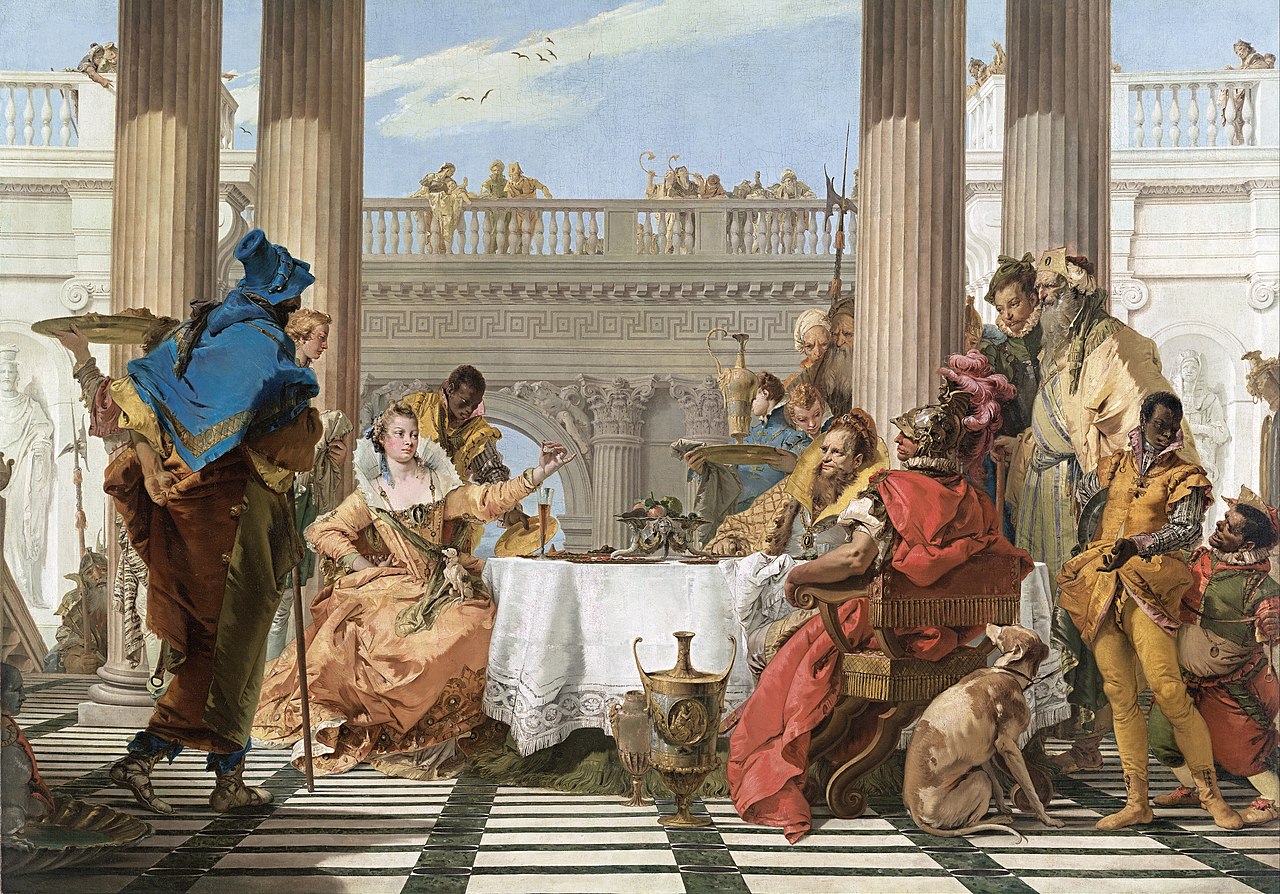
Cleopatra drops a pearl earring into a goblet of vinegar at a lavish banquet table, watched by Antony and attendants in Venetian dress.
Giovanni Battista Tiepolo, 1744
Antony disembarks to greet Cleopatra at Tarsus; she stands crowned and ceremonial as he bows, courtiers and dwarfs flanking the steps.
Giovanni Battista Tiepolo, 1747
Roman war galleys clash under cannon smoke; Cleopatra's ornate barge in the foreground, arms outstretched in despair as the battle is lost.
Lorenzo A. Castro, 1672
Cleopatra collapses across the dead Antony's body, the asp at her breast; an attendant lifts her head as Roman soldiers approach.
Alessandro Turchi, 1640
Cleopatra reclines beneath the awning of her gilded barge, scattered rose petals around her, as Antony steps aboard parting the curtain.
Lawrence Alma-Tadema, 1883
Cleopatra slumps semi-nude on her throne, eyes rolling back, the asp coiling at her breast; weeping attendants crowd around her.
Guido Cagnacci, 1660
Cleopatra sits on a low throne in a gauzy gown, head turned in cool sidelong scrutiny, hands gripping the lion-headed armrests.
John William Waterhouse, 1888
The dying Antony is carried in by attendants and lowered before the standing Cleopatra in her monument; she reaches for him in horror.
Eugene-Ernest Hillemacher
Recommended Editions

Folger Shakespeare Library
2004
Folger's the readable one. Text on one page, notes on the facing page, written in plain English instead of textbook-speak. Catches every word and reference you'd otherwise google, without breaking the scene to do it.


Please support us by purchasing through these links, at no extra cost to you!
Deep Dive
What It's About
This summary gives away plot details.
Notable Quotes
“Age cannot wither her, nor custom stale her infinite variety.”
“Age cannot wither her, nor custom stale Her infinite variety: other women cloy The appetites they feed: but she makes hungry Where most she satisfies.”

More by William Shakespeare
- 11A Midsummer Night’s Dream~1595William ShakespeareGrueling·Short·204 pagesInfluence24Popularity81ShakespeareComedyEnglish
- 13Hamlet~1600William ShakespeareGrueling·Medium·342 pagesInfluence97Popularity95ShakespeareTragedyEnglish
- 20Othello~1603William ShakespeareGrueling·Medium·314 pagesInfluence88Popularity75ShakespeareTragedyEnglish
- 23King Lear~1605William ShakespeareGrueling·Medium·384 pagesInfluence95Popularity72ShakespeareTragedyEnglish
- 26Macbeth~1606William ShakespeareGrueling·Short·223 pagesInfluence94Popularity87ShakespeareTragedyEnglish
- 40Richard II~1595William ShakespeareGrueling·Short·352 pagesInfluence22Popularity25ShakespeareHistory PlayEnglish
- 41Twelfth Night~1601William ShakespeareGrueling·Short·272 pagesInfluence20Popularity59ShakespeareComedyEnglish
- 49Romeo and Juliet~1595William ShakespeareGrueling·Short·287 pagesInfluence87Popularity99ShakespeareTragedyEnglish
- 51The Tempest~1611William ShakespeareGrueling·Short·259 pagesInfluence87Popularity61ShakespeareRomanceEnglish
- 56Love's Labour's Lost~1594William ShakespeareGrueling·Short·291 pagesInfluence8Popularity18ShakespeareComedyEnglish
- 67All's Well That Ends Well~1604William ShakespeareGrueling·Short·282 pagesInfluence15Popularity19ShakespeareComedyEnglish
- 69Much Ado About Nothing~1598William ShakespeareGrueling·Short·246 pagesInfluence19Popularity60ShakespeareComedyEnglish
- 75Julius Caesar~1599William ShakespeareGrueling·Short·288 pagesInfluence22Popularity61ShakespeareTragedyEnglish
- 76King Henry IV, Part 1~1596William ShakespeareGrueling·Short·274 pagesInfluence23Popularity24ShakespeareHistory PlayEnglish
- 78The Merchant of Venice~1596William ShakespeareGrueling·Short·288 pagesInfluence21Popularity60ShakespeareComedyEnglish
- 79Measure for Measure~1604William ShakespeareGrueling·Short·336 pagesInfluence19Popularity19ShakespeareComedyEnglish
- 90As You Like It~1599William ShakespeareGrueling·Short·320 pagesInfluence20Popularity58ShakespeareComedyEnglish
- 108Antony and Cleopatra~1606William ShakespeareGrueling·Short·400 pagesInfluence21Popularity33ShakespeareTragedyEnglish
- 116Richard III~1593William ShakespeareGrueling·Medium·369 pagesInfluence23Popularity58ShakespeareHistory PlayEnglish
- 125Henry V~1599William ShakespeareGrueling·Medium·292 pagesInfluence24Popularity51ShakespeareHistory PlayEnglish
- 133The Winter's Tale~1610William ShakespeareGrueling·Short·264 pagesInfluence17Popularity17ShakespeareRomanceEnglish
- 134The Taming of the Shrew~1591William ShakespeareGrueling·Short·304 pagesInfluence16Popularity59ShakespeareComedyEnglish
- 138Troilus and Cressida~1602William ShakespeareGrueling·Medium·416 pagesInfluence18Popularity18ShakespeareSatireEnglish
- 145The Comedy of Errors~1594William ShakespeareHard·Short·272 pagesInfluence16Popularity20ShakespeareComedyEnglish
- 147Coriolanus~1608William ShakespeareGrueling·Medium·342 pagesInfluence18Popularity32ShakespeareTragedyEnglish
- 151King John~1596William ShakespeareGrueling·Short·352 pagesInfluence14Popularity23ShakespeareHistory PlayEnglish
- 158Timon of Athens~1606William ShakespeareGrueling·Short·304 pagesInfluence10Popularity14ShakespeareTragedyEnglish
- 168The Two Gentlemen of Verona~1590William ShakespeareGrueling·Short·400 pagesInfluence9Popularity20ShakespeareComedyEnglish
- 169Henry IV, Part Two~1597William ShakespeareGrueling·Medium·338 pagesInfluence15Popularity23ShakespeareHistory PlayEnglish
- 171Titus Andronicus~1592William ShakespeareGrueling·Short·267 pagesInfluence12Popularity15ShakespeareTragedyEnglish
- 172The Merry Wives of Windsor~1597William ShakespeareGrueling·Short·263 pagesInfluence12Popularity21ShakespeareComedyEnglish
- 173Cymbeline~1610William ShakespeareGrueling·Medium·384 pagesInfluence11Popularity16ShakespeareRomanceEnglish
- 174Pericles~1607William ShakespeareGrueling·Short·456 pagesInfluence11Popularity16ShakespeareRomanceEnglish
- 175The Two Noble Kinsmen~1613William ShakespeareGrueling·Medium·384 pagesInfluence9Popularity15ShakespeareRomanceEnglish
- 182Henry VI, Part 1~1592William ShakespeareGrueling·Short·352 pagesInfluence14Popularity22ShakespeareHistory PlayEnglish
- 183King Henry VI, Part 2~1591William ShakespeareGrueling·Medium·512 pagesInfluence13Popularity22ShakespeareHistory PlayEnglish
- 184King Henry VI, Part 3~1591William ShakespeareGrueling·Short·384 pagesInfluence13Popularity21ShakespeareHistory PlayEnglish
- 193Henry VIII~1613William ShakespeareGrueling·Short·352 pagesInfluence10Popularity24ShakespeareHistory PlayEnglish
- Shakespeare's Sonnets1609William ShakespeareModerate·Short·512 pagesInfluence—Popularity—PoetsLyricEnglish